Managing Screen Time for Neurodivergent Kids (ADHD & Autism)
If you’ve ever set a screen-time timer for an ADHD or autistic child and watched the whole evening fall apart when it went off, you already know the standard advice doesn’t quite fit. The tidy scripts — “two hours a day,” “no screens after seven,” “just tell them it’s time to stop” — assume a brain that switches tasks easily and reads a countdown the way you do. Many neurodivergent kids don’t work like that, and it isn’t defiance. Transitions are genuinely harder, screens often do a job that goes well beyond entertainment, and a rule that ignores all of that tends to end in tears rather than balance. This guide starts from a different place: your child makes sense, the goal is a plan that fits them, and you’re on the same side of it.
Why standard rules often backfire
Most mainstream screen-time advice was written with a fairly narrow child in mind — one who can hear “five more minutes,” feel the time passing, and glide out of a game into homework without much friction. Plenty of neurodivergent kids can’t do that on demand, and when the advice fails, the child usually gets blamed for it. They’re called difficult, addicted, oppositional. Almost always, something more specific is going on.
Transitions are a real cost, not a bad attitude
Shifting from one activity to another takes a set of skills — noticing you need to stop, holding the next task in mind, letting go of the current one, getting your body to move. For many ADHD and autistic kids those skills are still developing, or they take far more effort than they look like they should. Ending a screen isn’t one small ask; it’s a stack of them at once. What looks like a meltdown over a video is often a brain that’s been asked to change gears faster than it can.
Hyperfocus is a different state of mind
When an ADHD or autistic child is deep in something they love, they can drop into hyperfocus — a state where the outside world genuinely thins out. Your voice from the kitchen may not register. This isn’t ignoring you, and it isn’t rudeness. Pulling someone out of that state abruptly feels jarring and disorienting, a bit like being shaken awake mid-dream. A rule that expects an instant, cheerful stop is fighting the child’s actual neurology.
Screens often regulate, not just entertain
Here’s the piece the standard framing usually misses. For a lot of neurodivergent kids, a screen isn’t only fun — it’s a tool for managing a nervous system that runs hot or floods easily. A familiar show, a predictable game, a favourite playlist can bring a racing or overwhelmed mind back down to something manageable. When you cut that off with no replacement, you’re not just removing a treat. You may be taking away the thing that was holding a hard day together, which is why the reaction can look wildly out of proportion to “just a screen.”
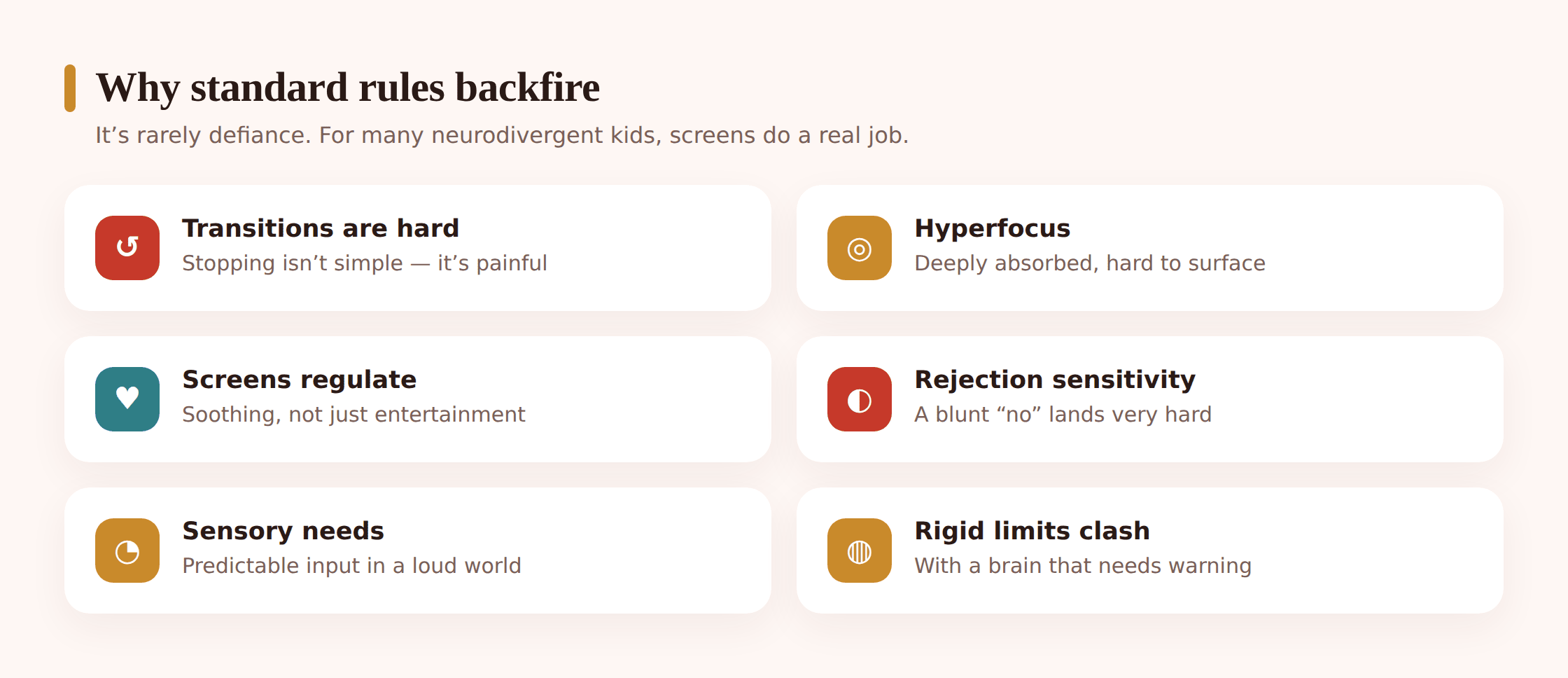
Rejection sensitivity turns a limit into a wound
Many people with ADHD feel criticism and perceived rejection intensely — a phenomenon parents often notice long before they have a name for it. A “time’s up” that you meant neutrally can land as “you did something wrong,” and the shame spike drives the outburst. Autistic children can experience a related sting when a change feels unfair or unexplained. Knowing this changes your tone: the way you end a screen matters as much as the ending itself.
Sensory needs are part of the picture
Screens can be a sensory refuge — controlled, predictable, low-demand, headphones sealing out a loud house. For a child who finds the wider world abrasive, that soothing quality is real and worth respecting. Yank it away into a chaotic, bright, noisy room and you’ve swapped a regulated state for an overwhelming one. The transition isn’t just about the screen; it’s about what waits on the other side of it.
Behaviour is communication. When a screen ending goes badly, it’s rarely manipulation. It’s usually a child telling you the demand was too big, too fast, or too raw. Read it as information, and the whole problem gets easier to solve.
What screens genuinely offer
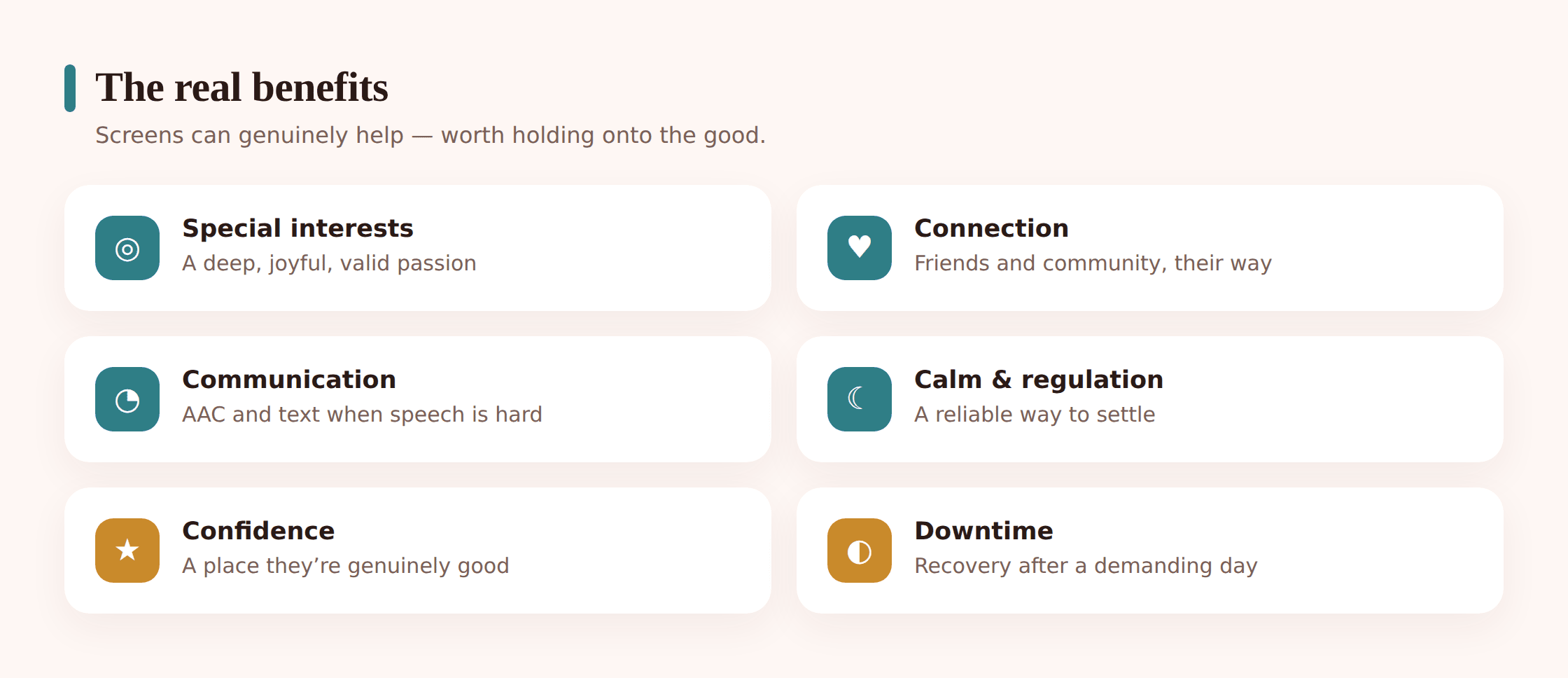
It’s easy to absorb the message that screens are simply a threat to be minimised. For neurodivergent kids the reality is more generous than that, and leaning only into restriction can cost your child something that matters. Screens earn their place in a lot of these households.
A home for special interests
Deep, passionate interests are a hallmark strength for many autistic and ADHD kids, and the internet is where those interests can run as far as the child wants to take them. Trains, marine biology, a specific game, a era of history, a way of animating — screens open doors a small town or a single library never could. This is real learning driven by genuine motivation, which is the kind that sticks. Treating it as “too much time on that thing” can quietly tell a child that the part of them that lights up is a problem.
Connection on terms that work
Face-to-face socialising can be draining or genuinely hard to read. Online spaces — a game with friends, a group chat, a community around a shared obsession — let some kids connect without the sensory load and split-second social demands of a playground. For a child who struggles to find their people locally, an online friend who shares their exact interest can be a lifeline, not a lesser substitute. Our guide to phones and teen mental health looks more at the connection side for older kids.
Communication and access
For some children, devices are how they communicate at all — AAC apps, text over talk, tools that turn a thought into words when speech won’t come. Screens also carry captions, read-aloud, and countless small accommodations that make the world reachable. When you’re shaping limits, it helps to separate this kind of use from recreational scrolling entirely; they’re not the same category.
A reliable way to come down
Used with a bit of intention, a screen can be a legitimate part of a child’s toolkit for calming and recovering after a demanding day at school. Naming it that way — “this is how you rest and reset” — is kinder and more accurate than framing every minute as indulgence. The question isn’t whether screens can soothe; it’s how to make that soothing part of a rhythm your child can eventually manage themselves.
Why getting off is so hard
If there’s one flashpoint almost every family hits, it’s the moment the screen has to end. Understanding the mechanics of that moment is most of the battle, because it stops you fighting the wrong thing.
Part of it is time itself. Time blindness is common in ADHD — the felt sense of how long you’ve been doing something can be wildly off, so “you’ve had ages” genuinely doesn’t match what the child experienced. Part of it is the abruptness: an unexpected stop, with no runway, jolts a nervous system that was settled. Part of it is loss — the child was somewhere good, and now they’re being pulled out with nothing chosen to land on. And underneath it all sits regulation. If the screen was doing the job of keeping them calm, ending it can tip a barely-managed state straight into overwhelm.
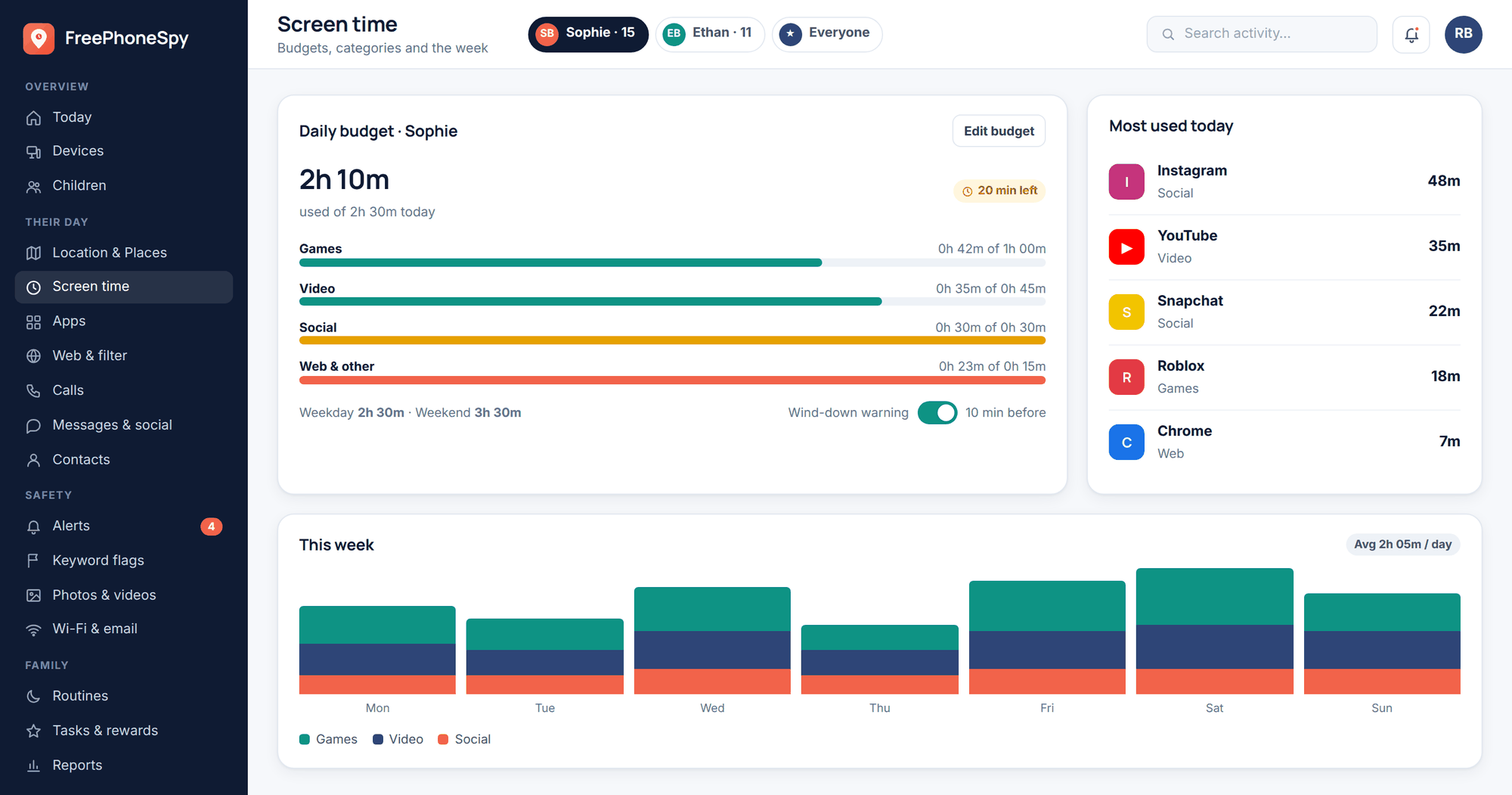
None of this means transitions are impossible. It means they need scaffolding, the same way you’d put a ramp where a step is too high. Build the ramp and the meltdowns shrink, often dramatically.
Easing transitions, step by step
These are the moves that tend to help. Not every one will fit your child — try them as experiments, keep what works, drop what doesn’t, and expect to adjust as they grow.
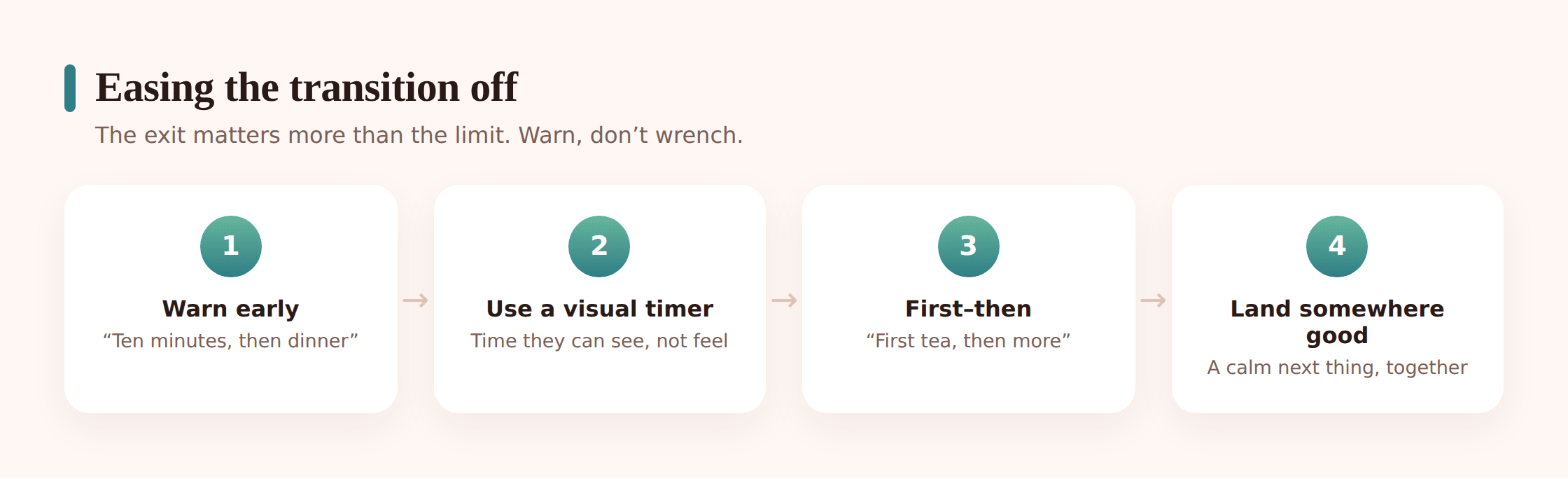
1. Warn early, and more than once
A single “two minutes” is rarely enough. Give a heads-up well before the end, then again as it approaches, so the ending stops being a surprise and becomes something the child can see coming and prepare for. Calm, warm, matter-of-fact — the warning is a courtesy, not a countdown to conflict.
2. Make time visible
Because felt time and clock time drift apart, a visual timer that shows time shrinking — a coloured disc, a sand timer, a bar that empties — does what your voice can’t. The child can watch the ending approach instead of being told it’s here. For many kids this single change turns a battle into a non-event.
3. Use “first, then”
Pair the ending with what comes next, in that order: “First we finish the level, then we have snack.” It gives the brain somewhere to land and reframes stopping as moving toward something, not just losing something. Choosing a genuinely appealing “then” matters — a soft landing, not a chore that makes the screen worth defending.
4. Find natural stopping points
Ending mid-level or mid-episode is uniquely painful and can feel deeply unfair. Where you can, time the stop to a natural edge — the end of a match, a saved checkpoint, the last video in a chosen playlist. A little planning here prevents a lot of the “but I wasn’t finished” grief.
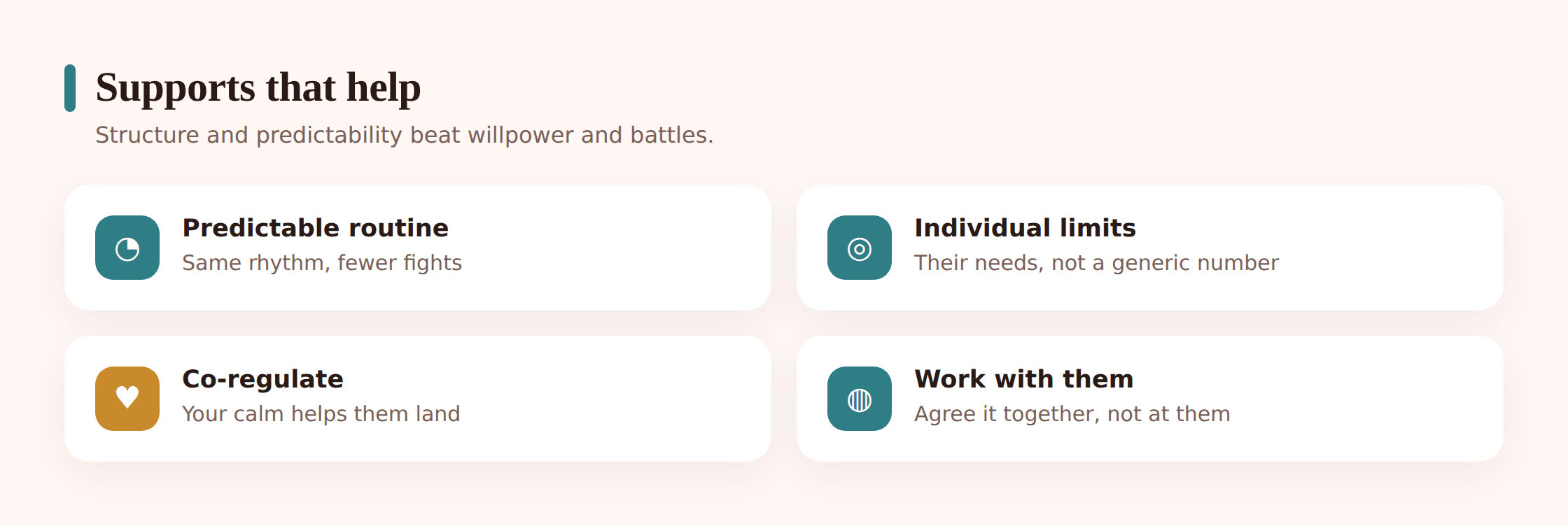
5. Build it into a routine
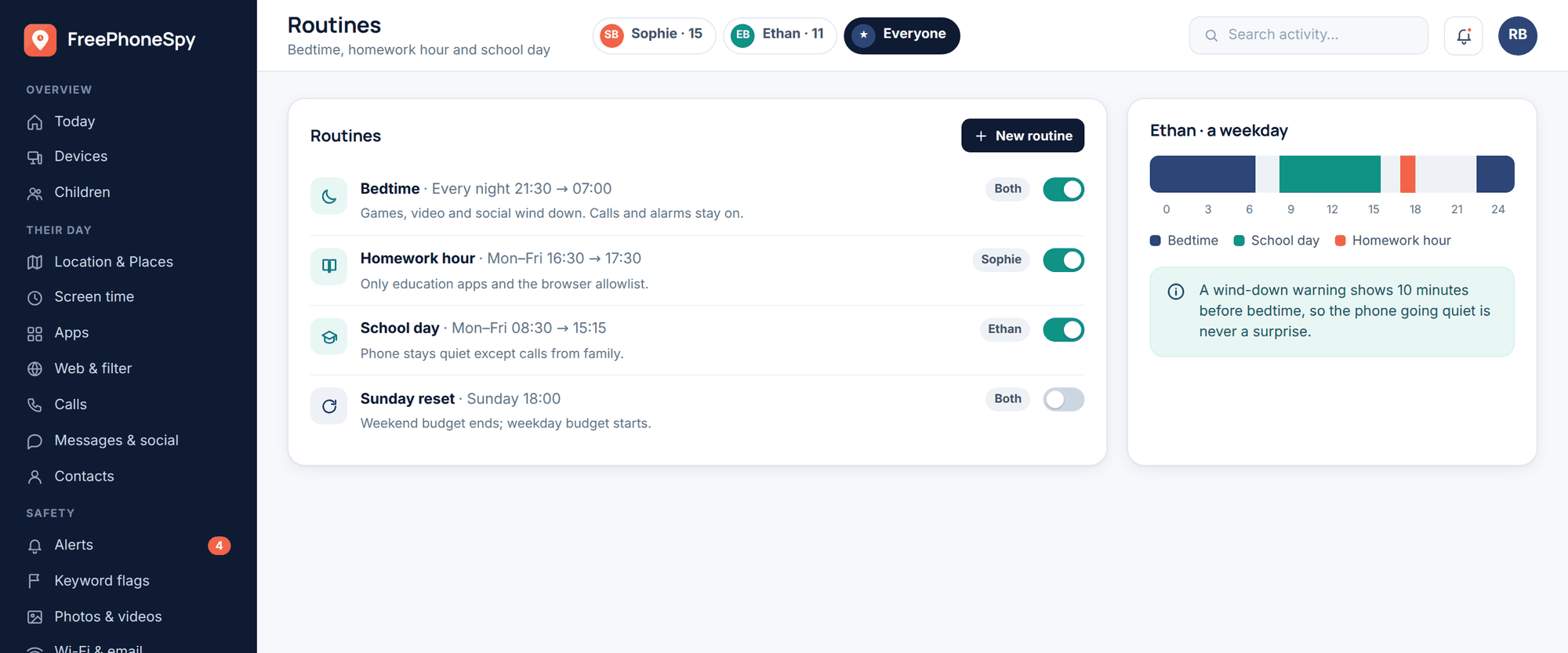
Predictability is regulating. When screens sit inside a known rhythm — after school, then a set wind-down, then the same next thing each day — the ending stops being a fresh negotiation every time and becomes just how the day goes. Our piece on healthy digital habits digs into building rhythms that stick.
6. Co-regulate through the hard bit
If the ending still brings a wobble, your calm is the tool. Stay close, keep your voice low and steady, name the feeling — “that was a good game, it’s hard to stop.” You’re not rewarding the upset; you’re lending your steadiness until theirs comes back. Meeting distress with your own frustration only pours fuel on it.
Individual limits, not one-size-fits-all
The single most freeing thing you can accept is that there is no correct number of minutes for a neurodivergent child. Two kids the same age can need wildly different things — one is genuinely restored by an hour of a favourite game, another gets more wound up the longer they’re on. A blanket figure copied from an article can’t know which is which. Yours does, because you watch what actually happens.
So watch the child, not the clock. Does your kid come off a particular game calmer or crankier? Is a certain app reliably followed by a rough patch, while another leaves them content? That pattern is your data, and it beats any general guideline. You might find one activity earns a generous allowance while another needs a firmer edge — and that different limits for different content is fairer, not inconsistent.
Content matters more than duration. An hour spent building something, learning, or connecting with a friend is a different thing from an hour of restless, agitated scrolling, even if the timer reads the same. Age-based defaults are still a useful starting point — our screen time by age guide lays them out — but treat them as a first draft you’ll edit heavily for your particular child, not a verdict.
Judge by the after, not the amount. The most reliable signal isn’t how many minutes passed — it’s the state your child is in when the screen ends. Regulated, satisfied, able to move on? The limit’s probably about right. Frayed and dysregulated? Something needs adjusting, and it might not be the number.
Working with your child
Plans imposed from above invite resistance from any kid, and land especially badly where rejection sensitivity or a strong need for fairness is in play. Plans built together get defended instead of dodged. So bring your child in as far as their age and stage allow.
Ask what their screens actually do for them — you may hear “it’s the only time my brain feels quiet,” which reshapes the whole conversation. Solve the transition problem with them rather than at them: let them help pick the timer, choose the “then,” decide which stopping points feel fair. When a child has a hand in the design, the plan becomes theirs to protect. For older kids especially, this shift from control to collaboration is what makes anything last.
Whatever you agree, model it. A parent glued to their own phone while enforcing a child’s limit is a fairness violation a neurodivergent kid will spot instantly and never let go of. If a family digital detox or a shared no-phones window is part of the plan, being in it yourself is what makes it credible.
When to bring in a professional
Most of this you can work through at home, patiently, over time. Sometimes an outside perspective helps, and reaching for one is a sign of good parenting, not failure.
- Screen transitions consistently end in distress that’s hard to recover from, despite your best scaffolding.
- Screen use seems to be crowding out sleep, eating, movement, or the relationships your child does have.
- Your child is deeply distressed themselves and can’t find any other way to regulate.
- You’re worn down, out of ideas, and want strategies tailored to your specific child.
- Something feels off in a way you can’t name, and you’d value a professional eye on it.
A GP or paediatrician is a sensible first door and can point you onward. An occupational therapist can be especially useful here — sensory needs and regulation are squarely their territory, and they can suggest tools and routines fitted to your child. An educational psychologist can help where school and learning are tangled in. None of these are a verdict on your parenting. They’re extra hands, and neurodivergent kids often do best when the adults around them are well supported too.
Questions parents ask
Is my child addicted to screens, or is this something else?
“Addiction” is a heavy word that often gets reached for too fast with neurodivergent kids. Frequently what looks like it is really hyperfocus, a special interest running deep, or a child using a screen to regulate a nervous system that needs the help. That doesn’t mean limits don’t matter — it means the framing shapes your response. Curiosity about what the screen is doing for your child will get you further than a label. If genuine distress or a real squeeze on sleep and relationships is present, that’s worth raising with a professional.
How much screen time is okay for an ADHD or autistic child?
There’s no single right number, and chasing one tends to frustrate everyone. Age-based defaults give you a starting point, but the better guide is your own child: watch what state they’re in when a screen ends and whether the content leaves them better or worse. A generous allowance for something that genuinely restores them, a firmer edge on something that winds them up — that’s not inconsistent, it’s individualised.
Why does ending screen time cause such a big meltdown?
Usually several things at once: transitions are a real cost for a developing brain, time can genuinely feel much shorter than it was, an abrupt stop jolts a settled nervous system, and if the screen was keeping your child regulated, ending it can tip them into overwhelm. It’s rarely manipulation. Early warnings, a visual timer, natural stopping points and a warm “first, then” tend to shrink these dramatically.
Should I use screens as a reward or punishment?
Tread carefully, especially where a screen is doing regulation work. Taking it away as a consequence can remove the very tool your child needs to calm down, which usually makes everything worse, and it can land as rejection for a kid who feels that keenly. Building screens into a predictable routine tends to work far better than making them a prize to win or lose.
My child only wants to talk about one thing online. Should I worry?
A deep, focused interest is a strength for many neurodivergent kids, not a warning sign — it’s often where they learn most and feel most themselves. Rather than shutting it down, get curious about it and look for ways to connect it to other parts of life. Worry is warranted only if the interest is genuinely crowding out sleep, eating, movement and every relationship, and even then the answer is gentle broadening, not a ban.
How do I set limits without constant conflict?
Build the plan with your child rather than handing it down, so it becomes theirs to protect. Make endings predictable with routines, visible with timers, and softer with a genuinely appealing “then.” Stay calm through the hard moments and lend your steadiness instead of matching their upset. And keep your own screen habits inside the same plan — nothing dissolves a fairness complaint faster than a parent who lives by the rules too.