Concert & Event Ticket Scams: Keeping Teens From Getting Burned
The tour sells out in four minutes. Your teen doesn’t get a ticket, and neither do half the people in their group chat. So the hunt moves to Instagram, to a Facebook resale group, to the replies under the artist’s post — anywhere someone might be waving a spare. Within an hour there’s a message: “Got two, face value, need them gone tonight, bank transfer only.” The seller has a profile, a photo of the tickets, a story about a friend who bailed. It looks like a lucky save. It’s very often a trap, built specifically for a young fan who wants this too badly to slow down. Ticket fraud isn’t a small corner of online scams — around big tours and festivals it becomes an industry, and teenagers are among its favourite marks. The good news is that the pattern almost never changes, so a teen who can name it stops falling for it.
Why ticket scams target teens
A teenager might not have much money, but for a scammer selling a phantom ticket, they’re close to the perfect customer. Each reason lines up with a defence you can teach.
They want it more, and they’ll act faster. When a favourite artist announces a show and it sells out in minutes, the wanting is intense and immediate. That craving to be there — with friends, at the thing everyone will be posting about — overrides the careful part of the brain that would normally ask, “wait, why is this stranger being so nice?” Scammers manufacture urgency on top of a longing the teen already brought with them.
The fear of missing out does half their work. Every story on their feed, every group-chat message about who’s going, cranks the pressure up. If four friends have tickets and one doesn’t, the odd one out will take a risk the others wouldn’t. Scammers know that missing the show feels, in the moment, worse than the abstract chance of losing forty pounds.
They’ve handled far fewer payments than an adult. A grown-up who has bought concert tickets before knows what a real resale site looks like, knows a genuine seller doesn’t insist on bank transfer, knows buyer protection is a thing you can lose. A fifteen-year-old buying their first big ticket has no template. When the seller says “just send it to this account and I’ll email the tickets over,” it doesn’t ring an alarm — because no alarm has been installed yet.
And the hype is loud, public, and easy to hijack. The moment a tour trends, scammers flood the artist’s posts and hashtags with “DM me, I have spare tickets.” They don’t need to find teens; the teens come to them, searching the very hashtags the fraudster is camped on.
Where these scams happen
Real resale exists too, which is exactly why the fakes blend in. Knowing the usual hunting grounds helps a teen stay sharp in the right places.
Direct messages and comment replies. The classic move: a teen posts “does anyone have a spare for [tour]??” and a stranger slides into the DMs within minutes. Or they scroll the replies under the artist’s own announcement post, where dozens of “I have two spare, DM me” comments are waiting. The account often looks real — a photo, some followers, a few posts — because it was either bought, hacked, or built for the purpose.
Facebook, Instagram and X resale groups and posts. “[City] Concert Tickets Buy & Sell” groups are full of genuine fans and salted with scammers. A post shows tickets at a fair price, the seller is quick and friendly, and the whole deal is done in a chat with no protection behind it.
Fake and cloned resale websites. Search the tour name and you may land on a site that looks like a professional resale platform — logos, a checkout, a countdown timer, “only 3 left.” It’s a clone or an invented brand designed to take a card payment (or push you to transfer) and deliver nothing. Sponsored search results and ads are a common way teens reach these.
Group chats and friend-of-a-friend deals. “My mate’s mate has two going spare.” The chain of trust makes it feel safe, but the person at the end is a stranger, and the money still leaves by bank transfer with nothing to claw it back.
These sit right next to the wider world of online scams that target kids, and the payment side overlaps heavily with money and shopping safety for teens. When your teen is the one selling online safely — offloading a ticket they can no longer use — the same rules run in reverse.
How the con actually works
Strip away the artist and the venue and there’s a short, repeatable script underneath. Once a teen can see the machinery, the magic stops working.
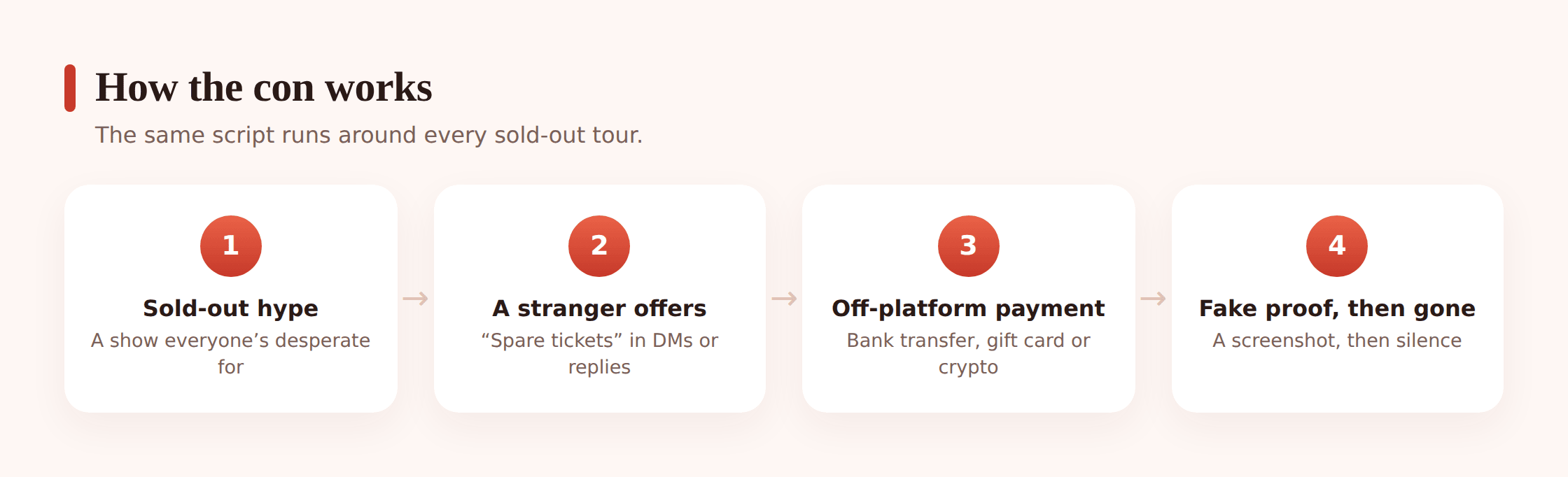
The hook. The seller appears with exactly what the teen wants — the right show, the right date, a believable price. Sometimes it’s suspiciously cheap (“can’t go, just want rid”), sometimes it’s inflated for a sold-out night and sold as the last chance to get in at all. Either way it’s pitched as a favour or a rescue.
The hurry. “Someone else is interested, I need to know in ten minutes.” “I’m about to list them elsewhere.” The pressure isn’t incidental — it’s the whole tactic. Rushing is how they stop the teen from checking anything, asking a parent, or noticing the account was made last Tuesday.
The pull toward an unprotected payment. Bank transfer, PayPal “friends and family,” a gift card code, or crypto. Every one of these has the same feature the scammer needs: once it’s sent, it’s gone, with no way for the teen or the bank to reverse it. A card payment through a real platform can be disputed. A transfer to a stranger cannot.
The “proof.” To calm nerves, the seller sends a screenshot of the tickets, a booking confirmation, even a photo of a physical ticket. None of it means anything. Screenshots are trivially faked or lifted from someone else’s real order, and the same “proof” gets sent to a dozen buyers for the same non-existent seat.
The vanish. The money lands, and the seller either goes silent, blocks the teen, or deletes the account. Occasionally they send a “ticket” that turns out to be a screenshot the venue’s scanner rejects at the door — the worst version, because the teen only finds out after travelling to the show.
The red flags that give it away
The costume changes every tour; the tells don’t. Teach these as a set, because scams usually trip several at once.
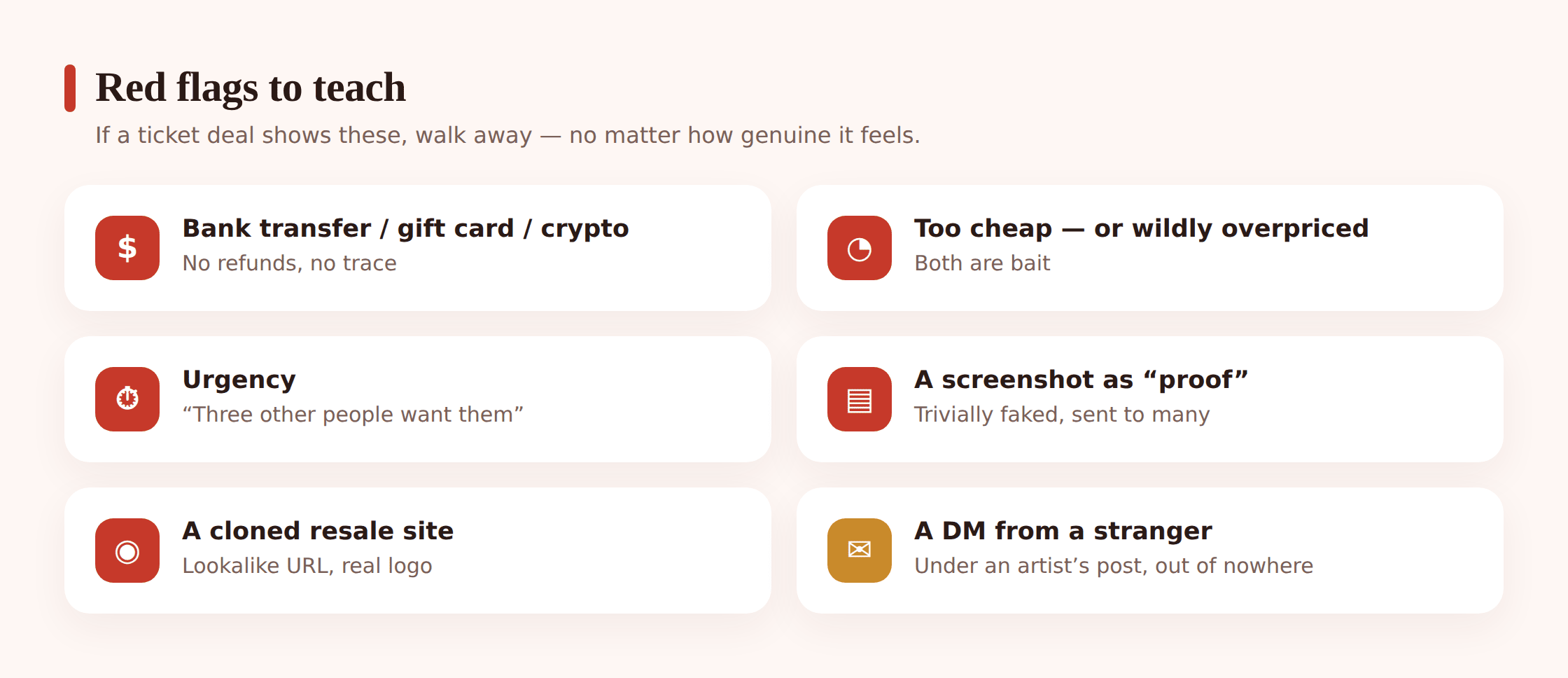
- Bank transfer, gift card or crypto only. A seller who won’t take a protected payment is choosing the one method you can’t get back. This single flag is enough to walk away.
- A price that’s too good — or wildly inflated. Face value or below for a sold-out show, “just want it gone,” is bait. So is a huge markup sold as your only way in. Both exploit the same rush.
- Urgency and pressure. “Decide now, others are waiting.” Real sellers can wait ten minutes for you to check. Scammers cannot afford to let you.
- No buyer protection. The whole deal happens in DMs with nothing standing behind it — no platform guarantee, no way to raise a dispute, no recourse if nothing arrives.
- Screenshots as “proof.” A picture of a ticket or a booking is not a ticket. It proves nothing and is easily faked or stolen.
- A thin or brand-new account. Created recently, few real posts, or a sudden pivot from unrelated content to “selling tickets.” Hacked accounts belonging to real people are common too, so a familiar name isn’t proof either.
- Moving off-platform fast. “Message me on WhatsApp instead” pulls the deal somewhere with even less protection and no record the platform can act on.
- A cloned website. Odd web address, tiny spelling differences from the real brand, no company details, a checkout that only offers transfer or crypto.
How to buy tickets safely
The rules here are short and they hold for every artist, every festival, every match.
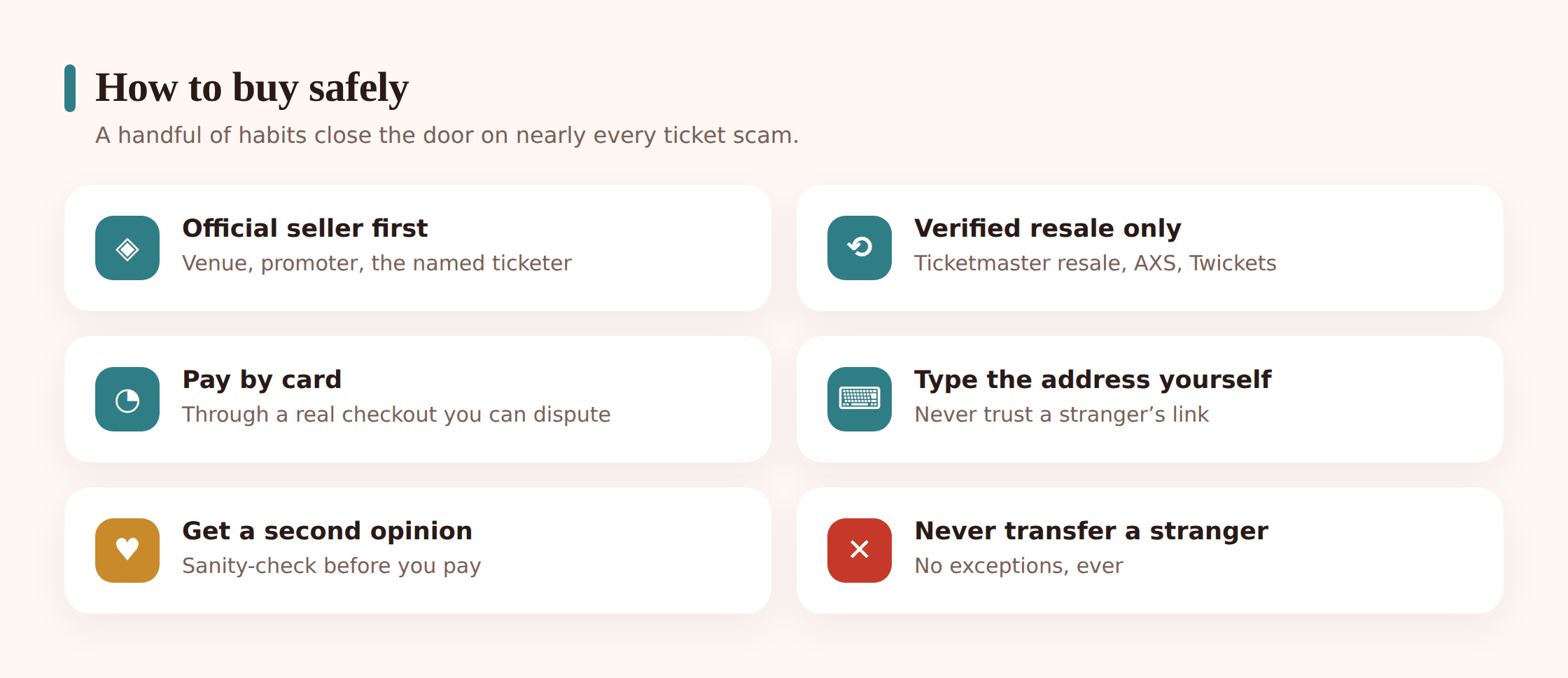
- Start with the official primary seller. Buy from the venue, the promoter, or the box office first — Ticketmaster, AXS, See Tickets, the festival’s own site, whoever the artist officially points to. If it’s genuinely sold out, sign up for official waiting lists and verified resale before you go anywhere near a stranger.
- Use verified, protected resale only. Platforms like Ticketmaster resale, AXS official resale, Twickets and other seller-verified marketplaces hold the ticket and the payment inside a system with actual protection. That’s the difference between a resale you can dispute and a transfer you’ll never see again.
- Pay by a method you can get back. A credit or debit card through a proper checkout can be challenged if the ticket never arrives. That protection is the point — it’s not just a payment, it’s a safety net.
- Never bank transfer, gift-card or crypto a stranger. No matter how convincing the seller, how good the price, or how urgent the deadline. This is the one rule that, on its own, blocks almost every ticket scam.
- Check the web address before you type anything in. Reach the resale site by typing the known name or via the artist’s official links — not through an ad or a link a stranger sent. One wrong letter in the address can be a clone.
- Slow the whole thing down. Agree a family rule: any ticket bought from an individual gets a second pair of eyes before money moves. Ten minutes of checking has never cost anyone a real ticket.
Worth saying to your teen plainly: missing a show is survivable, and there’s often another way in — an official resale drop the week of the gig, a last-minute release, a friend’s genuine spare. Losing money to a fake ticket buys neither the show nor the trust back. The band will tour again.
If your teen has been scammed
It happens to sensible people constantly, so the first job is to make sure your teen can tell you without dreading the reaction. Then move fast and methodically.
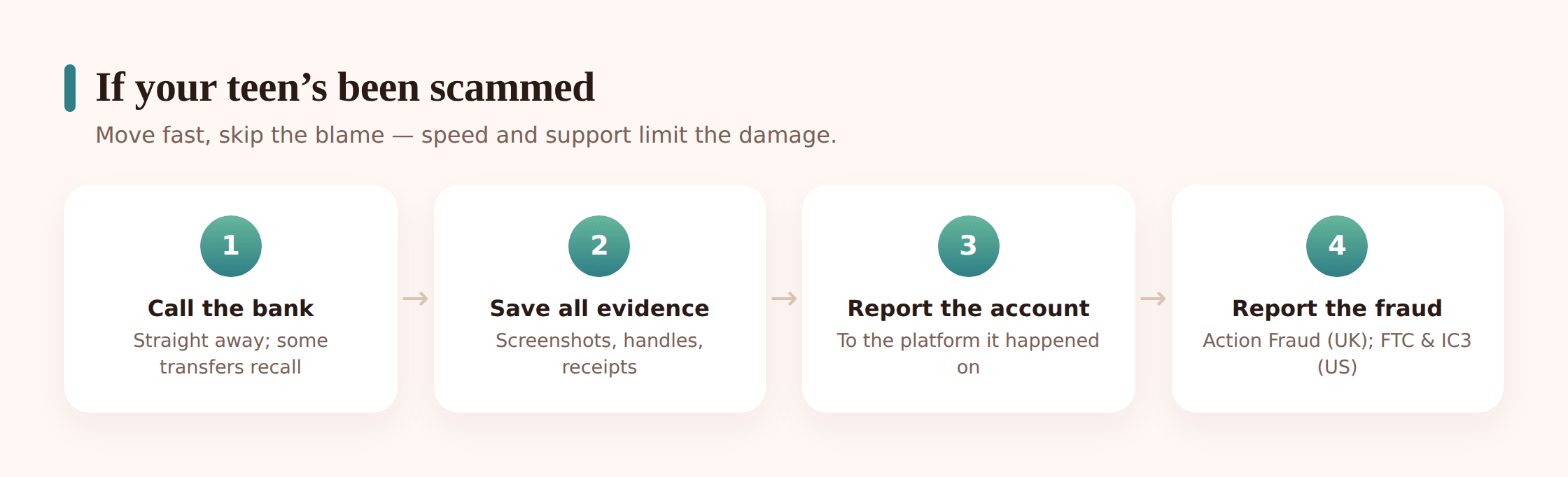
- Contact the bank immediately. Ring the number on the back of the card the moment you realise. If it was a card payment, ask about a chargeback or dispute. If it was a transfer, some can still be recalled if you’re quick, and banks run schemes for certain authorised-push-payment scams. Minutes matter here.
- Preserve every scrap of evidence. Before anything gets deleted, screenshot the listing, the profile, the whole chat, the payment confirmation, the account number or email, and any “proof” they sent. Blocking can come later; capturing it comes first.
- Report it to the platform. Tell Instagram, Facebook, X, or wherever it happened — the account, the post, the group. It helps get the seller removed before they reach the next fan, and creates a record.
- Report it to the right authority. In the UK, report to Action Fraud at actionfraud.police.uk (and to your bank). In the US, report to the FTC at reportfraud.ftc.gov and to the FBI’s Internet Crime Complaint Center at ic3.gov. Have the evidence you saved ready.
- Change passwords if anything was shared. If your teen handed over any login or account access during the deal, secure those accounts and turn on two-factor authentication.
- Handle the feelings, not just the fraud. Your teen probably feels stupid, embarrassed, and gutted about the show all at once. Tell them plainly that professionals built this to fool people, that coming to you quickly was exactly the right move, and that the money matters far less than the fact they told you. That reaction is what makes them tell you next time, too.
Awareness on the device, in the open
Talking is what does the real work here. Even so, a fake-ticket deal often leaves a small trail before the money moves: a conversation that jumps off Instagram into a private messaging app, a payment or wallet app that appears the night a tour goes on sale, a rush of messages from a handle no one in the family recognises. On an Android phone the two of you own and run together, FreePhone can alert you to newly installed apps, so a rushed transfer to a stranger isn’t the first anyone hears of it. It’s free, with every feature, and managed from any browser, and the point of it is to give you a natural opening — “who are you buying these off?” — a day or two before the gig, not to read over your teen’s shoulder.
The quick checklist
The whole article, boiled down to what to actually do and say.
- Buy from the official seller first — venue, promoter, or the artist’s named ticketer.
- If it’s sold out, use verified resale only, like Ticketmaster resale, AXS or Twickets.
- Pay by card through a real checkout so the payment can be disputed.
- Never bank transfer, gift-card or crypto a stranger for a ticket — ever, no exceptions.
- Treat urgency as a warning, not a reason to hurry. Real sellers can wait.
- A screenshot of a ticket is not a ticket. It proves nothing.
- Type the resale site’s address yourself; don’t trust ads or links from strangers.
- Get a second pair of eyes before sending money to any individual.
- If it goes wrong: bank first, save all evidence, report to the platform and Action Fraud (UK) or the FTC and IC3 (US).
- Coming to a parent fast, with no shame, is the move that limits the damage.
FAQ
The tickets are sold out and a stranger is offering some. How do I know if it’s genuine?
Assume it’s a scam until it proves otherwise. Genuine spares exist, but the safe way to buy them is through verified resale — Ticketmaster resale, AXS official resale, Twickets and similar — where the ticket and your money sit inside a protected system. If a stranger insists on bank transfer, gift cards or crypto, rushes you, or offers only a screenshot as proof, walk away no matter how convincing they seem. There’s usually another route in: official resale often releases tickets close to the event, so patience beats a risky transfer.
My teen already sent a bank transfer for a fake ticket. Can we get the money back?
It’s harder than with a card, but act immediately. Call the bank the moment you realise — some transfers can still be recalled if you’re fast, and banks run schemes for certain authorised-push-payment scams. Save every screenshot before anything is deleted, report the account to the platform, and report the fraud to Action Fraud at actionfraud.police.uk in the UK, or the FTC at reportfraud.ftc.gov and IC3 at ic3.gov in the US. Recovery isn’t guaranteed, which is exactly why teaching “never transfer a stranger” matters so much.
The seller sent a photo of the tickets as proof. Doesn’t that make it safe?
No. A photo or screenshot proves nothing — it’s trivially faked, and the same image of a real order gets sent to a dozen different buyers, none of whom get in. Some scammers even forward a genuine-looking barcode that’s already been used or belongs to a ticket sold to several people, so only the first through the gate gets in. Proof isn’t a picture; it’s buying through a platform that guarantees the ticket and protects the payment.
Why do scammers ask for bank transfer or gift cards specifically?
Because those payments can’t be reversed. A card payment through a real checkout can be disputed and often refunded if the ticket never turns up. A bank transfer to a stranger, a gift-card code read out over chat, or crypto sent to a wallet is gone the instant it leaves — there’s no dispute button and usually no way to trace it. When a seller steers you away from protected payment, that steering is the scam.
How do I talk about this without my teen hiding a mistake from me?
Start from “no ticket is worth you hiding this from me.” Fake-ticket sellers do this for a living and catch out clued-up, level-headed fans all the time, so if a teen has absorbed the idea that only fools get stung, they’ll stay quiet the moment it happens to them. Swap shame for a simple house rule that gives them an easy exit: any ticket from a private seller gets a two-minute check with you before a penny moves, no interrogation, no “told you so.” A quick chat before payment stops far more scams than any blocked website ever will.
Ticket scams thrive on a feeling — the ache of nearly missing the show your teen has been counting down to. You can’t remove that feeling, and you wouldn’t want to; caring about the music is part of being fifteen. What you can do is give them a few unshakeable rules and a home where a mistake gets met with help instead of blame. Teach the pattern once, keep the conversation open, and the next time a stranger appears with “spare tickets, transfer only,” your teen will already know exactly what they’re looking at.