What to Do If Your Child Sees Something Disturbing Online
It usually happens without warning. One video ends, another autoplays, and suddenly your child has seen something they can’t unsee — something violent, gory, or just deeply frightening. Maybe they came and told you. Maybe you only found out because they couldn’t sleep. Either way, the ground feels a bit shaky right now, and the most useful thing to know is this: your calm response matters more than the thing they saw. Kids are more resilient than we fear, especially when the adult beside them stays steady.
Why this happens to careful families too
The first thing to let go of is the idea that this means you did something wrong. You can have filters on, safe search enabled, and a kid who genuinely follows the rules, and it can still happen. The internet doesn’t hand out disturbing material only to careless people. It surfaces things by accident, all the time.
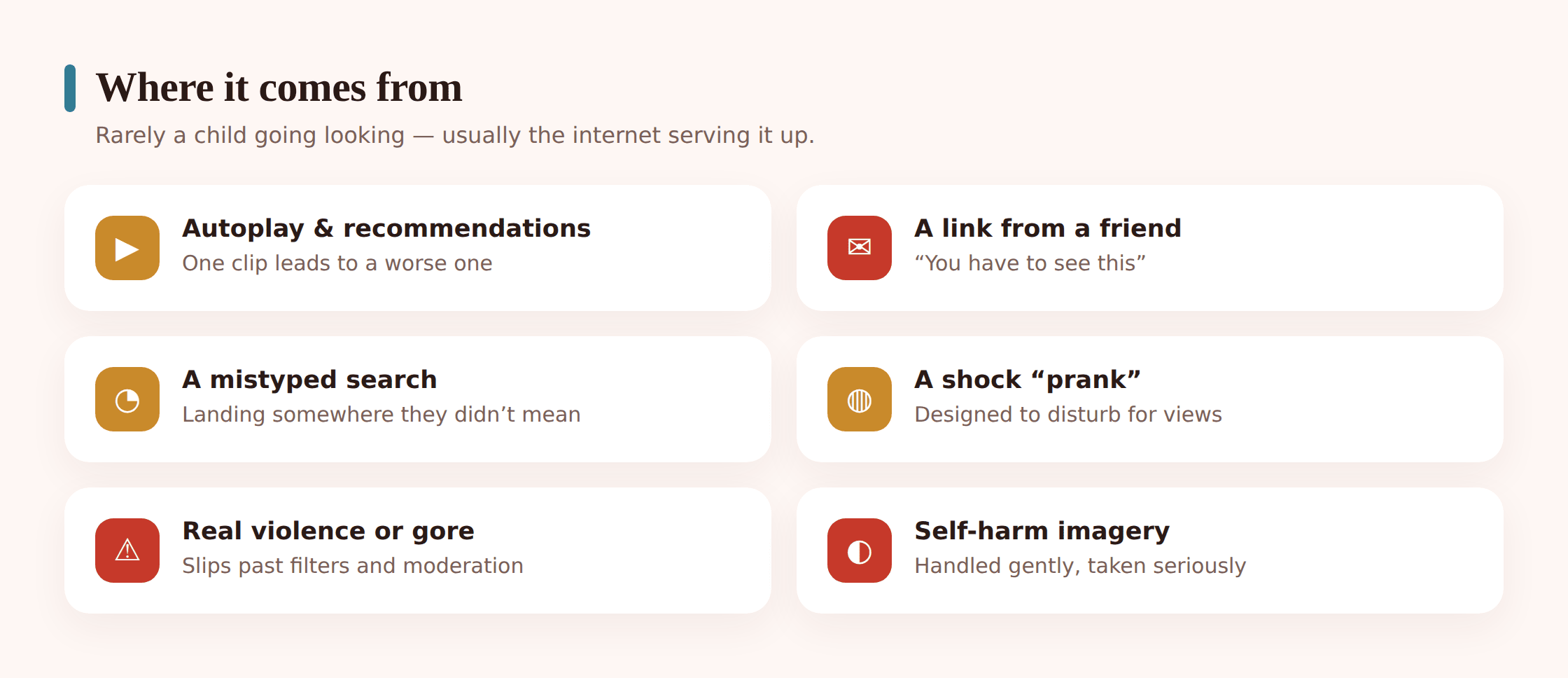
It helps to understand the usual routes, because knowing them takes the mystery out of it and points at real fixes later.
Autoplay. A perfectly ordinary video finishes, and the platform loads the next one automatically. Your child didn’t choose it. It just started, and by the time anyone reacts, they’ve seen a few seconds that stick.
Recommendations. The “up next” rail and the endless scroll are built to keep attention, and sometimes the thing that keeps attention is shocking. A child watching harmless clips can be nudged, one recommendation at a time, toward something that never should have reached them. Our piece on how social media algorithms work goes into why the feed does this.
A link from a friend. “You have to see this.” Kids share things to get a reaction, and a younger child clicking a link from an older sibling’s friend has no idea what’s coming. Group chats spread shock clips fast, sometimes as a dare or a joke that isn’t funny.
A mistyped or innocent search. A word that means one thing to a child can pull up something else entirely. An image search for a cartoon character, a game, or an animal can return results nobody expected. This is where a “shock” version of something familiar catches kids out.
A disguised clip. Some content is deliberately hidden inside something that looks child-friendly — a familiar character, a cheerful thumbnail — precisely so it gets past a quick glance. It’s a nasty tactic, and it’s not your child’s fault for being fooled by it.
How kids actually react
There’s no single “right” reaction, and a child’s response often doesn’t match how upset they actually are inside. Knowing the range helps you read your own child instead of expecting a script.
Some kids are visibly shaken. They cry, they cling, they don’t want to be alone, they ask a lot of questions. This is hard to watch but it’s honest, and honestly it’s easier to help with, because you can see it.
Some replay it. They keep bringing it up, describing it, asking whether the thing they saw was real, whether it could happen to them or to you. The repetition isn’t them being dramatic. It’s a young brain trying to make a frightening thing make sense by turning it over and over.
Some have delayed reactions. They seem fine for a day or two, then the nightmares start, or bedtime gets difficult, or they suddenly won’t go upstairs alone. The gap between seeing something and reacting to it can be confusing — you may not even connect the two at first.
And some act completely unbothered. They shrug, they say “it’s fine,” they go back to their game. Sometimes they genuinely are fine. Sometimes “unbothered” is a shield, and the feelings surface later or come out sideways as irritability, poor sleep, or a stomach ache with no cause. Take a calm, unbothered response at face value, but keep a gentle eye out over the next week.
Younger children tend to fear the concrete — that the monster or the violence will come to their house. Older kids and teens may wrestle with something more abstract: that the world contains this, that people do these things, that it’s out there and can’t be un-known. Both are real distress, and both deserve to be taken seriously without being inflated.
Responding in the moment
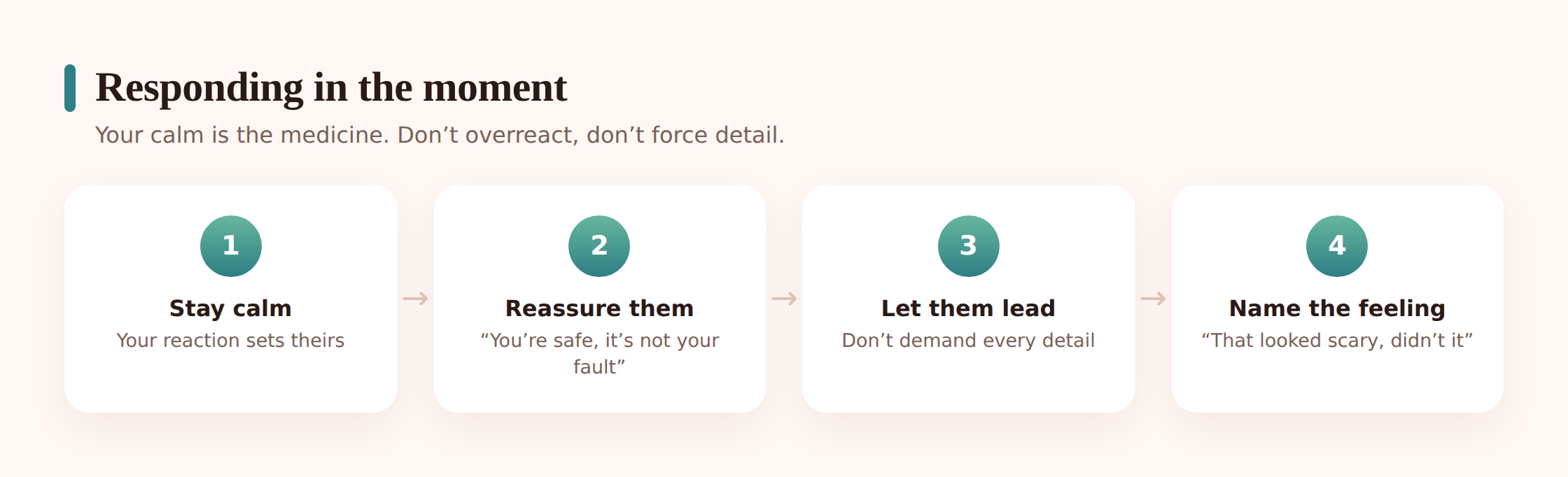
If your child has just seen something and is upset, or has just told you, here’s a way through the next few minutes. You don’t need to get it perfect. You mainly need to be present and steady.
Step 1 — Settle your own face and voice first
Your child is watching you to learn how frightening this is. If you gasp, snatch the phone, or look horrified, you’ve just told them it’s even worse than they thought. Take one slow breath. Soften your voice. You can feel alarmed inside and still keep your outside calm — that’s not fake, that’s the job right now.
Step 2 — Move the screen away gently, not dramatically
Turn the device over or close it without a big reaction. “Let’s put that down for a sec” is enough. You’re removing the image from view, not confiscating anything as a punishment. If you rip the phone away, the lesson your child learns is that showing you things gets the phone taken — and next time they won’t tell you.
Step 3 — Come alongside and name that they’re safe
Get down to their level, put an arm around them if they’ll let you, and lead with safety: “You’re okay. You’re here with me. That’s over now.” Physical closeness settles a frightened nervous system faster than any words. Let them feel that the room they’re in is safe, whatever they just saw.
Step 4 — Validate the feeling, whatever it is
“That looked really scary, didn’t it” or “I can see that upset you” tells them their reaction makes sense. Don’t talk them out of it — “it’s just a video, don’t be silly” teaches them to hide feelings, not to lose them. If they seem fine, you can match that too: “That was a horrible thing to pop up. I’m glad you told me.”
Step 5 — Thank them for telling you
If your child came to you, this is the single most important thing you can do: make them glad they did. “I’m really glad you came and told me. You did exactly the right thing.” You are protecting every future disclosure with this one sentence. A child who gets a warm response this time will come back next time.
Step 6 — Follow their lead on detail — don’t dig
Let them tell you as much or as little as they want. Don’t interrogate them for a frame-by-frame account — making them describe it in detail can actually cement it. A gentle “you don’t have to tell me all of it, just as much as you want” gives them control back, which is exactly what a scary experience took away.
Step 7 — Do something ordinary and grounding next
Once they’ve settled, shift into something normal and comforting — a snack, a walk, a familiar show, a game you play together, bedtime with the light on if that helps tonight. You’re showing them, not just telling them, that life carries on and they’re safe in it.
The days after
The first conversation is rarely the whole story. Disturbing images have a way of resurfacing — at bedtime, in the dark, when the distraction stops. How you handle the following days matters as much as the first hour.
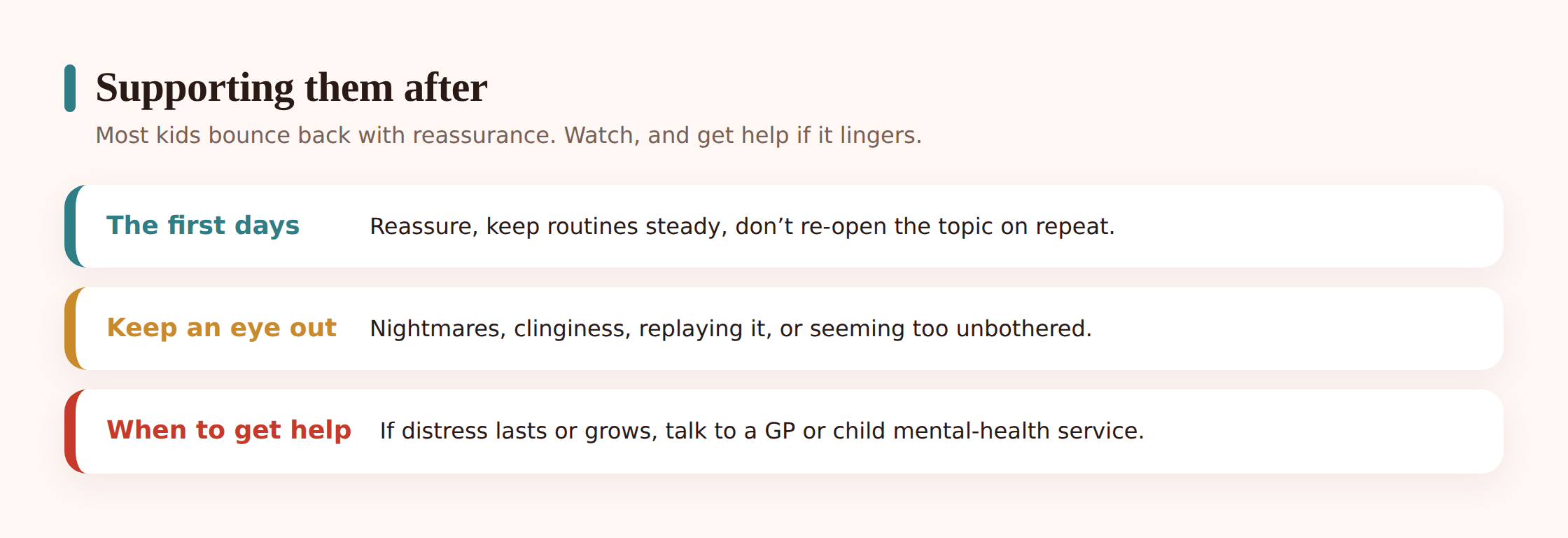
Keep the door open without forcing it. A light “how are you doing after that thing yesterday?” once, not a daily inquiry, lets them know they can come back to it. If they don’t want to talk, that’s fine — the invitation is what counts. Some kids process by talking, some by drawing, some by playing it out with toys, some by just needing you nearby. All of that is normal.
Expect some sleep disruption and meet it kindly. A few nights of a night-light, a slightly longer bedtime, checking the room, or sleeping with the door open aren’t setbacks. They’re a child self-soothing. Give the extra reassurance freely for a week or two; it almost always settles. Avoid screens in the hour before bed for a while, since the calmer the wind-down, the easier the sleep.
Answer the “was it real?” question honestly and simply. Kids often fixate on whether what they saw actually happened. Match your answer to their age. For a younger child, “a lot of scary things online are made up to look real, like a horror film” is often both true and enough. For an older child who saw something that clearly was real, you can be honest that yes, bad things do happen in the world — while anchoring it: “and it’s rare, and there are people whose whole job is to stop it, and you are safe here.” Don’t over-explain. Answer what they asked.
Put it in proportion, gently. Without dismissing the feeling, you can help a child zoom out: the world is mostly ordinary and kind, most people are good, and the reason that clip was shocking is precisely because it’s not how things usually are. This is quietly a media-literacy lesson too — that a feed can make the rare and horrible feel common. Our guide to media literacy for kids has more on helping them read what they see with a clearer eye.
Watch for the pattern, not the single bad night. One rough night, a couple of questions, a bit of clinginess — that’s a child processing normally, and it typically fades within a week or two. It’s the persistence and the spread into other areas of life that tell you something more is needed, which is the next section.
Reducing the chance it happens again
You can’t build a wall high enough to guarantee a child never sees anything upsetting — nobody can, and chasing that certainty leads to a locked-down childhood that doesn’t work anyway. What you can do is lower the odds a lot, and, just as importantly, prepare your child for the next time so it lands more softly.
Settings that quietly do a lot
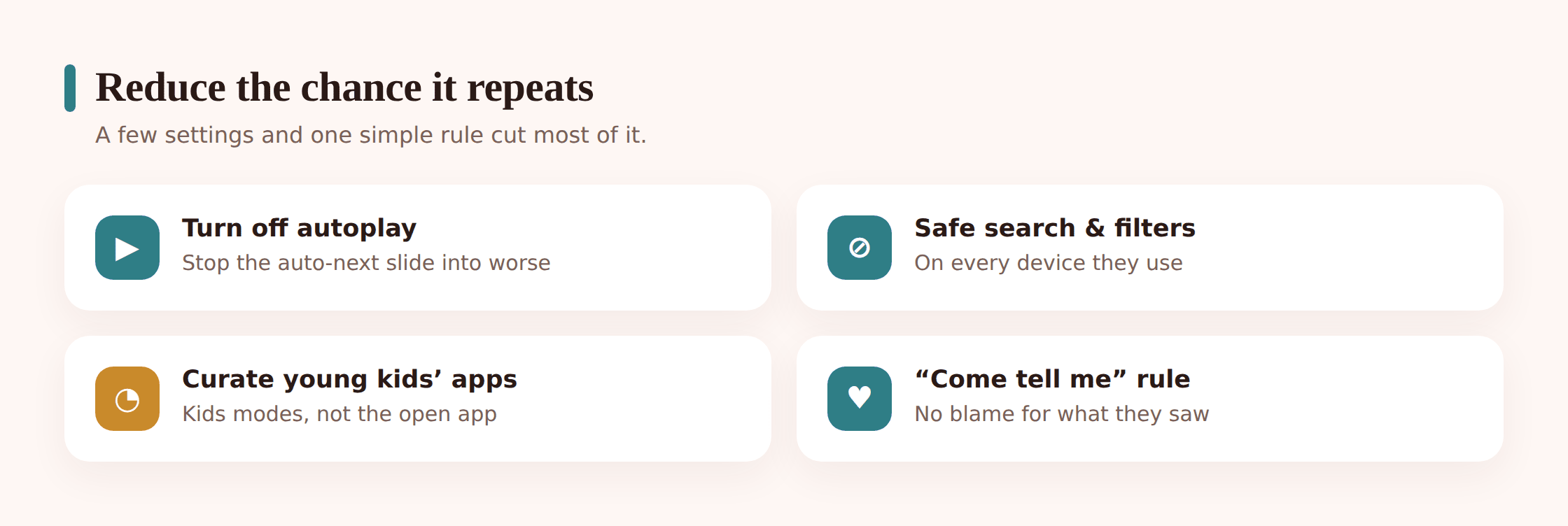
- Turn autoplay off on video apps and browsers. This one setting removes the single most common route — the video nobody chose. It puts a small human pause between one clip and the next.
- Enable safe search on every search engine and app store the child uses, and on the browser itself. It’s not perfect, but it filters out a large share of the worst results.
- Use content filters and restricted modes built into the platforms — YouTube’s supervised experience or restricted mode, the kids’ version of an app where one exists, and your device’s family settings.
- Set up device-level parental controls, not just per-app ones. Screen-time and content controls at the operating-system level catch things individual apps miss.
- Keep young children on curated apps rather than the open web and open recommendations. The younger the child, the more the walls should be built in.
- Watch and use devices in shared spaces where you can. A tablet used in the kitchen gets a different kind of content than one used alone under a duvet.
The conversation that matters more than the settings
Filters fail. Kids grow, switch devices, use a friend’s phone, find the gaps. The most durable protection isn’t a setting — it’s a child who knows what to do when something slips through. So teach the plan before it’s needed, calmly, as a normal part of life online:
- “If something ever pops up that scares or upsets you, it’s not your fault.” Say this out loud, in advance. It removes the shame that stops kids telling you.
- “Look away and put the screen down.” A simple physical action a child can actually do in the moment beats a vague rule.
- “Come and tell me — you’ll never be in trouble for it.” The promise that telling you is safe is the whole game. Make it and keep it.
- “You don’t have to click a link just because a friend sent it.” Give them permission to say no to “you have to see this.”
This same “come tell me, you won’t be in trouble” foundation is what protects your child across every online risk, from talking about online pornography to viral challenges. It’s the one habit worth building above all others.
If the content your child saw involved a person being hurt, illegal material, or something clearly meant to shock or harm, it can be reported — both to the platform and, in some cases, to the appropriate authorities. Our guide on how and where to report harmful content walks through the practical steps.
When a reaction needs more than you
Most children recover from a one-off exposure with time, comfort, and a steady parent. But sometimes the reaction runs deeper or lasts longer than ordinary upset, and that’s not a failure on anyone’s part — it just means a bit of extra help is the right call. Trust your gut; you know your child.
Consider reaching out to a professional if, after a couple of weeks, you’re seeing things like:
- Sleep problems or nightmares that aren’t easing, or a real fear of sleeping alone that’s new.
- Anxiety that’s spreading into daytime — clinginess, refusing to go to school, panic that seems out of proportion.
- Intrusive replaying — they can’t stop thinking or talking about it, or say the image “keeps coming back” to them.
- Withdrawal from things they used to enjoy, a flat or frightened mood that doesn’t lift, or a big change in appetite.
- Physical complaints with no medical cause — recurring stomach aches or headaches that track with the distress.
- Any sign the content has changed how they see themselves or their own safety in a lasting way.
A good first step is your GP or family doctor, who can listen and point you to the right support, including your local child and adolescent mental health service. Your child’s school may have a counsellor or pastoral lead who can help too. Asking for support early isn’t an overreaction — it’s the same as taking a persistent cough to the doctor. Children’s brains are wonderfully able to heal from frightening experiences, and a bit of professional guidance often speeds that along.
If it was self-harm or suicide content
This deserves its own note, handled carefully. If your child has seen imagery or content relating to self-harm or suicide, treat it with a little more attention — not alarm, but attention. This kind of material can affect a young person more than a one-off scary clip, especially an older child or teen who’s already struggling.
Respond the same calm way — settle yourself, come alongside, thank them for telling you, validate the feeling. Then gently open the door a bit wider. You can ask, without dread in your voice, how they’re feeling in themselves and whether they’ve ever had thoughts like the ones in what they saw. Asking calmly and directly does not put ideas into a child’s head; it does the opposite — it tells them this is something they’re allowed to talk about with you.
If your child seems affected, seems low in themselves, or if anything they say worries you, don’t sit with it alone. Reach out for professional support: your GP, your local child mental-health service, or a helpline are all appropriate starting points, and they’re used to exactly these conversations. If the content related to eating or body image, the National Alliance for Eating Disorders offers information and a helpline for families looking for guidance. And if you ever believe your child is in immediate danger, treat it as the emergency it is and get urgent help straight away.
A quick checklist
If you want the short version to keep in your head for the moment it happens:
- Steady your own face and voice before anything else.
- Put the screen down gently — no snatching, no punishment.
- Come close and lead with safety: “You’re okay, that’s over now.”
- Validate whatever they’re feeling, including feeling fine.
- Thank them for telling you, and mean it.
- Let them share as little or as much as they want — don’t dig for detail.
- Do something ordinary and grounding next.
- Check in lightly over the following days, and watch for lasting change.
- Turn off autoplay, switch on safe search, check your filters.
- Teach the plan for next time: look away, put it down, come tell me, no trouble.
- If distress persists past a couple of weeks, or it was self-harm content and your gut says so, reach out for professional support.
Questions parents ask
My child saw something scary — will it traumatise them?
Almost certainly not from a single exposure, especially with a calm parent beside them. Children are remarkably resilient, and most bounce back within days to a couple of weeks with comfort and normal routine. Trauma is more likely when a child is left alone with a frightening experience, has no one safe to tell, or is met with anger. Because you’re paying attention and staying steady, you’ve already tilted the odds strongly toward a full recovery.
Should I ask what they saw?
Let them lead. Give them the chance to tell you and make it clear they can, but don’t press for a detailed account. Some kids need to talk it out; others do better leaving the details behind. Forcing a frame-by-frame description can actually reinforce the image. “You can tell me as much or as little as you like” respects both kinds of child.
Should I watch it myself to know what they saw?
Usually no — not out of curiosity, and not to “assess” it. Seeing it yourself rarely helps and often leaves you rattled too, which makes it harder to stay the calm one. The exception is if you may need to report it, or if you genuinely need to understand the nature of it to help — and even then, brace yourself and don’t do it in front of your child.
When should I worry rather than just wait it out?
Give it a week or two of ordinary settling. Worry — in the useful, act-on-it sense — if the distress isn’t easing, if it’s spreading into sleep, school, mood, or appetite, if they can’t stop replaying it, or if anything about their reaction feels off to you. That’s the point to talk to your GP or your child’s school. Trust your instinct; a parent’s gut about their own child is worth a lot.
My child seems totally unbothered. Is that a problem?
Not necessarily. Plenty of kids genuinely shrug things off, particularly older ones who’ve built up a bit of a thick skin online. Take it at face value, keep a gentle eye out over the following week for delayed reactions like sleep changes or unexplained irritability, and leave the door open. If they stay fine, they’re fine.
How do I stop it happening again without banning everything?
You can’t reduce the risk to zero, and trying to usually backfires. Turn off autoplay, enable safe search and content filters, keep younger kids on curated apps, and use devices in shared spaces where you can. Then do the thing that matters most: teach your child what to do when something slips through, and promise they’ll never be in trouble for coming to tell you. The settings lower the odds; the open door handles the rest.