What to Do When Monitoring Flags a Problem: A Calm Response Guide
You set up open monitoring so you’d know, and now you know. An alert has fired, or a name you don’t recognise has appeared, or the dashboard is showing a late-night pattern that wasn’t there last week. Your chest tightens and part of you wants to act this second. Here’s the thing worth holding onto before you do anything: the tool did its job the moment it surfaced this. What decides how it goes from here is not the flag itself but how you respond to it. A steady, relationship-first response is what keeps your child bringing things to you instead of learning to route around you. This guide walks through that response, from the first move to the weeks afterwards.
The first move when a flag appears
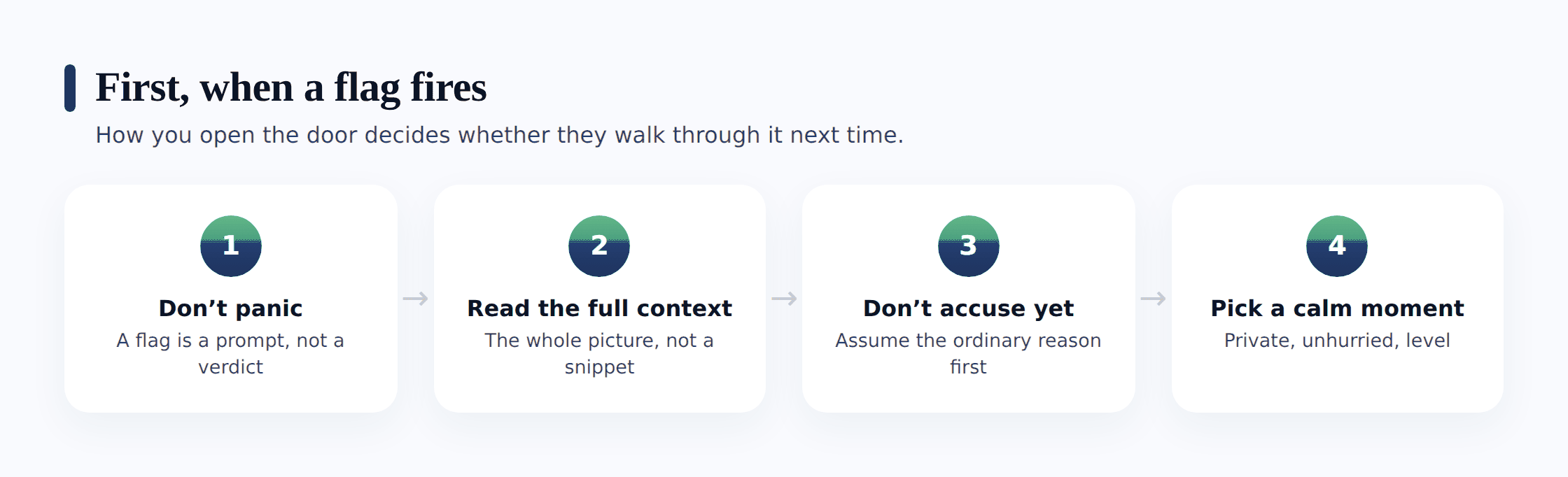
A flag arrives with a jolt, and the jolt lies to you a little. It makes a single data point feel like a full story, and it makes right now feel like the only moment to act. Neither is true. Almost nothing an alert surfaces gets worse in the hour it takes you to steady yourself, and almost everything gets worse if you charge in while your pulse is still up.
So the first move is deliberately small: do nothing rash. Don’t fire off a message to your child. Don’t storm down the hall. Don’t start deleting or confiscating. A flag is an invitation to look properly, not a verdict you have to enforce in the next sixty seconds.
Give yourself a beat to separate the feeling from the plan. Fear and anger are useful signals that something needs your attention; they are terrible advisers on how to give that attention. If you can, wait until you’re somewhere private and unhurried before you even open the full detail. An evening’s pause costs you almost nothing and buys you a clearer head, which is worth far more than speed in nearly every case that isn’t an active emergency.
There is one clear exception, and it’s worth naming up front so you don’t hesitate when it counts. If the flag points to genuine, immediate danger — a child talking about ending their life, an adult stranger arranging to meet, an active threat of violence — then you act now and stay close, while still keeping your voice level. Everything else in this guide assumes you have a little time, because the truth is that you usually do.
Read the full context before you assume
An alert is a headline. Before you respond, read the article underneath it, because context changes the meaning of almost everything monitoring catches.
A flagged word might sit inside a joke between friends, a song lyric, a piece of homework, or a genuine cry for help — and those need wildly different responses. An unknown contact might be a new classmate, a cousin’s friend, a gaming teammate, or someone who has no business talking to a child. A late-night screen-time flag might be one anxious night before an exam, or a settled habit of talking to someone your child can’t stop thinking about. The dashboard shows you the shape of things; your job is to look at the surrounding detail and work out which story you’re actually in.
Resist the pull to fill the gaps with your worst fear. Our minds are efficient at that, and monitoring gives the anxious imagination plenty of raw material. Read what’s actually there. Look at the thread around the flagged message, not just the flagged line. Check whether this is the first time you’ve seen it or the tenth. Notice who spoke first, and whether your child was leading, following, or plainly uncomfortable.
Work out how serious it really is
Once you’ve read the context calmly, the real work is judgement: placing what you’ve found on a scale from ordinary to genuinely dangerous. This matters enormously, because responding to a cringey-but-normal thing as though it were an emergency does real harm — it teaches your child that honesty triggers a crisis, and that lesson makes them quieter next time.
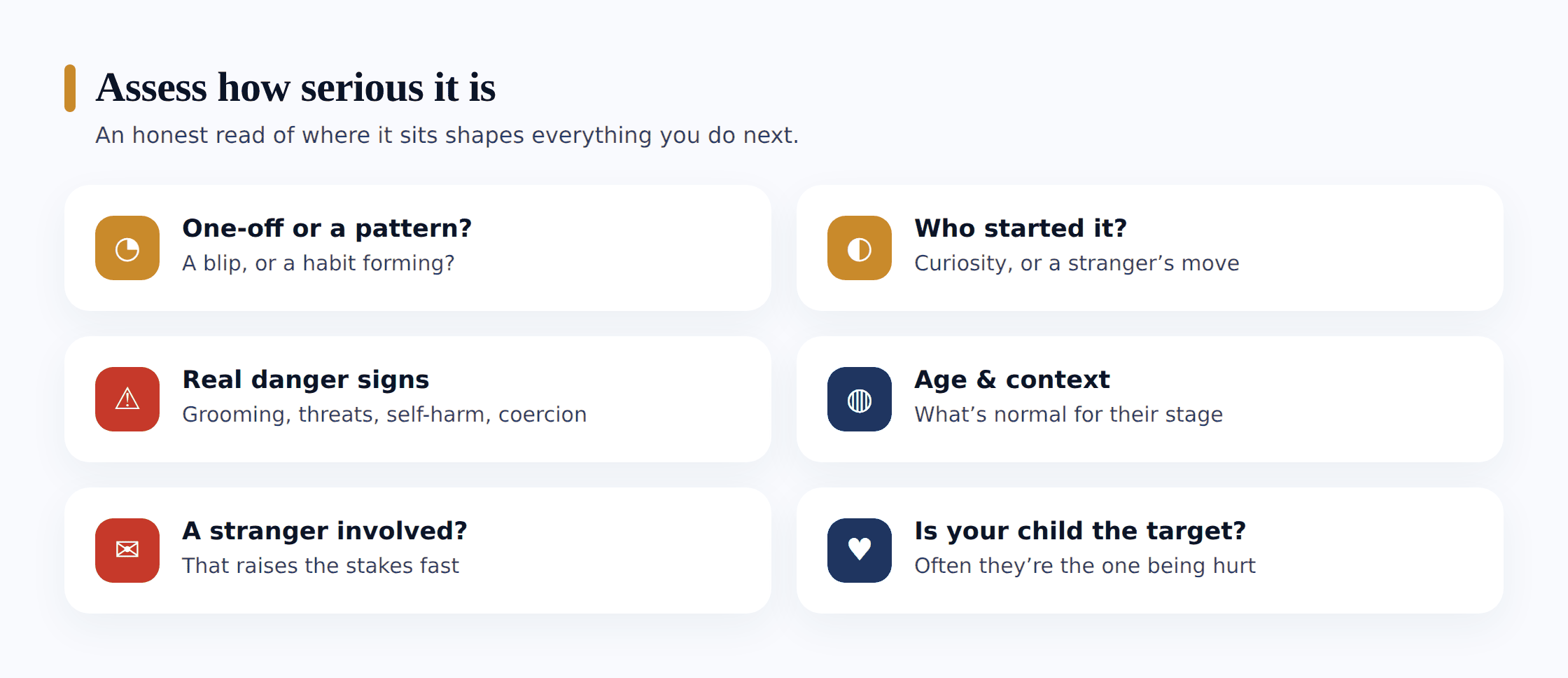
A handful of questions help you place it:
One-off or pattern? A single flagged search out of curiosity is a very different thing from the same worrying theme appearing again and again. A one-time late night is not a habit. Look for whether this is a stray moment or a direction of travel.
Who started it, and who’s on the other side? A jokey message between classmates sits worlds apart from contact by an unknown grown-up, or by someone pretending to be a kid. Notice whether your child instigated something or was pulled into it. If any adult or unknown party is involved, the seriousness climbs sharply.
Is your child the target rather than the instigator? Sometimes a flag shows your child being pressured, threatened, groomed, or coerced — the victim, not the driver. That reading changes your whole posture: less “what have you done” and much more “you’re not in trouble, and I’ve got you.”
Are there real danger signs? Some things sit high on the scale by their nature: grooming, sexual coercion or requests for images, threats, signs of self-harm, or anything that looks predatory or illegal. Age and context matter too — the same word or app means something different at nine than at fifteen.
Sorting the flag into a rough tier is what tells you which track to take. Broadly, most of what monitoring surfaces is minor — the everyday scrapes of growing up next to a phone that never picks a sensible moment. A smaller share is serious and needs more than a chat. The next section handles both.
Acting on it: two tracks
Once you know roughly how serious it is, your response splits into two tracks. Choosing the right one is most of the job.
Track one: something minor — talk and guide
If what you’ve found is curiosity, a one-off, a bit of edgy humour, or ordinary growing up arriving earlier than you’d like, the answer is not a crackdown. Over-reacting to small stuff is how you spend the trust you’ll need for the big stuff. Treat it as a chance to guide, not to police.
Step 1 — Decide it’s guidance, not punishment
Go in aiming to understand and steer, not to sentence. A curious search or a rude meme is a teaching moment, and teaching moments go badly when they start with consequences.
Step 2 — Raise it lightly and openly
Because the monitoring is out in the open, you can name it plainly and without drama: “The app flagged this and I wanted to check in — what’s the story?” Light and curious beats grave and loaded.
Step 3 — Guide, then let it rest
Share the bit of context or judgement they might be missing, agree anything worth agreeing, and then close it warmly. One good, calm conversation does more than a fortnight of returning to the subject.
Track two: something serious — take it seriously
If the flag points to grooming, abuse, sexual coercion, a credible threat, or signs of self-harm, this stops being a parenting chat and becomes a safeguarding situation. Your child needs you to act, and to act well.
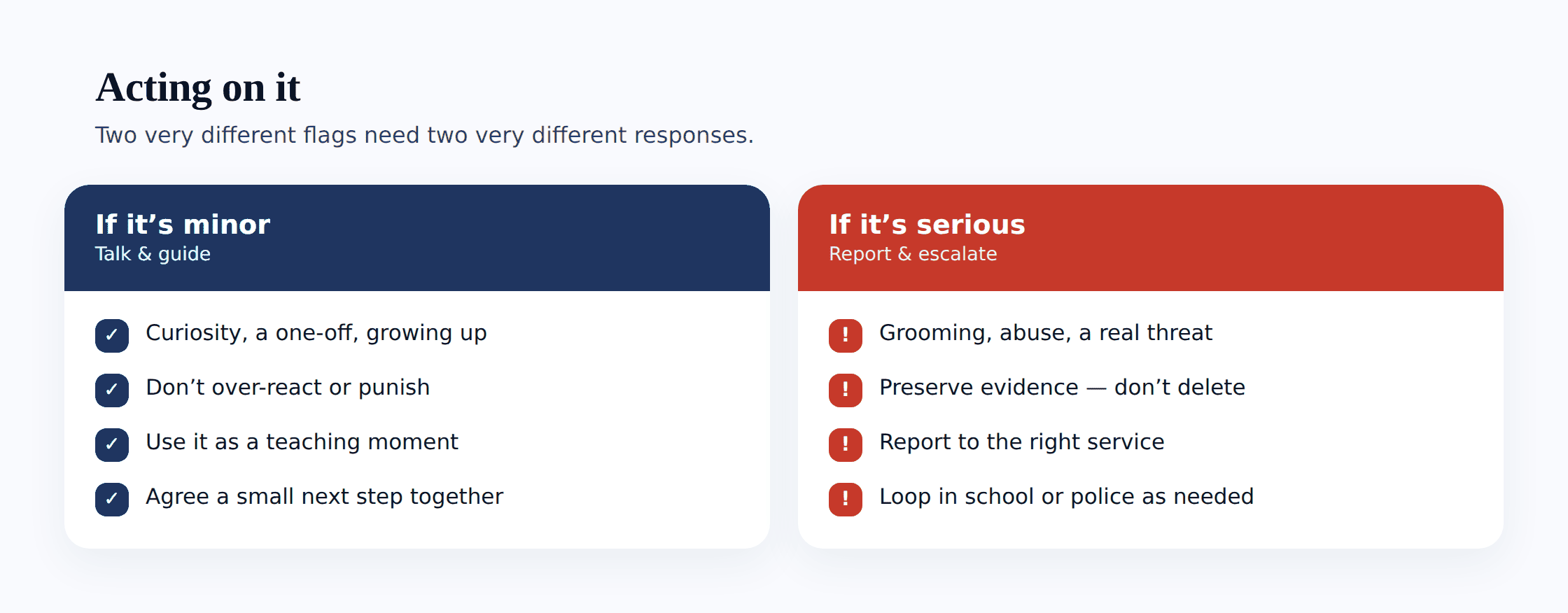
- Preserve, don’t delete. Screenshot and keep the messages, names, and dates. Deleting destroys the evidence that a professional or the police may need.
- Don’t investigate an offender yourself. If an adult is involved, don’t confront them or try to gather more. Report it and let the specialists work.
- Report to the right service. For anything predatory, sexual, or involving images of a child, contact the police and, in the UK, CEOP; in the US, the NCMEC CyberTipline at report.cybertip.org. For immediate danger, call 999 or 911.
- Bring in the school where it fits. For bullying, threats, or anything tangled up with classmates, the school has powers you don’t at home, and usually already knows the young people in the picture.
- Get health support for self-harm or eating concerns. For self-harm worries, your GP or doctor is a sound first door and can refer onward; a reputable helpline can talk you through the moment. Where disordered eating is part of it, the National Alliance for Eating Disorders offers guidance and support for families.
Through all of this, keep your child close and keep them clear that they aren’t the one in trouble — especially when they’re the target. The instinct to withdraw the phone as a reflex is understandable, but for a victim of grooming or coercion it can feel like a punishment for telling the truth. Change access as a considered safety step you explain, not as a snatch.
Talking to your child about it
Whichever track you’re on, there’s a conversation, and how you open it shapes everything that follows.
Lead with care, not accusation. Your child’s nervous system reads your tone before it hears your words, so a warm, unhurried opening keeps them in the room where a sharp one sends them into denial. Be honest that the monitoring flagged it — that’s the whole point of doing this openly, and there’s nothing to hide. “The app flagged something and I want to understand it, not tell you off” is a true and disarming way in.
Then get their side, and mean it. Ask, and actually listen to the answer before you decide what it means. The context they add often reframes the flag entirely — the stranger is a known teammate, the dark joke was a joke, the late nights were nerves before results day. And whatever they tell you, don’t punish honesty. If a child tells you the truth about something difficult and the sky falls on them, you’ve just taught them not to next time. Reward the telling even when you don’t love what was told.
After you act: repair and ease off
Acting on a flag isn’t the end of the job — the days after matter as much as the moment itself, because that’s where trust is either rebuilt or quietly eroded.
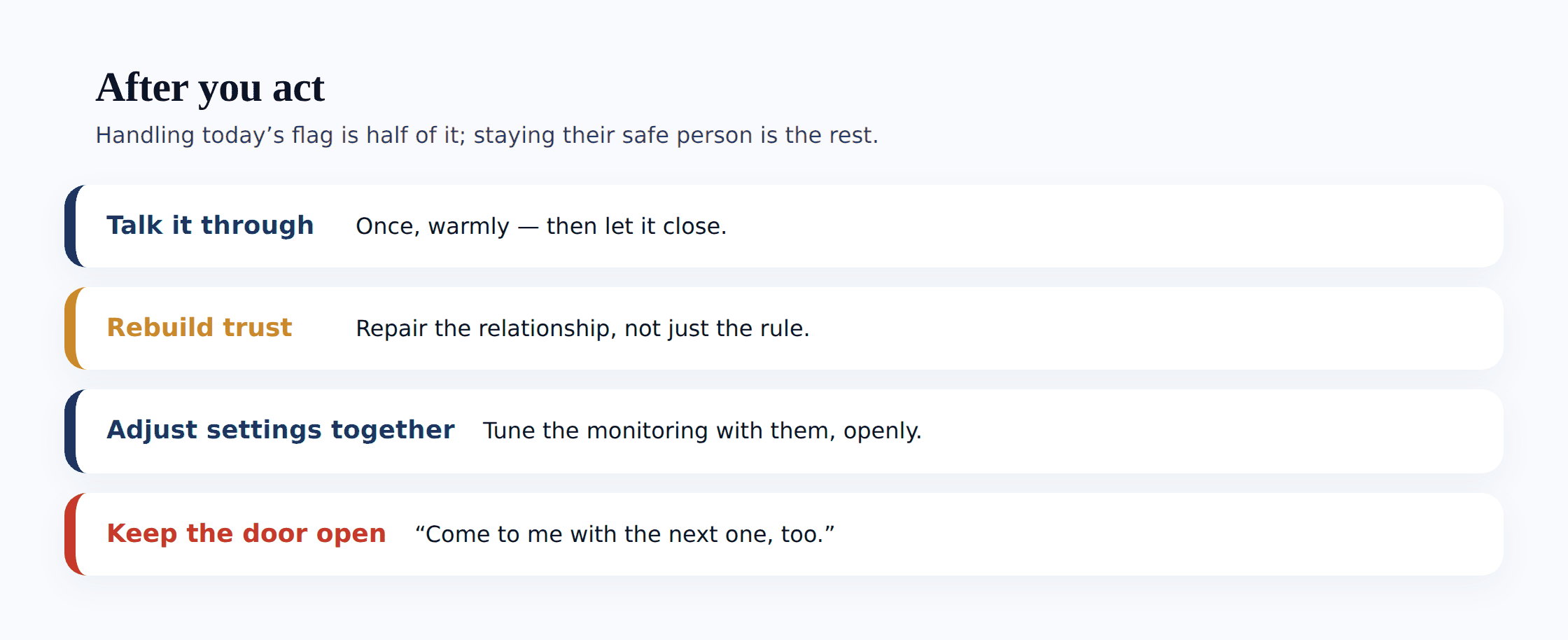
Talk it through once it’s settled, then resist two temptations. Don’t keep circling back to it — one warmly closed conversation does more than a week of reopening the wound, which only signals that the subject will follow them around. And don’t let the flag curdle into constant suspicion. Start scanning every screen for the next problem and they will sense the shift, and the result is a child who learns to conceal more skilfully, not one who is any safer.
Where it makes sense, adjust settings together rather than tightening them in secret. If a new app needs a limit, or a fresh alert is worth adding, do it side by side and explain why. Changes your child helped make are ones they’ll respect; changes imposed silently are ones they’ll work around. Keep the door open with a plain, repeated message: you can always come to me, and I’d rather you told me than hid it.
Then, once things are steady again, ease off. Monitoring that only ever ratchets tighter teaches a child they can never earn back room. As trust rebuilds, loosen the reins — fewer alerts, a lighter touch, more privacy — so the arrangement grows with them. That easing is itself a message: I trust you, and this was never about control.
How FreePhone fits
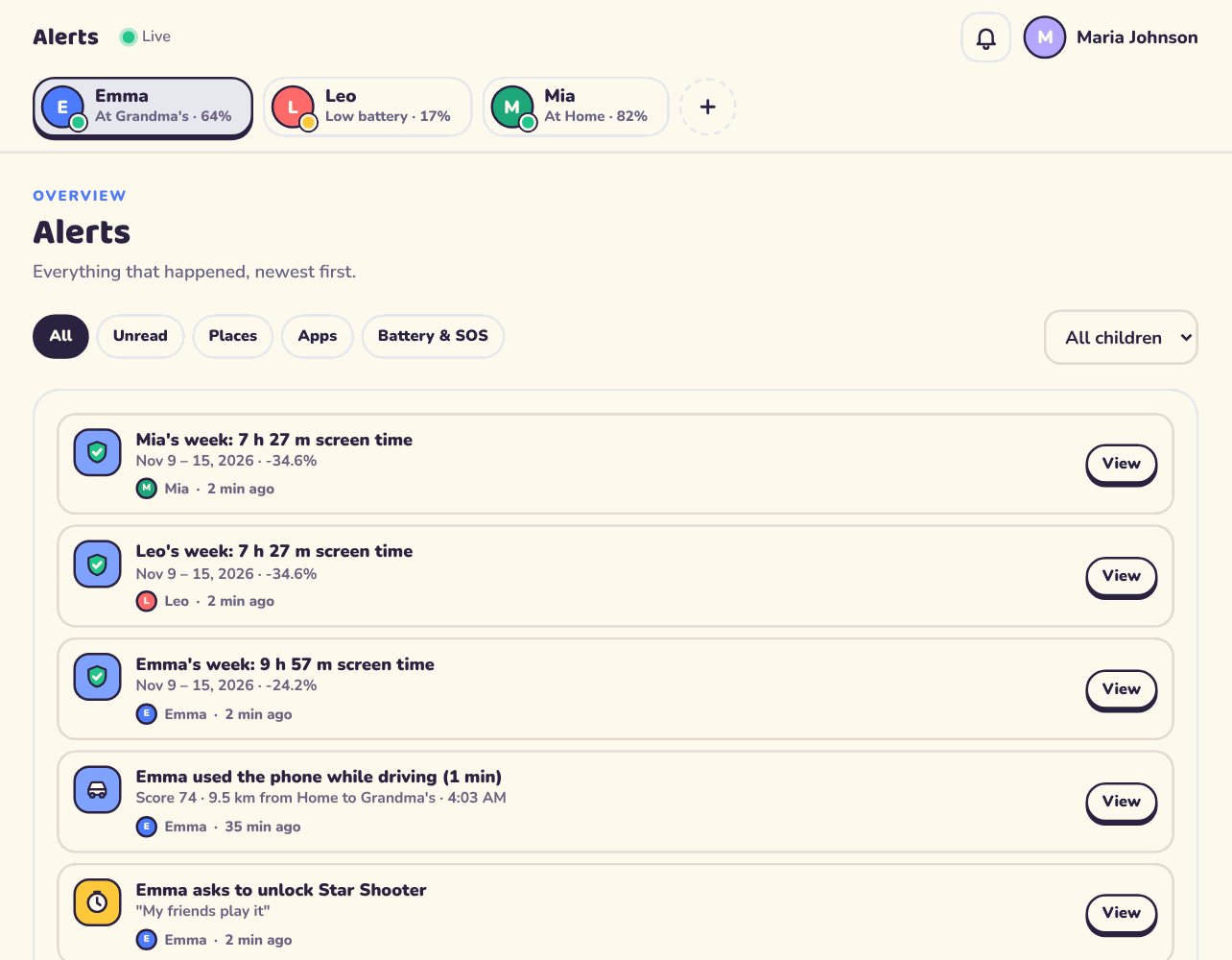
The reason a worrying moment can be a calm, shared conversation rather than a confrontation is that FreePhone is built to be transparent. Because your child knows it’s there, an alert — a new app, a missed curfew, a late night on the phone — is simply something you can talk about openly, no cover story, no betrayal to explain. It never reads messages, so it won’t flag words; you set it up together, it runs on Android, and everything lands in one view you can check from any browser. It’s free, with every feature, so you can switch on only what your family actually needs.
Questions parents ask
An alert just fired — do I confront my child right now?
Almost never in the first heat of it. A flag is a starting point, not a verdict, so read the full context first and pick a calm, private moment to raise it. Confronting a child while your pulse is up tends to produce denial and a closed door rather than honesty. The one exception is genuine, immediate danger — an adult arranging to meet, a real threat, talk of self-harm — where you stay right beside them and act straight away, voice kept steady.
How do I tell a minor flag from a serious one?
Ask whether it’s a one-off or a pattern, who started it, and who’s on the other side. Ordinary curiosity, edgy humour, and growing-up-early behaviour sit at the minor end and call for guidance, not a crackdown. Grooming, coercion, threats, requests for images, and signs of self-harm sit at the serious end and need more than a chat. If an adult stranger is involved or your child is being targeted, treat it as serious until you know otherwise.
Should I hide that the monitoring showed me?
No — and that’s the advantage of doing it openly. Your child agreed to the monitoring, so you can say plainly that the app flagged something and you want to understand it. Trying to disguise how you know usually unravels and shifts the focus onto your sneakiness instead of the actual issue. Naming it honestly keeps the conversation where it belongs and models the openness you’re asking of them.
Where do I report something genuinely serious?
For anything predatory, sexual, or involving images of a child, contact the police and, in the UK, CEOP; in the US, the NCMEC CyberTipline at report.cybertip.org. For self-harm concerns, start with your GP or doctor, or a reputable helpline. Where disordered eating is involved, the National Alliance for Eating Disorders supports families. For immediate danger, call 999 or 911. Keep whatever proof exists instead of clearing it away, and leave the tracing of any adult offender to the professionals rather than doing it yourself.
Should I tighten all the settings after a flag?
Rarely as a reflex. Ratcheting everything tighter after every flag teaches a child they can never earn back room, which pushes them to hide. Adjust what genuinely needs adjusting, do it together where you can, and explain why. Then, once things are steady, ease off again — fewer alerts, a lighter touch. The arrangement should grow with your child, not just clamp down each time something surfaces.
Where to turn for support. Some flags touch on sensitive, frightening things, and you don’t have to handle them alone. Your GP or doctor is a good first stop for self-harm or mental-health worries and can refer onward. A school counsellor or pastoral lead often already knows your child. For anything predatory or involving a child sexually, the police, CEOP (UK) and the NCMEC CyberTipline (report.cybertip.org, US) are the right doors, and the National Alliance for Eating Disorders supports families where eating is part of the picture. Reaching out early is a caring, sensible move, not an overreaction.
A flag is only ever the beginning of a story, and you get to decide how the rest of it goes. Read the context, judge it honestly, respond with care on the right track, and close every conversation with the door open. Do that, and monitoring becomes what it’s meant to be — not a trap that catches your child out, but a way for the two of you to keep facing the tricky bits together.