Vaping & Nicotine Marketing: How It Targets Teens Online
A disposable vape in a rainbow of colours, named after a fizzy sweet, held up in a fifteen-second video by someone your teen already follows and trusts — that is not an accident. It is a marketing decision, made carefully, aimed squarely at a young audience. You do not have to become an expert in vape brands to help your child. But understanding how these products are sold, and why the sell works so well on teenagers, gives you something far more useful than a ban: a way to talk about it that keeps your teen talking back.
Why teens are the target
Nicotine is a repeat-purchase product. Someone who starts young and stays hooked can be a customer for decades. That single commercial fact sits underneath almost everything you will read below. Public-health bodies have warned for years that a large share of lifelong nicotine use begins in the teenage years, which makes adolescents the most valuable audience a nicotine seller can reach — and the group that advertising rules are meant to protect most tightly.
Teenage brains also happen to be unusually receptive. The parts that handle reward and habit are firing hard, while the parts that weigh long-term consequences are still under construction. That is not a flaw in your child; it is normal development. But it means novelty, social approval, and a quick hit of feeling-good land with extra force. A product wrapped in bright colour, sweet flavour, and the glow of a popular creator is aimed at exactly those levers.
And teens are online in a way that is easy to reach and hard to police. A television advert has to clear rules and a broadcaster. A fifteen-second clip on a social feed can be made by anyone, seen by millions, and gone before a regulator notices. Sellers know that gap. Much of the marketing that reaches young people now does not look like advertising at all — which is rather the point.
How the marketing actually reaches them
Once you know what to look for, the playbook is fairly consistent. It leans on colour and flavour to make the product feel innocent, on trusted faces to make it feel normal, and on the design of the platforms themselves to make it feel everywhere. Here is how the pieces fit together.
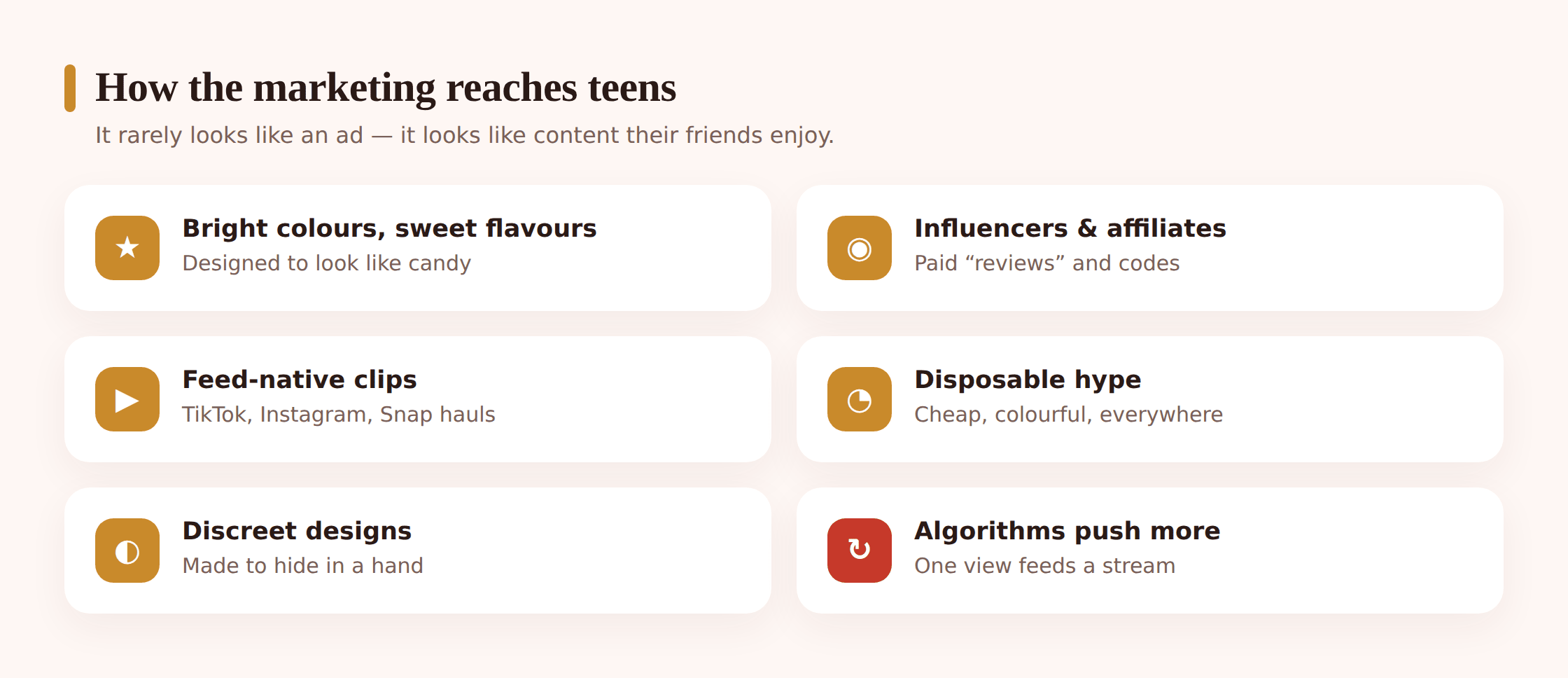
Bright colours and sweet flavours
Walk past a display of disposable vapes and the first thing you notice is that they look like sweets. Neon casings, fruit and dessert names — bubblegum, blue raspberry, cotton candy, mango ice. None of that is designed for a fifty-year-old trying to quit cigarettes. Regulators in several countries have found that flavour and packaging of this kind appeal disproportionately to young people, and some have moved to restrict or ban disposables and certain flavours for exactly that reason. The sweetness does double duty: it makes the product pleasant, and it makes it feel like a treat rather than a drug.
Influencers, hauls, and the “aesthetic”
The most powerful channel is not an advert; it is a person. A creator your teen follows films an “unboxing” or a “haul”, shows off a new device the way they would a pair of trainers, mentions a discount code, and moves on. It reads as a recommendation from a friend, not a paid promotion — and often the paid part is never clearly disclosed. Some of it runs through affiliate schemes, where the creator earns a cut of every sale their code drives, giving them a direct incentive to push. This is the same machinery that sells everything else to young audiences, which is why it is worth understanding kids and influencers as its own subject; nicotine simply borrows the same pipes.
There is also an “aesthetic” layer. Vapes appear as props in lifestyle content — the moody bedroom photo, the night-out clip, the “get ready with me” video — never as the subject, just casually present, part of a look. That quiet, repeated presence normalises the product more effectively than any hard sell. It says: this is what fun, attractive, popular people have in their hand.
The platforms and their feeds
TikTok, Instagram, and Snapchat all prohibit the sale and promotion of nicotine products to young users, and they do remove a great deal of it. But the volume is enormous and the workarounds are creative — misspelled hashtags, coded emoji, content that shows the product without naming it, accounts that disappear and reappear. The recommendation algorithms make it worse. Engage with one clip and the feed learns to serve more of the same, so a passing curiosity can turn into a steady stream. The teen did not go looking for it a second time; the feed brought it back.
Discreet designs and disposable hype
Modern devices are built to be missed. Some look like highlighter pens, USB sticks, or car key fobs; some are small enough to hide in a fist. That discretion is a selling point marketed openly — “easy to carry”, “subtle” — which in the context of a teenager means “easy to use where an adult will not notice”. Disposables amplify the whole thing: cheap, no charging or refilling, bought and binned, treated almost like a fashion accessory that changes with the flavour of the month. The low price and low commitment lower the barrier to a first try.
Hidden and unregulated sales
The sharpest end of this is the sale itself. Legitimate retailers are age-restricted. But a slice of the trade has moved into private messages, group chats, and unregulated online sellers, where a teen can arrange a purchase with little or no age check. Some sellers use social platforms as a shop window and shift the actual transaction to direct messages to dodge moderation. Products bought this way are a genuine unknown — no guarantee of what is inside, whether it is legal, or how strong it is. This overlaps with the wider world of media literacy and spotting manipulation, because the same instinct that helps a teen see through a fake news headline helps them see through a “trusted seller” in a DM.
The through-line: very little of this looks like an advert. It looks like a friend’s recommendation, a nice photo, a bit of fun. That disguise is the strategy — and naming it out loud to your teen takes away a lot of its power.
How to spot the marketing and the products
You do not need to search your child’s room or their phone to stay aware. Most of what is useful comes from knowing the signs and keeping your eyes open in the ordinary way. Here is a calm checklist rather than a stakeout.
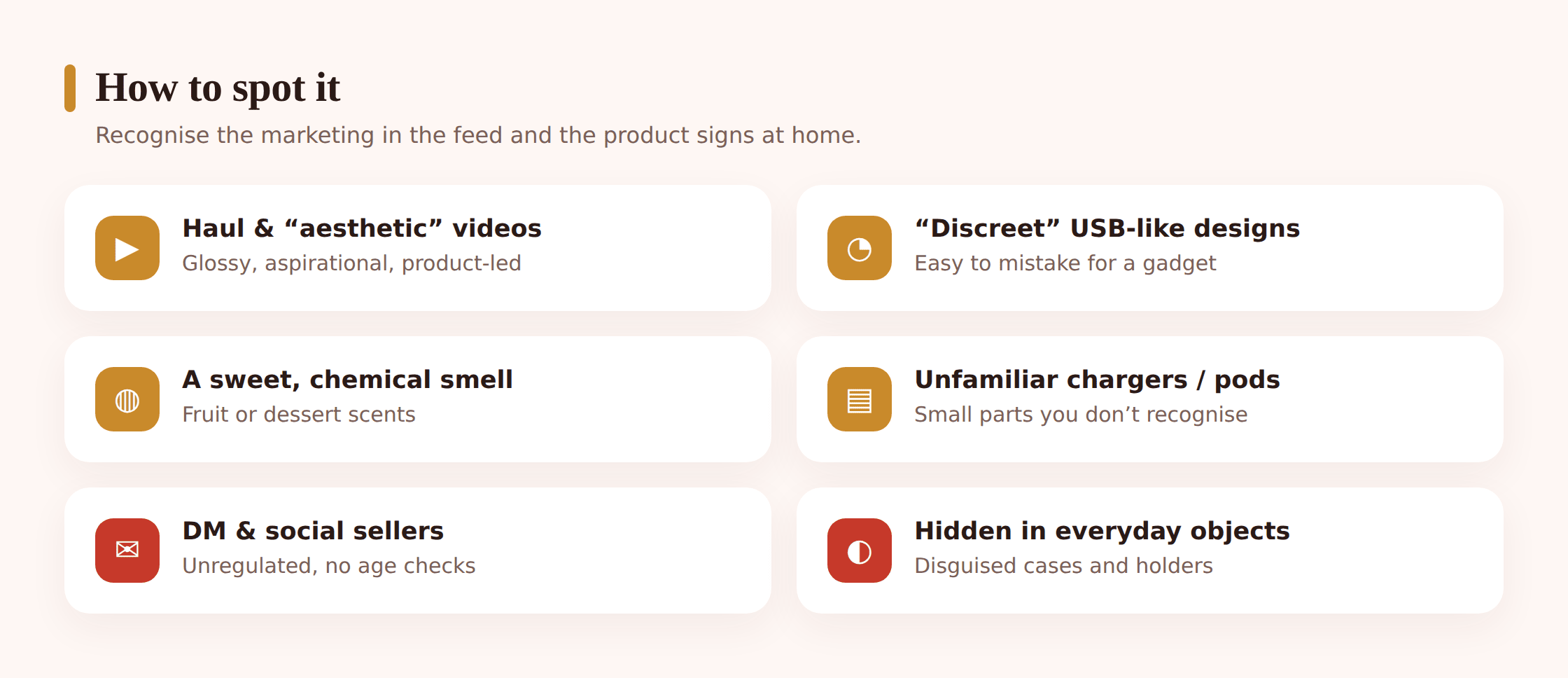
- Sweet, unexplained smells. Vape aerosol often smells faintly of fruit, candy, or dessert, and fades fast. A recurring sweet scent with no obvious source is one of the more common signs.
- Objects that are not what they look like. A “highlighter”, “pen”, or “USB stick” that never gets used as one, or small colourful devices you do not recognise.
- Marketing in the feed. Fruit-flavour names in captions, discount codes for products you cannot place, creators casually holding a colourful device, hashtags that are nearly-but-not-quite a real word.
- New sellers in the messages. Not the content of private chats, but the pattern — a new contact, talk of “codes” or “drops”, meeting up to collect something.
- Physical tells. Increased thirst, a dry cough, or nosebleeds can accompany vaping, though each has plenty of innocent explanations too. Treat them as a reason to ask gently, not a verdict.
- Spending that does not add up. Small, regular amounts of cash or online spending with nothing obvious to show for it.
A word of caution on all of these: any single sign can mean nothing. A sweet smell might be a new deodorant; a USB stick might be a USB stick. The point of knowing them is not to build a case, but to notice a pattern early enough to open a kind conversation.
The real risks worth understanding
You will talk to your teen more effectively if you understand the risks yourself, plainly and without drama. The goal here is accuracy, not fear.
Nicotine and a developing brain
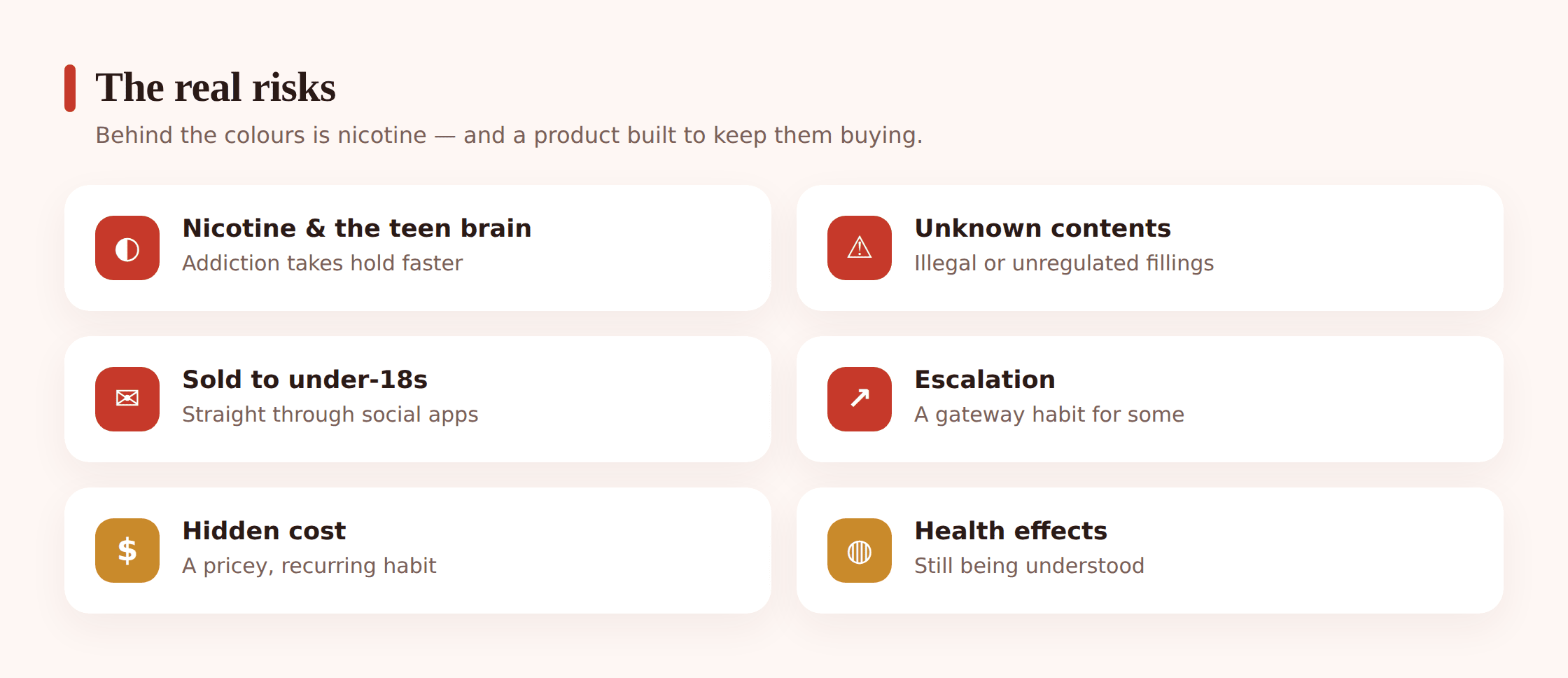
Nicotine is addictive, and the adolescent brain forms those habits faster and holds them harder than an adult one. Public-health bodies warn that nicotine can affect attention, mood, and impulse control while the brain is still developing, and that dependence can set in quickly — sometimes before a teen even thinks of themselves as a regular user. Many young people genuinely do not realise how much nicotine a single disposable can contain; some hold the equivalent of dozens of cigarettes’ worth. The addiction is not a moral failing. It is chemistry doing exactly what the product was designed to make it do.
Unknown and illegal contents
A vape bought from a proper, age-checked retailer is a regulated product. One bought through a DM or an unregulated seller is not. Regulators have found illegal vapes on sale that exceed legal nicotine limits or contain substances that were never declared, and there have been serious health scares tied to contaminated or black-market products. When a teen cannot say for certain what is in the device in their hand, that uncertainty is itself the danger.
Being sold to as a minor
There is a risk that has nothing to do with the chemistry: your child being treated as a target by adults running a business. Being sold an age-restricted product through a social platform means an unregulated stranger has your teen’s attention and, sometimes, their contact details and their money. That relationship can expose a young person to more than nicotine. It is worth folding into the broader conversation about talking to kids about online safety, because the safeguard is the same: knowing that a friendly seller in the DMs is not a friend.
How to talk about it without a lecture
Here is the part that matters most. A teenager who feels lectured stops listening; a teenager who feels respected keeps the conversation going. The aim is to talk with your child about the marketing, not at them about the habit. Curiosity beats a warning almost every time.
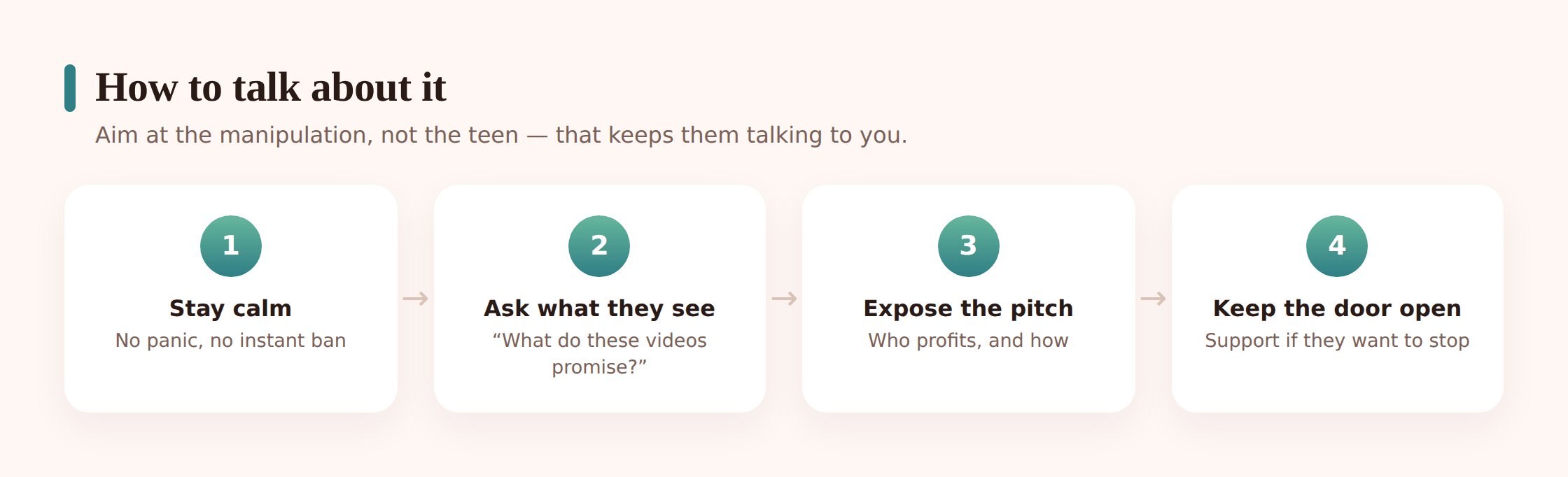
A strong way in is to talk about the marketing rather than their behaviour. Most teens do not enjoy being manipulated, and framing it as “look at what these companies are doing to people your age” puts you on the same side of the table. Try openers like these:
“Have you noticed how many vapes are named after sweets and come in those bright colours? Who do you reckon that’s aimed at?”
“I keep seeing creators casually holding a vape in their videos. Do you think they’re getting paid to do that, or is it just a thing now?”
From there, a few ideas worth landing gently rather than all at once. That the sweetness and colour are a deliberate design choice, not a coincidence. That “aesthetic” content is still an advert, just one dressed up as a lifestyle. That the addiction is the product working as intended, so quitting later is genuinely hard by design — which is a reason to be wary of starting, not a judgement on anyone who has. And that a seller in a DM is running a business, not doing a favour.
Keep it a two-way exchange. Ask what they have actually seen, whether friends vape, what they make of it. You will learn more from listening than from any statistic, and your teen will be far more open next time if this time did not turn into a telling-off. If it helps, name your own footing honestly: you are not trying to catch anyone out, you just want them to see the game that is being played on them.
What to do if you find your teen is vaping
If it turns out your child is already vaping, the first job is to manage your own reaction. Anger and punishment tend to drive the behaviour underground, not end it. Calm and support give you a real chance to help.
- Stay calm and lead with concern. Open with “I care about you and I want to understand”, not “how could you”. Your teen is bracing for a fight; not getting one is disarming in the best way.
- Get curious about the why. Stress, fitting in, boredom, curiosity, a friend who offered — the reason shapes the help. Ask, and listen without jumping in.
- Take nicotine addiction seriously. If they have been vaping regularly, they may be genuinely dependent, and “just stop” is not realistic advice. Treat quitting as something you will support, not demand.
- Point to real quitting help. Free, teen-focused services exist and work better than willpower alone. Offer to look at them together rather than handing over a leaflet.
- Loop in a professional if you need to. A GP or doctor can advise, rule out other concerns, and take some of the weight off you.
- Keep the relationship intact. Whatever the specifics, make sure your teen leaves the conversation knowing they can still come to you. That is what makes the next conversation possible.
Quitting nicotine is hard, and a relapse is not a failure of character — it is a normal part of stopping something addictive. Your steadiness across several attempts will matter more than any single perfect talk.
Where a family tool fits
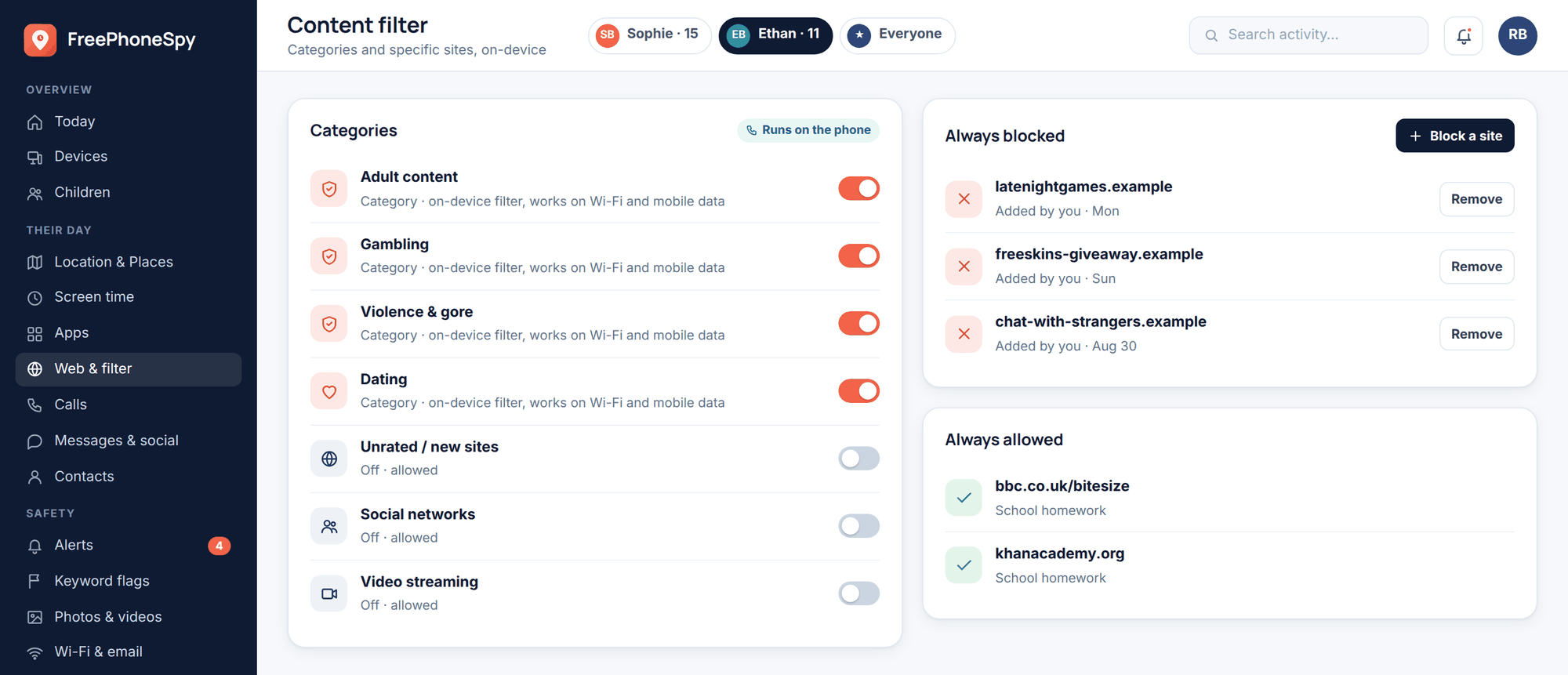
If your family already uses a monitoring app, be honest with yourself about what it is for here. It will not read your teen’s mind or their private messages, and it should not be used to stalk them. What an open, consent-based tool like FreePhoneSpy can genuinely help with is the ordinary awareness that starts a conversation sooner: content filtering to screen out some of the sites and unregulated sellers pushing these products, and a simple view of what has been newly installed, so a sudden new marketplace or seller app is something you can ask about rather than miss.
FreePhoneSpy is meant to be set up together, in the open, on your child’s Android phone — not slipped on quietly. You view things from any browser with nothing to install on your side, and it is free to start. Think of it as one layer of support among several, agreed with your teen, not a way to catch them out. The real protection is still the relationship: the talking, the trust, the knowing they can come to you. The tool just helps you notice when it is time to check in.
Support, not surveillance. A family tool earns its place by getting you into the conversation earlier. It is no substitute for being the parent your teen wants to tell when something is going on.
Common questions
Why are vapes made to look and taste like sweets?
Because sweetness and bright colour make the product feel harmless and appealing, particularly to young people. Regulators in several countries have found that these flavours and designs appeal disproportionately to teens, and some have restricted disposables or certain flavours for that reason. The look is a marketing choice, not a coincidence — which is a useful thing to point out to your teen, because most of them dislike being manipulated.
Are the influencers I see holding vapes actually being paid?
Sometimes yes, sometimes it is casual “aesthetic” placement, and often you cannot tell — which is part of the problem. Some promotion runs through affiliate codes that pay the creator per sale, and the paid nature is not always disclosed. The safest assumption to share with your teen is that any product appearing repeatedly in content they follow may well be there for commercial reasons, whether or not money openly changed hands.
How are teens buying vapes if they are age-restricted?
Legitimate retailers do check age. But some of the trade has moved into private messages, group chats, and unregulated online sellers where checks are weak or absent, sometimes using a social platform as a shop window and moving the sale into DMs. Products bought this way are an unknown quantity, and regulators have found illegal vapes that exceed nicotine limits or contain undeclared substances. It is worth telling your teen plainly that a friendly seller in the messages is a stranger running a business.
My teen is vaping. What is the single most important thing to do?
Stay calm and keep the relationship open. Anger and punishment tend to push it out of sight rather than end it. Lead with concern, get curious about why, treat any dependence as real and worth supporting rather than something to command away, and point to proper quitting help. A GP or doctor can advise, and your steadiness across more than one attempt will matter more than any one conversation.
Where can we get help to quit?
In the US, teen.smokefree.gov has free resources, and the Truth Initiative runs a free “This Is Quitting” text-message program built for young people. In the UK, the NHS Better Health / Quit Smoking service offers support, and Talk to FRANK (talktofrank.com) has clear information on nicotine and other substances. A GP or doctor is a good first port of call in either country. Offering to look at these together, rather than handing them over, tends to land better.
The companies selling nicotine to young people have put real effort into making it look like fun, like a lifestyle, like a friend’s tip rather than a sale. The best thing you can give your teen is not a rulebook but the ability to see that machinery for what it is — and the confidence that when they have a question, or a problem, you are the calm person they can bring it to. Learn the signs, name the marketing out loud, and keep the door open. If your teen is already vaping, start with the free support at teen.smokefree.gov, the NHS Quit Smoking service, or Talk to FRANK, and speak to a GP — and lead with concern, not a lecture.