Cleaning Up a Digital Footprint: Helping Teens Manage Their Online Reputation
Somewhere out there is a version of your teen from three years ago — a cringey caption, a tagged photo they forgot about, an old username tied to a joke that hasn’t aged well. None of it defines who they are now, but a college reader or a summer-job manager can still find it. This guide is about the fix: sitting down together, seeing what’s actually out there, and coaching your teen to shape a reputation they’d be glad to stand behind.
Why an online reputation is worth managing
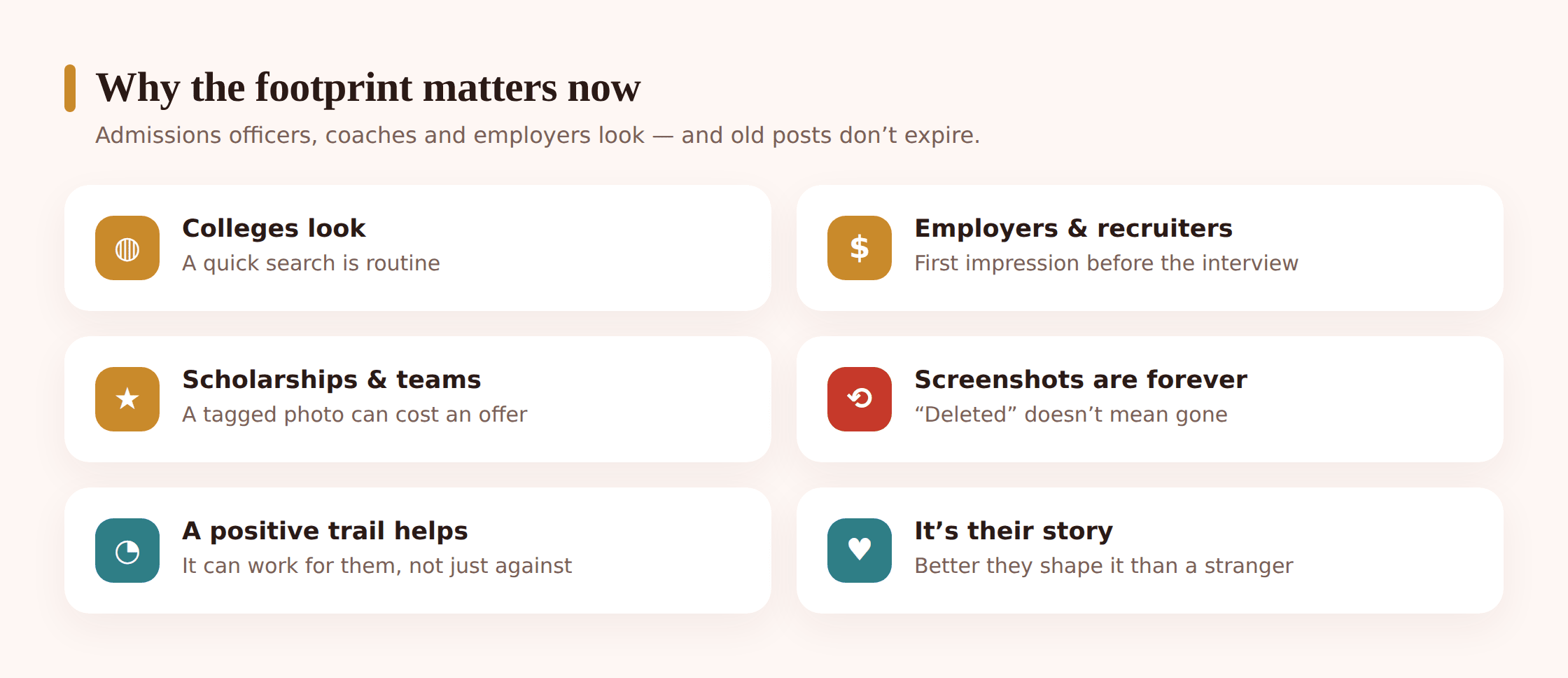
Your teen’s name is a search term. When they apply for a scholarship, a first job, an internship, or a spot on a competitive program, there’s a decent chance someone types that name into a search bar before making a decision. Many admissions officers and hiring managers say they’ve looked up a candidate online at least once, and a good number report that what they found changed their mind — sometimes for the better.
That last part matters. This isn’t only about scrubbing away the bad. A thin or messy online presence can read as carelessness; a thoughtful one can read as maturity. A teen who has a clean, coherent footprint — and who knows how to keep it that way — walks into those moments with an advantage.
If your teen hasn’t yet grasped what a footprint even is, start there first. Our companion piece on understanding what a digital footprint is covers the awareness side — what gets collected, how it lasts, why it follows you. This guide picks up after that: the hands-on work of cleaning up what exists and steering it forward.
Frame it as a career skill, not a punishment. Managing your reputation online is something professional adults do on purpose. Presenting the cleanup as a grown-up skill your teen is learning early lands far better than “let’s go delete your embarrassing posts.”
Step one: audit what’s already out there
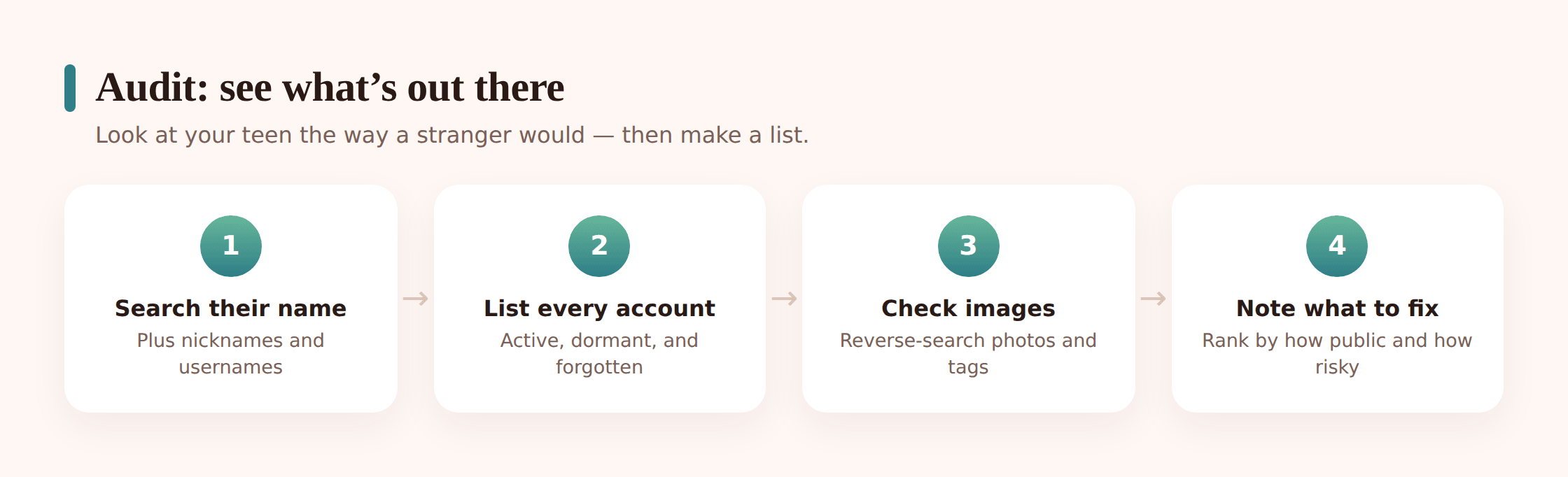
You can’t clean what you can’t see. The first session is pure reconnaissance — no deleting yet, just finding. Do it together, with your teen holding the phone or keyboard. The goal is a full picture of what a stranger could turn up.
Run the self-audit
- Search their name every way it appears. First and last, nicknames, old usernames, name plus town, name plus school. Use more than one search engine, and check the image results too — that’s where forgotten photos hide.
- Log out first. Search in a private or incognito window so you see what the public sees, not the personalized results your own logged-in account serves up.
- List every account they’ve ever made. Current apps are easy. The hard part is the graveyard — the gaming forum from year seven, the abandoned second Instagram, the YouTube channel with two videos. Password-manager entries and old email inboxes jog the memory.
- Check who else posts about them. Tagged photos, group chats that went public, a sports team’s roster page, a relative who overshares. Your teen doesn’t control these directly, but they can ask.
- Write it all down. A simple shared list — platform, username, “keep / clean / delete.” This becomes the map for the next session.
Expect some surprises, and expect some feelings. Old posts can be genuinely mortifying to revisit. Keep it light. A raised eyebrow shuts the whole project down; a “oh wow, the fedora phase” keeps them laughing and cooperating.
Step two: the cleanup workflow
Now the tidying. Work through the “clean” and “delete” columns from the audit, one account at a time. The point isn’t to erase your teen’s history — a totally blank slate looks odd too — it’s to remove the specific things that misrepresent who they are now or hand strangers information they shouldn’t have.
The cleanup passes
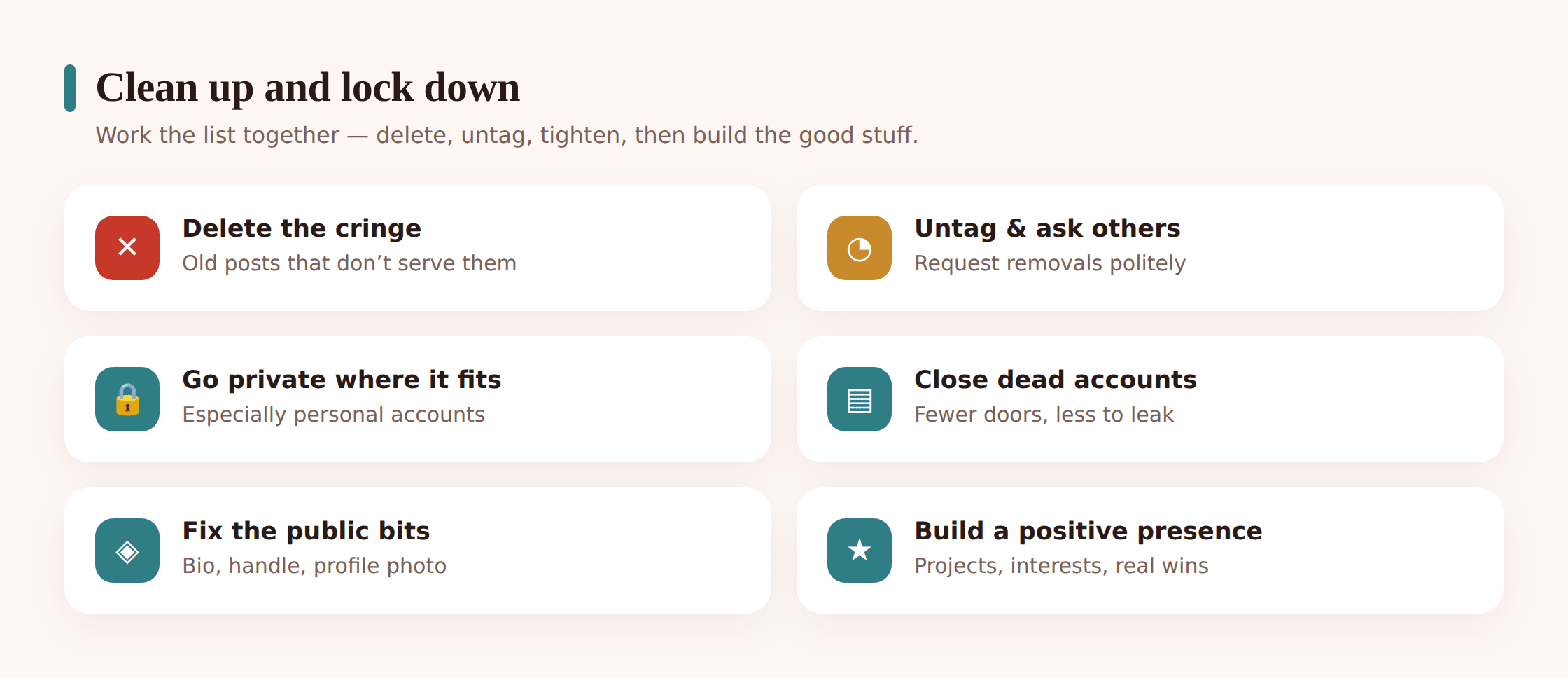
- Delete the genuinely regrettable. Cruel jokes, anything discriminatory, posts naming other people badly, references to drinking or vaping, oversharing of personal drama. If your teen would wince showing it to a favorite teacher, it goes.
- Untag rather than demand deletion. For photos on other people’s accounts, untagging removes the link to your teen’s profile. If a photo is genuinely harmful, a polite direct message asking the friend to take it down usually works.
- Archive instead of delete when unsure. Most platforms let you hide a post from public view without destroying it. Good for the “not terrible, but not their best” pile — it disappears from the profile while staying recoverable.
- Retire dead accounts. That abandoned forum profile is still searchable. Where a platform allows it, delete old accounts outright; where it doesn’t, strip the profile of real name, photo and personal details so it stops pointing back at your teen.
- Clean up the username itself. An immature or suggestive handle undercuts everything else. Changing it on the accounts that matter — or making a fresh, plain one for anything semi-public — is worth the hassle.
- Deal with what you can’t delete. Some things live on other people’s sites. If a page is genuinely damaging, most search engines and platforms have removal request forms, especially for content involving a minor. It’s slower, but it exists.
One caution: deleting in anger backfires. If your teen is mid-conflict with a friend, or upset about a specific photo, help them pause before nuking a whole account. Reputation cleanup works best as a calm, deliberate session, not a heat-of-the-moment purge they’ll regret.
Step three: tighten privacy without going dark
Cleanup handles the past. Privacy settings handle the future — they decide who gets to see the next thing your teen posts. The aim isn’t to lock everything down to invisible. It’s a deliberate split: keep the personal, day-to-day stuff for real friends, and let a curated, public-safe layer be what a stranger finds.
- Set the main accounts to private. The everyday feed — the inside jokes, the messy selfies, the friend-group chatter — belongs behind an approved-followers wall.
- Prune the follower list. A private account still leaks if it has approved hundreds of near-strangers. Trim it down to people your teen actually knows.
- Turn off location tagging. Geotags and precise location on posts hand out patterns — where they train, when they walk home. Off by default.
- Strip personal details from public bios. Full birthday, phone number, exact school, home area. A first name and a vibe is plenty for a public-facing profile.
- Review tagging and mention settings. Set accounts so your teen approves tags before they appear, closing the door on friends adding them to things unexpectedly.
There’s a real balance to strike here, and teens feel it keenly — too much lockdown can feel like their autonomy is being taken away. Our guide to balancing a teen’s privacy and independence gets into where that line sits. For the platform-by-platform specifics of feeds, DMs and group chats, social media safety goes deeper than we can here.
Step four: build a presence worth finding
Here’s the shift that separates reputation management from mere damage control. Once the old mess is cleared, the best defense is a good offense: a small amount of genuinely positive, public-safe content that shows up when someone searches. If a reader finds a thoughtful project, a volunteering post, or a portfolio, that’s the impression they walk away with.
This doesn’t mean turning your teen into a personal brand or performing for an audience. It means making sure the true, good stuff is findable.
- A public-safe profile or two. A clean, real-name account that shares interests, achievements, or creative work — the version of themselves they’d happily show a stranger.
- Evidence of real interests. Sports, art, coding, music, a cause they care about. Genuine passion reads well and needs no exaggeration.
- A portfolio, if it fits. For teens into art, writing, film or code, a simple public portfolio is far more valuable than any social feed — and it’s entirely theirs to shape.
- Consistency across accounts. The same tidy username and a recognizable photo on the public layer makes the good results the ones that rank, crowding out the old noise.
The two-minute vanity search. Teach your teen to search their own name every few months, logged out. It takes two minutes and it’s exactly what an admissions reader will do. Seeing their own results makes the whole thing concrete in a way no lecture can.
Step five: habits that keep it clean
A one-off cleanup is a snapshot. Reputations drift — new apps, new posts, a friend’s careless tag. The lasting win is a handful of habits your teen carries forward on their own, long after this project is a memory.
The habits that stick
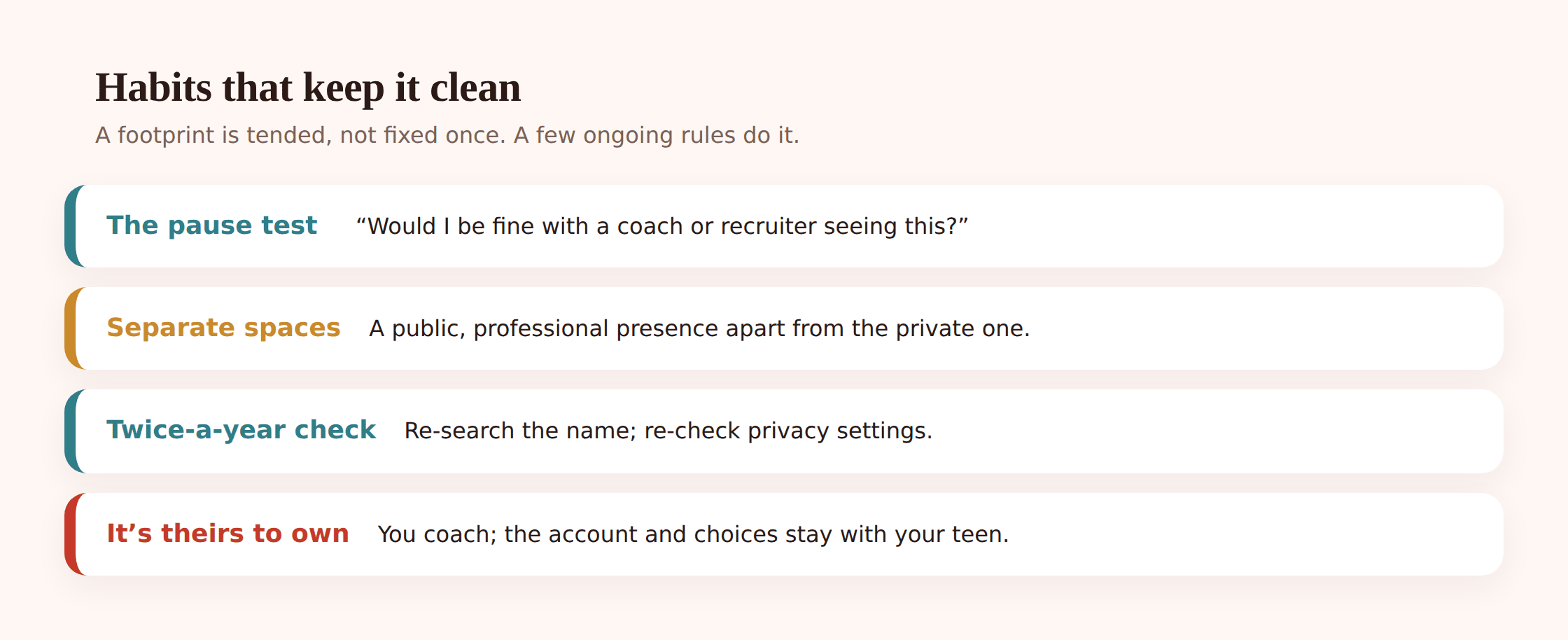
- The pause test. Before posting: “Would I be fine with this attached to my name, in public, five years from now?” A moment’s hesitation is the answer.
- The screenshot rule. Anything sent to anyone can be captured. “Private” messages aren’t a vault. If it would be a disaster public, it doesn’t get typed.
- Post about others as you’d want them to post about you. Ask before tagging, don’t share a friend’s low moment, and untag graciously when asked. Reputation is a two-way courtesy.
- A quarterly tidy. Twenty minutes every few months: a vanity search, a scan of recent posts, a check that privacy settings on new apps didn’t default back to public.
- Separate the private and the public on purpose. Know which account is the friends-only one and which is the findable one, and post accordingly.
These habits outlast any single platform. Whatever app replaces today’s favorites, a teen who pauses before posting and cleans up after themselves is protected. That’s the actual goal — not a perfectly scrubbed profile today, but a young adult who manages their own reputation instinctively.
Doing this as a family
Everything here works because it’s done with your teen, out in the open. The moment it becomes something done to them, or behind their back, you lose the cooperation the whole project depends on. Keep the tone collaborative: you’re the experienced hand, they’re the owner of the account and the final decision-maker.
For younger teens still learning the ropes, some families like a supportive tool in the mix — and if you go that route, transparency is the rule. FreePhone is one option worth knowing about: it’s an Android app you set up together, with your teen fully aware it’s there, viewable from any browser, and free, with every feature. Used the right way, it’s a shared checkpoint — a way to notice when a new app appears, and a prompt for a conversation, not a substitute for one. It doesn’t read posts or messages; it supports the coaching in this guide, it doesn’t replace the talking, and it was never meant to be covert. As teens show they’ve got the hang of managing their own footprint, that scaffolding loosens, the way any good guardrail should.
FAQ
My teen posted a lot of embarrassing stuff years ago. Is it too late to fix?
Not at all. Set accounts to private, delete or archive the genuinely regrettable posts, untag old photos, and retire dead accounts. You can’t erase every trace, but you can shrink the public footprint dramatically. Then build a small positive presence so the good results outrank the old ones over time.
Do colleges and employers really look people up online?
Many do, at least sometimes. Surveys of admissions officers and hiring managers suggest a fair number have searched candidates and that what they found occasionally affected a decision. It’s not universal, and it’s rarely the deciding factor on its own — but it happens often enough that a clean, coherent footprint is worth the modest effort.
Won’t a totally scrubbed profile look suspicious?
A little, yes. The aim isn’t invisibility. It’s a deliberate split: a private, friends-only layer for everyday life, and a curated public layer that’s honest and shows real interests. A thoughtful, findable presence reads as maturity. An eerily blank one can read as hiding something.
Something harmful is on a site we don’t control. What can we do?
First, ask the person who posted it to take it down — a calm, direct message often works. If that fails and the content is genuinely damaging, most search engines and platforms have removal request forms, with stronger protections for content involving a minor. It’s slower and not guaranteed, but the channels exist.
How do I coach this without it becoming a fight?
Frame it as a career skill adults use on purpose, keep your reactions light when you find old cringe, and let your teen make the final call on each post. Offer your read, then respect their decision. The cooperation is worth more than winning any single deletion — and it’s what makes the habits stick after the project ends.
Cleaning up a footprint is really a handshake between two things: clearing away what no longer represents your teen, and helping them build the reputation they actually want. Do it together, keep it honest, and hand them the habits to carry it forward. The version of them that a stranger finds online should be a version they’re glad to be — and by working through this side by side, that’s exactly the one you’re helping them shape.