Is Phone Monitoring Legal? A Parent’s Guide
Watching your seven-year-old’s phone, out in the open, on a device you bought and pay for? That’s generally fine in most places. Secretly reading your partner’s texts? That’s usually illegal, and always a betrayal. Almost every phone-monitoring question sits somewhere between those two, and two simple ideas decide most of them: who owns the device, and does the person know.
- First, an honest disclaimer
- The two ideas that decide most cases
- Parents and minor children
- Teens approaching adulthood
- Other adults: partners, exes, roommates
- Employees and work phones
- Recording calls and audio
- A quick scenario table
- The law varies by country and state
- How to stay on the right side of the line
- FAQ
First, an honest disclaimer
We’ll keep this plain and practical. The goal isn’t to scare you or to hand you loopholes. It’s to help a parent understand why monitoring a young child is normal and lawful, and why pointing that same software at an adult who hasn’t agreed to it is a different thing entirely.
The two ideas that decide most cases
You can skip a lot of confusion by holding onto two questions.
Ownership. Whose device is it, and whose accounts are on it? If you bought the phone, pay the bill, and set it up under a family account for your own child, you have a strong claim to manage what happens on it. If the device belongs to another adult and runs their private accounts, you don’t.
Consent and knowledge. Does the person being monitored know it’s happening? Consent is the difference between transparency and surveillance. For a young child, a parent or guardian can usually give that consent on their behalf. For an adult, only that adult can.
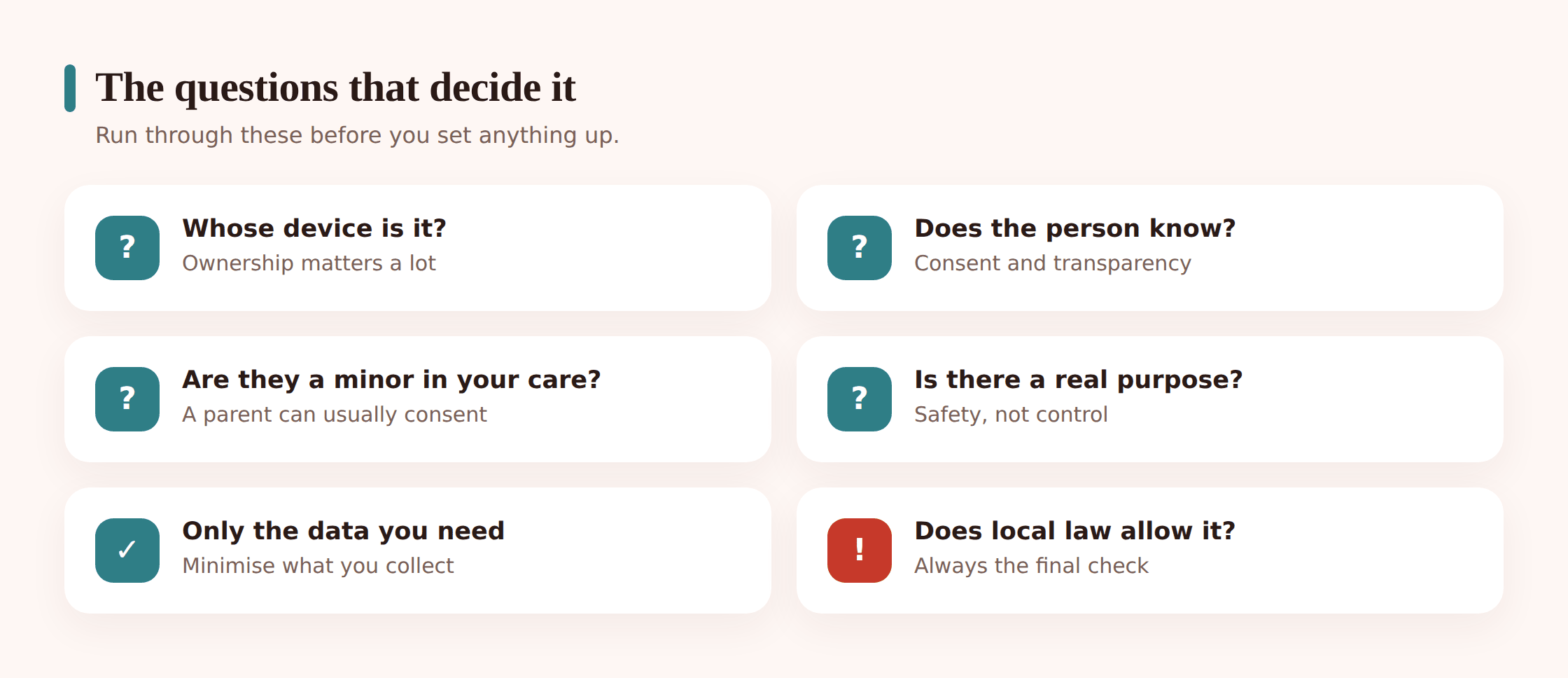
When ownership and consent both point your way — your device, your minor child, done openly — you’re in the clear in most places. When they point away — someone else’s device, an adult who doesn’t know — you’re in dangerous territory, both legally and ethically. Most real-life questions are just a matter of figuring out which way each one points.
Parents and minor children
Here’s the headline for parents: monitoring your own minor child is generally lawful, and doing it openly is both the safest and the kindest way to do it.
The reasoning is straightforward. You’re the parent or legal guardian. You’re responsible for your child’s safety and wellbeing. The phone is usually yours — you bought it, you pay for it, you set the rules. And for a young child, a parent can typically give consent on the child’s behalf, which is exactly why so many family-safety tools exist and operate legally.
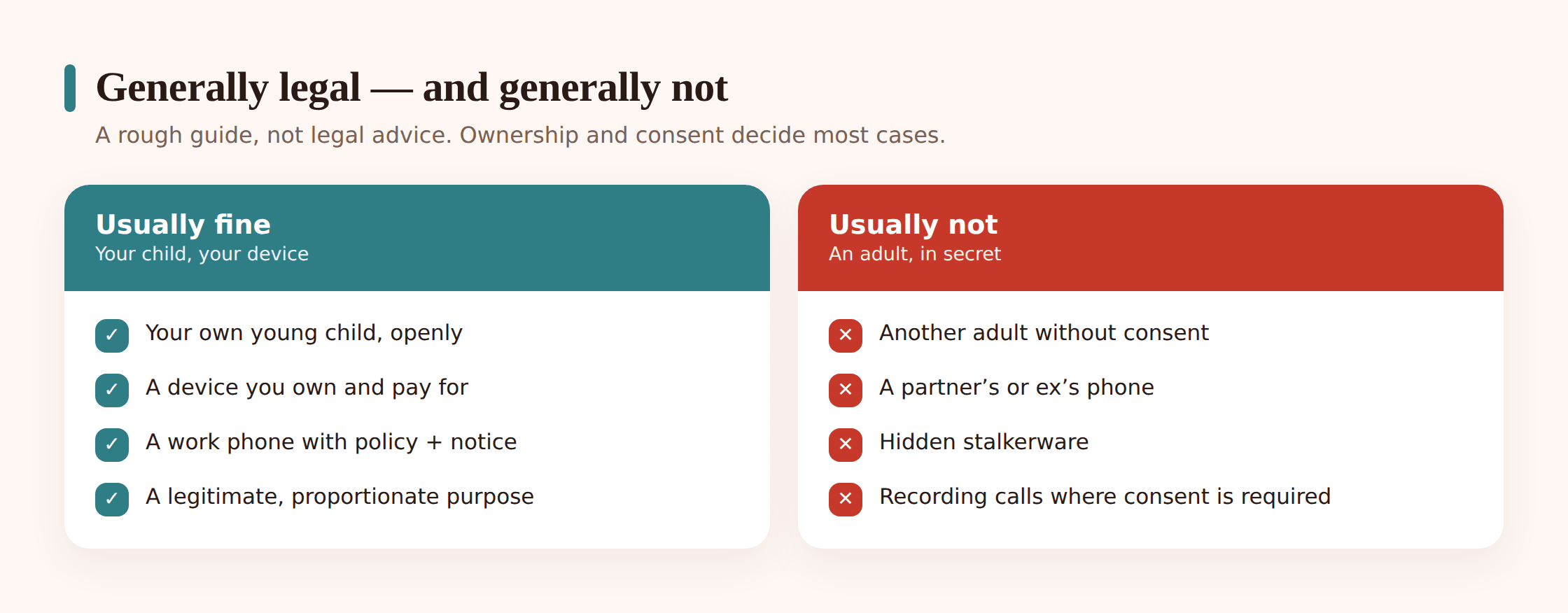
That said, “you can” isn’t the same as “anything goes.” A few principles keep you clearly on the right side:
- Be open about it. Tell your child the phone is monitored and why. Transparency is often the legally safer path, and it’s the one that keeps trust intact.
- Have a real reason. Safety, screen time, contact with strangers, online risks — legitimate purposes, not idle curiosity.
- Match the monitoring to the age. A young child needs closer oversight than a fifteen-year-old.
- Don’t over-collect. You don’t need to read every message to keep a kid safe.
If you want the full walkthrough of setting this up thoughtfully, our complete guide to child phone monitoring covers the practical side — what to monitor, how much, and how to talk to your kid about it.
One important caveat: the picture gets more nuanced as a child gets older. “Age of majority” — the age at which someone becomes a legal adult — varies by place, and it’s usually 18, but not everywhere. As your child approaches it, both the law and common sense start to shift.
Teens approaching adulthood
A teenager is not a small child. The law tends to recognise that, and so should you. As kids get older, their reasonable expectation of privacy grows, and the case for heavy, silent monitoring gets weaker — legally and as a matter of raising a functioning adult.
The bright line is the age of majority. Once your child is a legal adult, monitoring them without their consent is a completely different question, even if they still live at home and you still pay the phone bill. At that point they’re an adult, and adults get to consent for themselves.
So with older teens, lean hard into openness. Talk about what you monitor and why. Loosen the reins as they earn it. Many families move from monitoring to a shared-location agreement or simple check-ins — an arrangement everyone knows about and agrees to. That’s not just better parenting; it keeps you clearly inside the law as your teen crosses into adulthood.
Other adults: partners, exes, roommates, adult children
This is the part where the answer is simple and firm: don’t.
Secretly monitoring another adult’s phone — a spouse, a partner, an ex, a roommate, your own grown-up child — without their knowledge or consent can break several kinds of law at once. Depending on where you are, that can include:
- Wiretapping and interception laws, which cover secretly capturing someone’s calls, messages or communications.
- Stalking and harassment laws, which can cover covertly tracking someone’s location or movements.
- Computer-misuse laws, which cover accessing someone’s device or accounts without authorisation.
These are often criminal offences, not just civil ones. And the hidden “spy” apps built for this — the ones designed to be undetectable — are what security researchers call stalkerware. Installing that kind of software on an adult’s phone without consent is illegal in many places, full stop.
The ethics are just as clear as the law. Even where you might think you could get away with it, secretly surveilling a partner is a serious violation of another person’s autonomy. If you’re worried about a relationship, the answer is a conversation, or a professional — not spyware.
If you’re on the other side of this and think someone may be monitoring you without consent, we have two guides that help: how to tell if your phone is being monitored and how to stop someone tracking your location.
Employees and work phones
Employee monitoring has its own rules, and this is only the short version. The general shape: monitoring is far more defensible on company-owned devices, with a clear written policy, proper notice and consent, and a genuine business reason behind it.
Where it goes wrong is covert monitoring, or reaching onto an employee’s personal phone. Watching a device an employee owns, or tracking staff secretly, is legally risky and often unlawful. The safe version is transparent: company hardware, a policy people have actually read and agreed to, and monitoring limited to what the business legitimately needs.
If you’re an employer weighing this up, read our dedicated employee phone monitoring guide before you do anything.
Recording calls and audio
Call and audio recording deserves its own warning, because the rules are genuinely inconsistent from place to place.
The core split is between “one-party consent” and “two-party” (or “all-party”) consent. In a one-party-consent place, it can be legal to record a conversation you’re part of. In an all-party place, everyone in the conversation generally has to agree. Cross a state or national border and the answer can flip. Recording a call that touches two different jurisdictions gets complicated fast.
A quick scenario table
A rough guide, not a ruling. The last column is where the real caveats live.
| Who you’re monitoring | Whose device | Generally legal? | Key caveat |
|---|---|---|---|
| Your young minor child | Yours / the family’s | Generally yes | Best done openly; you consent on their behalf |
| Your older teen | Yours / the family’s | Usually, but nuanced | Privacy expectations rise; changes at the age of majority |
| Your partner or ex | Theirs | Generally no | Covert monitoring can be criminal; never do it |
| An employee’s work phone | The company’s | Sometimes | Needs a written policy, notice/consent, legitimate reason |
| A stranger or acquaintance | Theirs | No | No ownership, no consent — this is stalking |
If you want a fuller treatment of where the ethical line sits — not just the legal one — our piece on monitoring vs spying digs into it.
The law varies by country and state
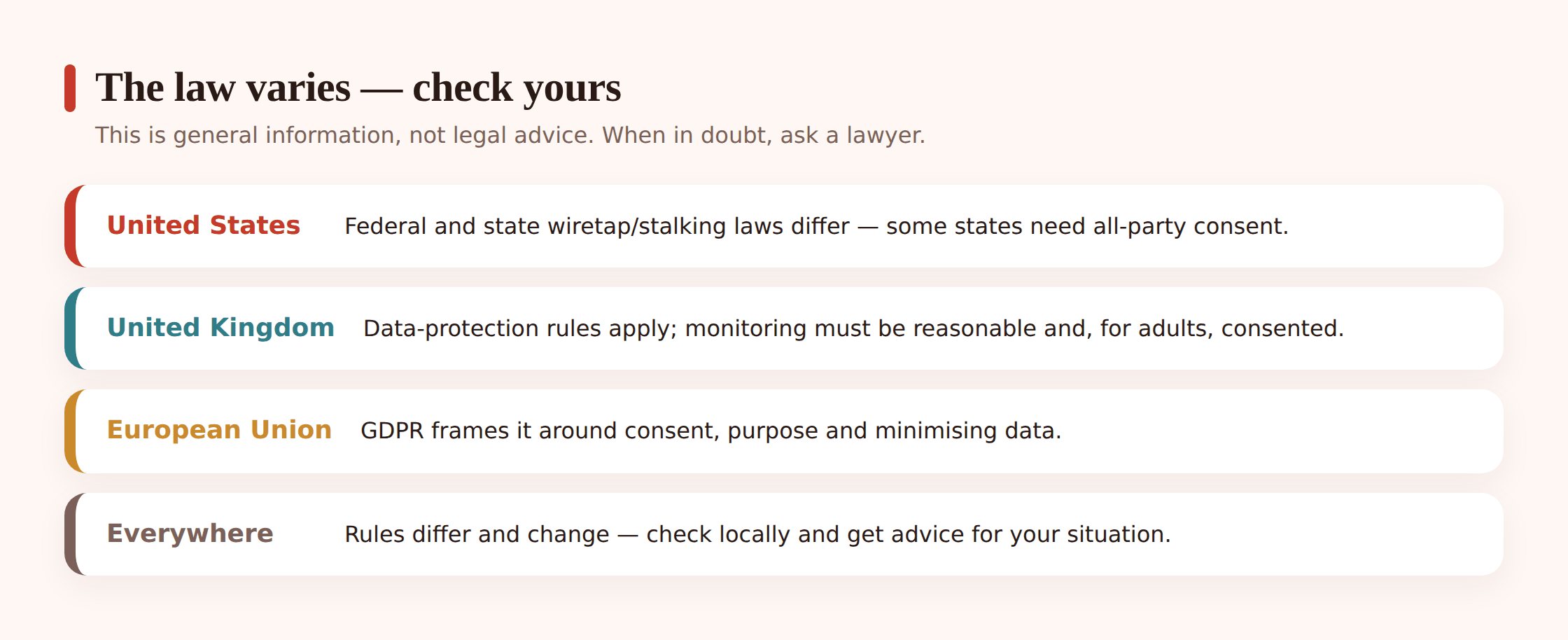
There is no one worldwide answer to “is phone monitoring legal,” and anyone who gives you one is oversimplifying.
In the United States, this is largely a state-by-state matter, layered on top of federal law, and states genuinely differ — especially on recording. In the UK and across the EU, data-protection rules like the GDPR shape how personal information can be collected and used, which affects monitoring too. Other countries have their own frameworks again. The safest habit is to treat your own local law as the one that matters and to check it before acting.
How to stay on the right side of the line
You can boil most of this down to a short checklist. Follow it and you’ll rarely be anywhere near trouble.
- Monitor only your own children, or devices you actually own. That’s the foundation everything else rests on.
- Be transparent. Let the person know. For kids, tell them plainly. Covert surveillance of any adult is off the table.
- Get consent where it’s required — from an older teen, an employee, anyone who’s a legal adult.
- Have a legitimate purpose. Safety and wellbeing, not suspicion or control.
- Collect the minimum. Less data, kept for less time, is safer for everyone.
- Follow your local law, and get advice when you’re not sure.
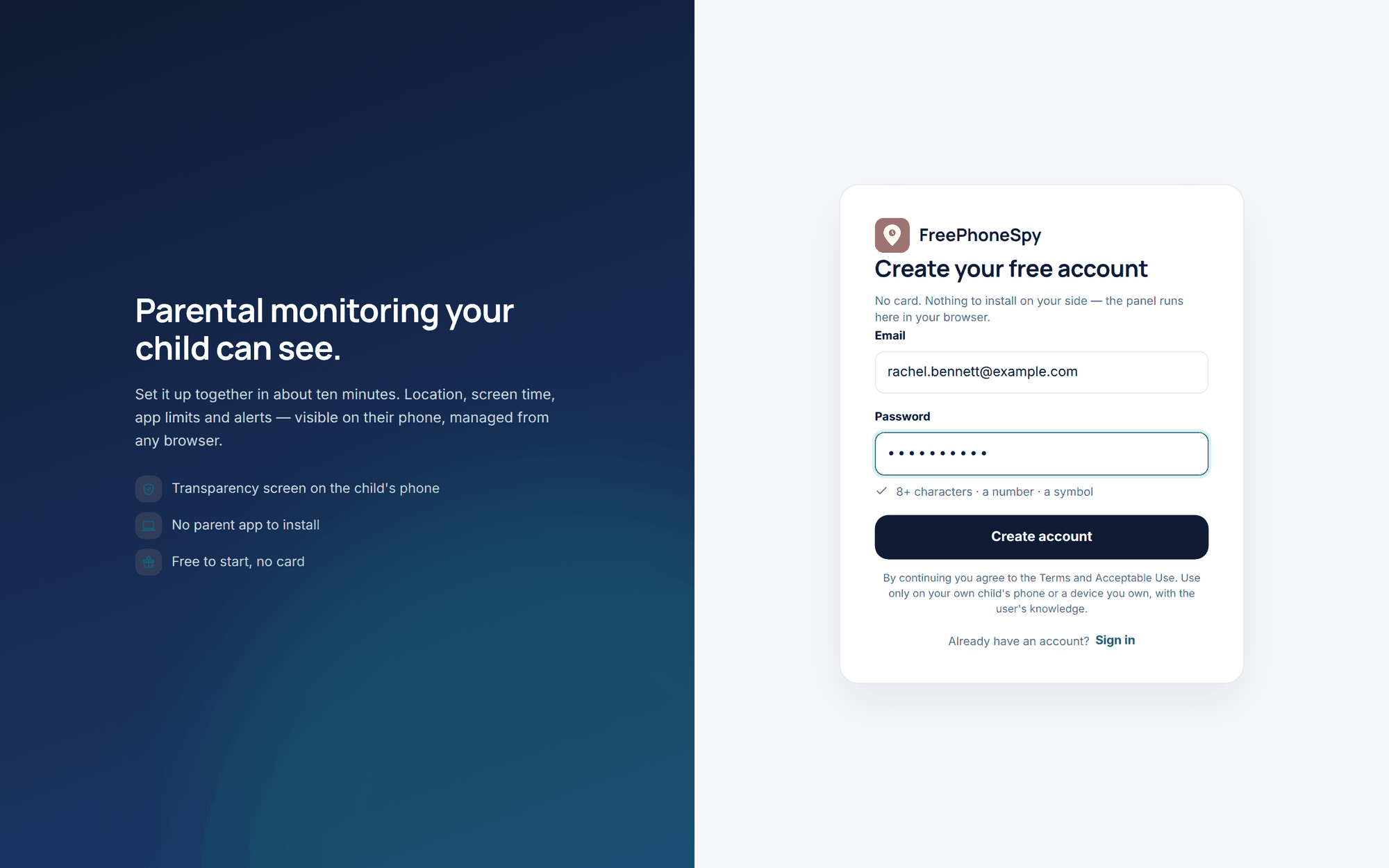
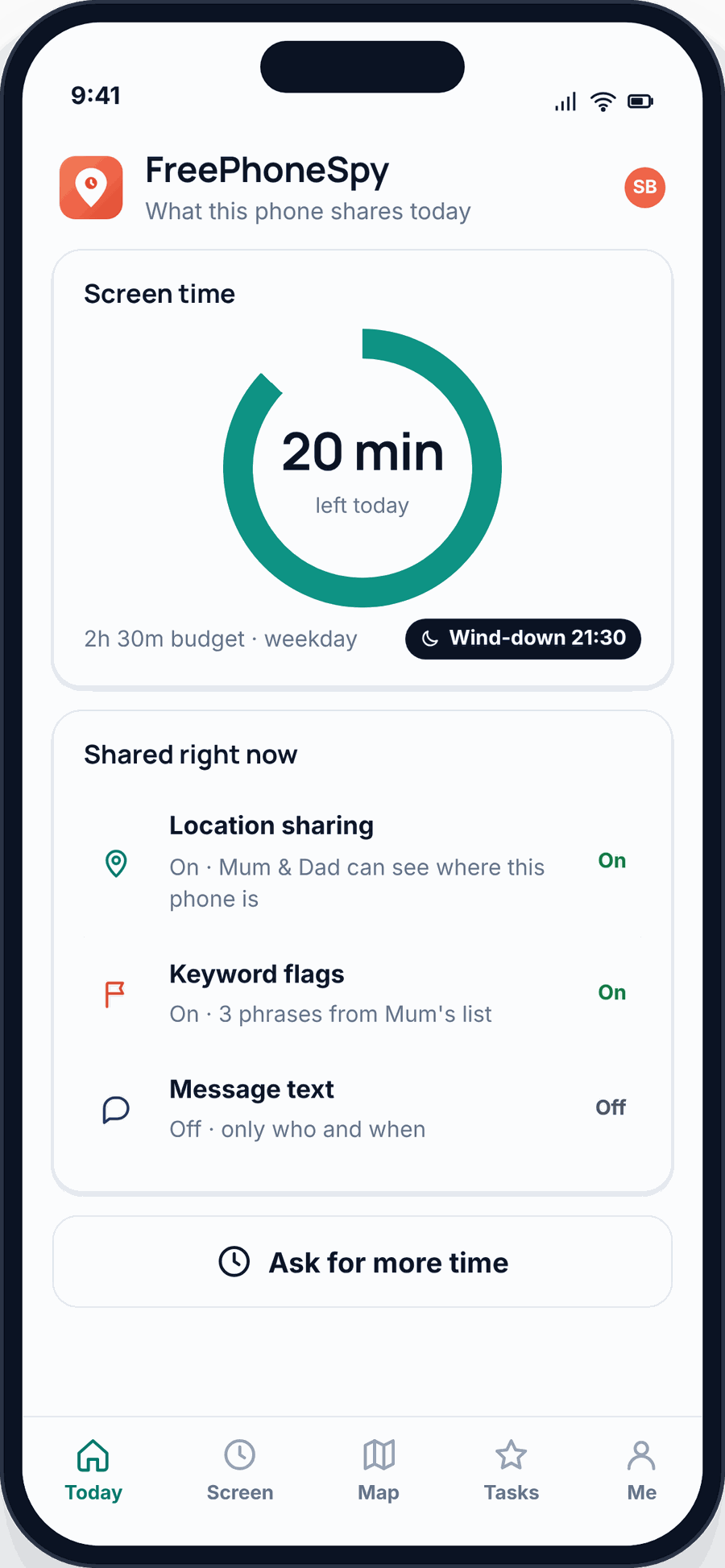
This is exactly the model FreePhoneSpy is built around. It’s consent-first, transparent parental monitoring for your child’s Android phone, run from a web panel — and the child can see it’s installed. It’s meant for your own children, on devices you own. That’s the legal, ethical way to do this, and it’s the only way we build.
FAQ
Is it legal to monitor my child’s phone without telling them?
In most places you can legally monitor your own minor child, and for a young child you can consent on their behalf. But telling them is usually the safer and better choice — both for the relationship and, often, legally. As kids get older, openness matters more.
Can I monitor my spouse’s phone if I pay the bill?
Paying the bill doesn’t make the phone yours or give you the right to read an adult’s private communications. Secretly monitoring a partner can break wiretap, stalking and computer-misuse laws. Don’t do it.
What about my 17-year-old — are they still a minor?
Usually yes, but the age of majority varies by place and is commonly 18. As a teen nears that age, both privacy expectations and the law shift. Once they’re a legal adult, monitoring without their consent is a different matter entirely.
Is spy or stalkerware software illegal?
Software designed to secretly monitor an adult without their consent — stalkerware — is illegal in many places and unethical everywhere. FreePhoneSpy isn’t built that way; it’s transparent parental monitoring the child can see.
Can employers monitor employees’ phones?
Sometimes, on company-owned devices, with a clear written policy, proper notice or consent, and a legitimate business reason. Covert monitoring and reaching onto personal devices are legally risky. See our employee monitoring guide for the detail.
Is it legal to record phone calls?
It depends entirely on where you are. Some places allow one-party-consent recording; others require everyone to agree. The rules can change across a border. Check your local law before recording anything.