How to Monitor Your Child’s Text Messages the Right Way
Your child’s phone buzzes at the dinner table, a name you don’t recognise flashes up, and something in your chest tightens. You want to know they’re okay. You also don’t want to become the parent who reads every private word and quietly kills the trust between you. Those two wishes pull in opposite directions, and most advice about “monitoring your child’s text messages” pretends only the first one exists. This guide holds both. It’s about keeping your child safe around messaging while treating them like a person who deserves some privacy — and it starts from one firm rule: never in secret.
Why parents worry about texts
The worry is rarely about the texts themselves. It’s about what can reach a child through them. A phone is a door that swings both ways: it lets your kid stay close to their friends, and it lets the wider world walk straight up to them, in their bedroom, at midnight, with no adult in the hallway.
A handful of real risks sit behind most parents’ unease, and it helps to name them plainly rather than let them swirl as one big fog of dread.
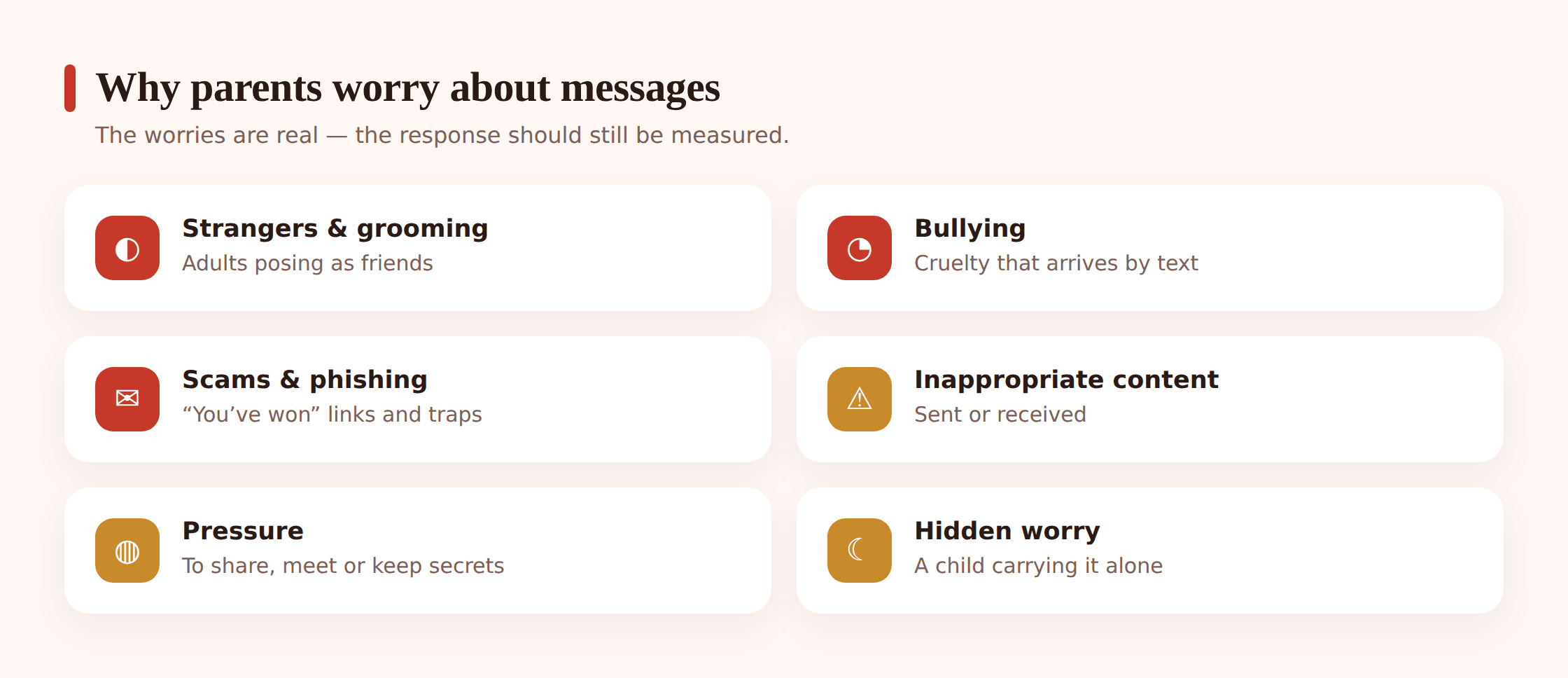
- Strangers making contact. An unknown number that starts friendly and warms up fast. A “wrong number” that keeps texting. The stranger who somehow knows your child’s name.
- Bullying. Cruelty travels well over text — the group chat that turns on someone, the message sent to hurt, the pile-on that follows a kid home from school and never lets up.
- Scams. Fake delivery texts, prize links, “your account is locked” messages. Kids click, kids trust, and kids hand over details a savvier adult wouldn’t.
- Grooming. The slow, deliberate build of a relationship an adult has no business having — flattery, secrecy, gifts, “don’t tell your mum,” an escalating ask.
- Inappropriate content. Images and links a child stumbles into, gets sent, or is pressured to share back.
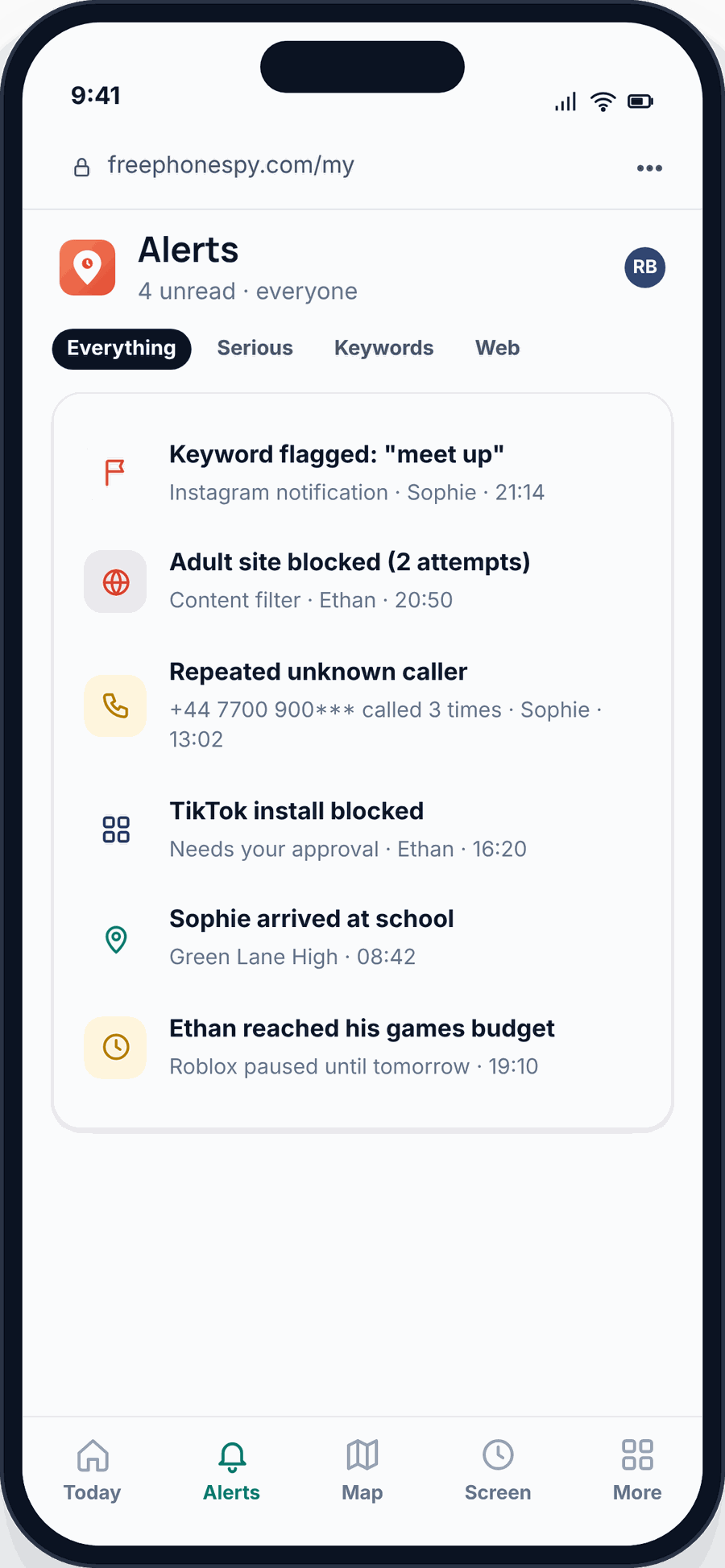
Here’s the part worth holding onto: almost every one of those dangers announces itself in the shape of the messaging long before the content matters. A brand-new contact texting fifty times a day. Messages clustering at two in the morning. A number with no name attached that keeps coming back. You can spot the pattern of a problem without reading a single private sentence — and that distinction is the whole ethical heart of this.
The ethics: where the line actually sits
Reading a child’s private messages is intrusive. There’s no gentle way around that, and pretending otherwise is where a lot of parents go wrong. A text conversation with a friend is, to a teenager, roughly what a diary or a phone call in your own bedroom was to you. It’s where they work out who they are, complain about you, flirt badly, and say things they’d die of embarrassment to have read aloud. Most of it is completely harmless and none of your business.
So draw the line clearly. On one side sits a safety-oriented overview: knowing roughly who your child talks to, getting a heads-up when a genuinely worrying thing appears — a stranger making contact, a grooming phrase, bullying language, a scam. On the other side sits reading every private message: sitting inside their conversations, scrolling their jokes and crushes and secrets because you can.
The first protects your child. The second surveils them. And the difference is not subtle to the person being watched. A kid who knows a worrying phrase might get flagged still feels free to be a normal, silly teenager in their chats. A kid who knows every word is being read learns two things fast: to move the real conversations somewhere you can’t see, and that you didn’t trust them. You end up less safe, not more, and you’ve spent the relationship to get there.
The honest position, then, favours the lightest touch that does the job. Agree it together. Watch for the genuinely dangerous, not the merely private. And dial it back as your child earns more room. If you want this drawn out more fully, we’ve written about exactly where monitoring ends and spying begins — it’s the single most useful frame for every decision on this page.
The age-based sliding scale
“How much oversight is right?” has no single answer, because a seven-year-old and a sixteen-year-old are barely the same species once you hand them a phone. The honest rule is a sliding scale: more oversight for younger children, far more message privacy as they grow. Your job is to keep sliding in the direction of trust, not to hold the line at maximum control because it feels safer.
Young child (roughly 7–10)
A first phone or a hand-me-down for staying in touch. Close oversight is appropriate and expected here. You might know their small circle of contacts, see who’s messaging, and keep message content more visible — with the child fully aware. At this age it’s genuinely training wheels, and most kids don’t experience it as a betrayal because you’re openly teaching them how a phone works.
Tween (roughly 11–13)
The friendship group widens, group chats appear, and privacy starts to matter to them in a new way. This is the age to shift from “seeing things” to “being alerted to worrying things.” Lean on the shape of the messaging and a few keyword flags rather than reading conversations. Keep checking in out loud.
Teenager (roughly 14+)
A teenager deserves real message privacy. By now the default should be that you don’t read their conversations at all. What stays reasonable is a light safety net — an alert if a genuine danger phrase appears, a shared understanding that they’ll come to you if something’s wrong. Reading a competent teenager’s texts wholesale is a trust-wrecker with very little safety upside.
Wherever your child sits, the direction of travel is the same: as trust grows, you let go. Tell them that out loud. “Right now we do it this way, and as I see you handling things well, we’ll ease off” is a promise kids respond to, because it makes good behaviour worth something.
The honest, consent-based ways to do it
So what does keeping a child safe around texting actually look like when you refuse to snoop? It looks like a handful of open, unglamorous habits that work far better than secret surveillance ever could.
Agree it openly, first
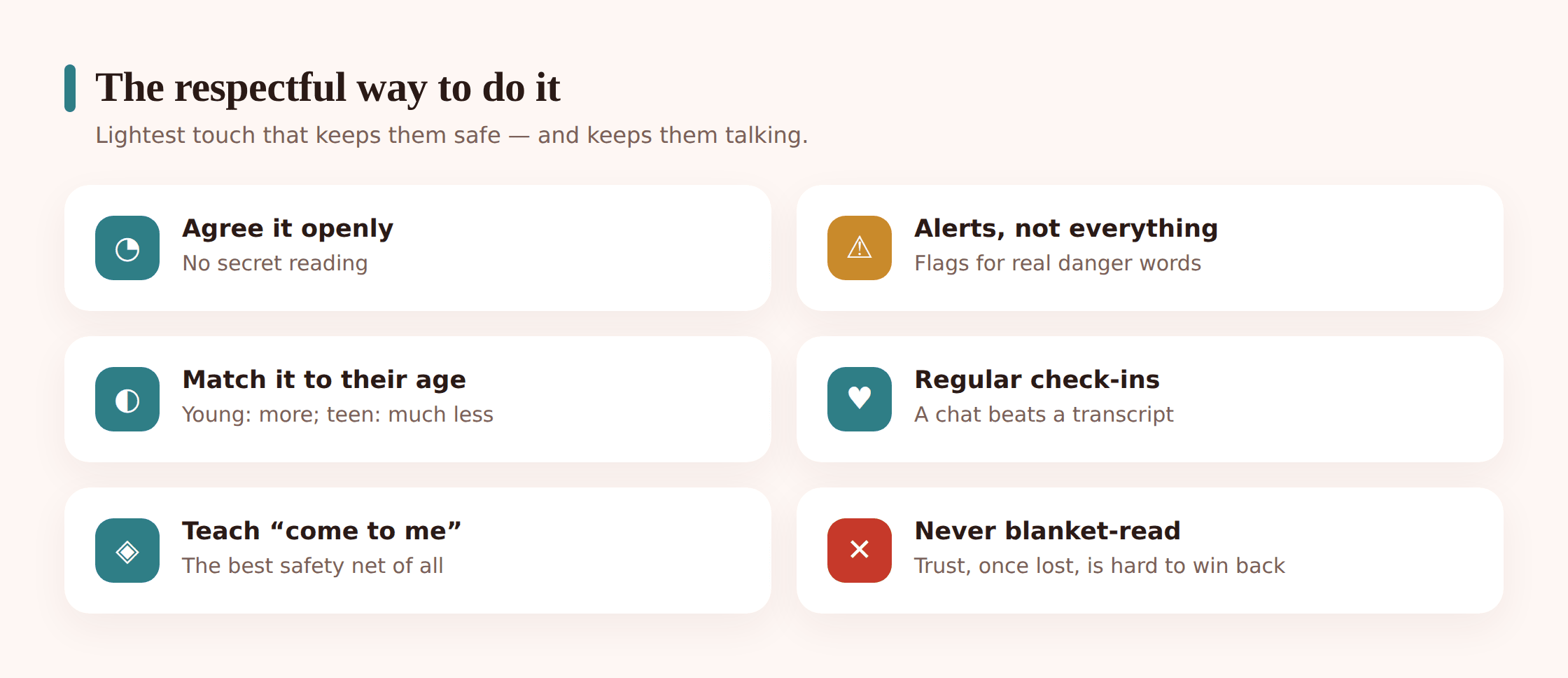
Before any tool, there’s a conversation. Sit down with your child and be honest about what you’re doing and why. Not “I’m going to monitor you,” but “I want to help you stay safe on this thing, here’s what I’ll be able to see, here’s what I won’t, and here’s how that changes as you get older.” When your child helps set the rules, they own them. When they’re sprung on them, they resent them and route around them.
Use alerts and keyword flags, not blanket reading
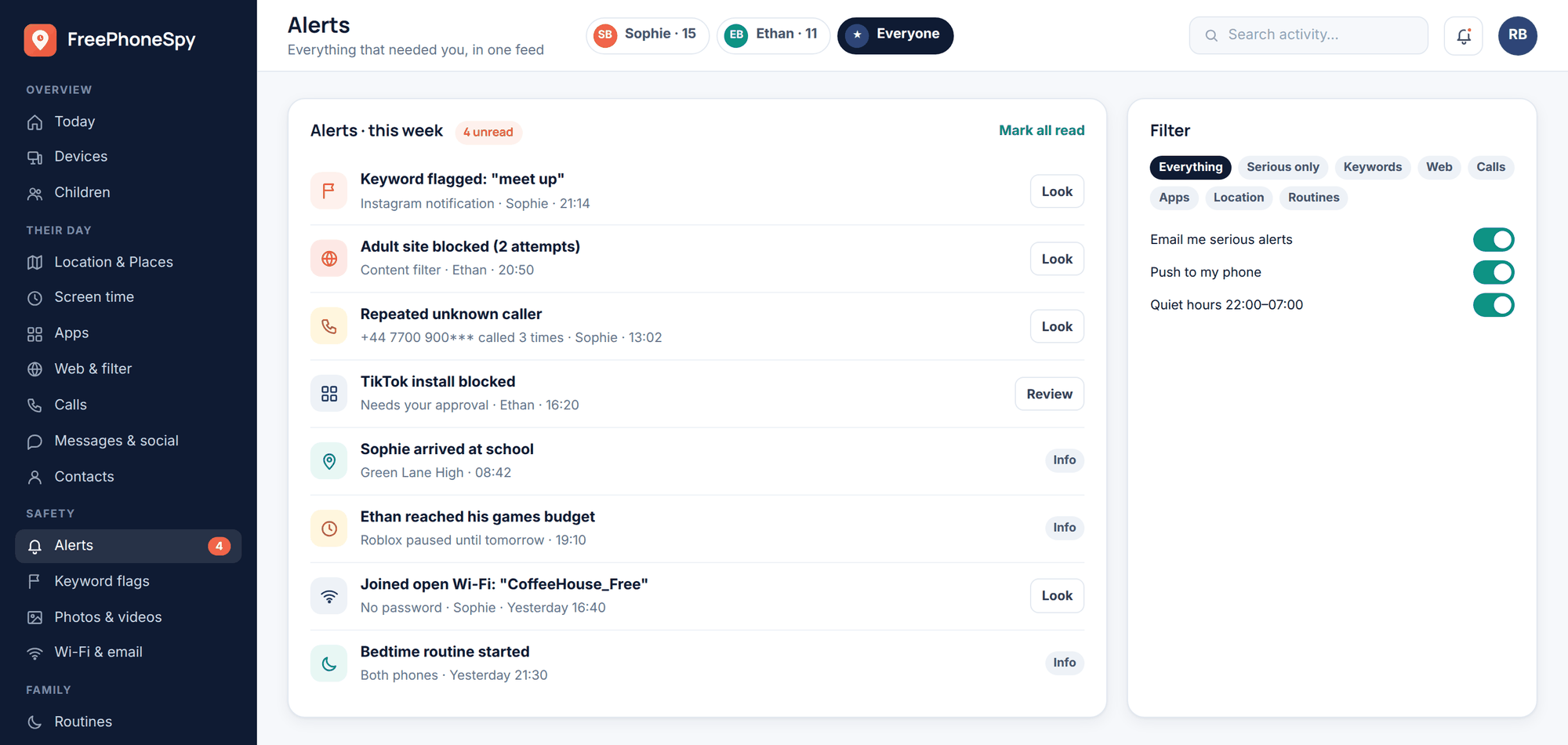
This is the single most important practical shift. Instead of reading everything, you watch for the few things that genuinely signal danger. A short list of words and phrases — the language of grooming (“don’t tell anyone,” “meet me alone”), the language of bullying, a name you’re worried about — gets flagged when it appears, and the rest of your child’s messaging stays private. You catch the heavy stuff without wading through the harmless stuff. It’s a lighter touch that’s actually more protective, because you’re looking for signal instead of drowning in noise.
- Know roughly who they talk to and how often — the pattern, not the content.
- Flag genuine danger words rather than reading whole conversations.
- Notice new contacts and odd-hour spikes; those are your real cues.
- Let the private, harmless majority stay private.
Keep the check-ins regular and open
The best monitoring tool in the world is a five-minute chat. Ask about their online life the way you’d ask about their day — casually, often, without an agenda. “Anyone weird message you lately?” “How’s the group chat, still dramatic?” Kids who are used to talking about this stuff tell you things a flag would never catch, because a lot of what matters — how a conversation felt, why they’re upset — leaves no keyword behind.
Teach them to come to you
This is the endgame, and it’s worth being explicit about. The goal isn’t a phone you can see into forever. It’s a child who, when a stranger says something odd or a friend turns cruel, brings the phone to you and says “look at this.” That only happens if they’re confident you won’t overreact, punish them, or take the phone away as a first move. Every calm response you give buys you the next disclosure. That’s the actual safety system. Everything else is scaffolding around it.
What to avoid
Just as useful as knowing what to do is knowing what quietly does damage, even when it comes from a loving place.
- Secret spyware. Anything installed to be hidden, anything sold on being undetectable. If your child can’t know it’s there, it’s the wrong tool, full stop. When they find out — and they usually do — the breach of trust outlasts whatever you were worried about in the first place.
- Reading everything. Even with a child’s knowledge, sitting inside all their conversations is more than almost any family needs and more than is healthy. It teaches kids to move the real talk somewhere you can’t follow.
- Using texts to snoop or control. Monitoring is for safety, not for catching them swearing, checking who they fancy, or managing your own anxiety by reading along. The moment it becomes about control rather than danger, it’s stopped protecting them and started policing them.
- Weaponising what you find. Bringing up a private message in an argument, or letting a joke slip that you clearly read, tells your child nothing they say is safe. That’s the fastest way to lose the whole thing.
A simple test before you look at anything: “Am I checking because there’s a real safety reason, or because I’m curious or anxious?” If it’s the second, close the panel and go talk to your kid instead.
If you do find something worrying
Say a flag fires, or your child shows you something, or you spot a pattern that genuinely alarms you. How you handle that first moment matters more than what you found.
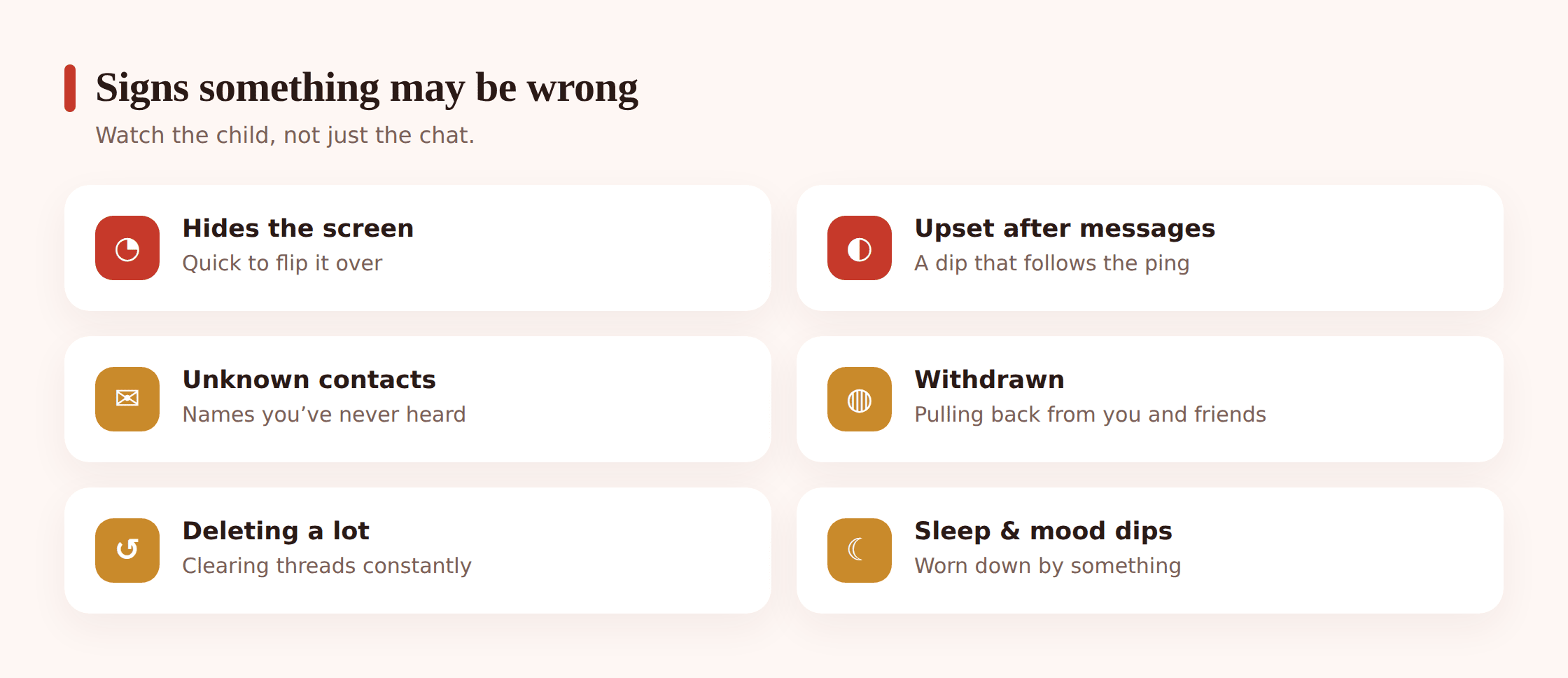
Stay calm first. The adrenaline urge is to march down the hall and confront. Resist it. Almost nothing you found gets worse in the next hour, and almost everything gets worse if you act while your heart is pounding. Put the phone down, breathe, and let the shaking pass before you say a word.
Talk, don’t interrogate. Lead with concern, not accusation. “I saw something that worried me and I want to understand it” opens a door; “What is THIS?” slams one. Give your child room to explain — kids are often more tangled up in something than in charge of it, and the full story rarely matches your worst first reading.
Don’t punish the honesty. This is the one that decides whether they ever come to you again. If your child was brave enough to tell you, or answers you truthfully, the worst thing you can do is respond with confiscation and grounding. Punish the honesty and you teach concealment. Reward it — with calm, with help, with “thank you for telling me” — and you keep the line open for the next thing, which there always is.
If what you’ve found is bullying, our guide to spotting and stopping cyberbullying walks through the specifics on both sides. If a stranger is involved, if there’s any sexual content involving your child, or if it feels like more than you can handle alone, preserve what you’ve seen and bring in help — the school, your GP, or the police, depending on how serious it is. Trust your gut: if it feels criminal, treat it that way.
Messaging beyond plain SMS
One honest caveat, because plain text messages are only part of the picture now. Most of the real conversation has moved into apps — WhatsApp, Snapchat, Instagram DMs, Discord, and half a dozen others your child uses more than SMS. Some of those apps are built to make messages vanish, which means no tool can reliably show you what was said, and you shouldn’t trust anything that claims otherwise.
What that means in practice: the SMS log is a smaller window than it used to be, and the open habits matter more than ever precisely because the technical view is partial. The check-ins, the trust, the “come to me if something’s wrong” — those reach into the apps a flag can’t. It’s also worth knowing that deleted texts sometimes aren’t entirely gone; if you ever genuinely need to, here’s the honest picture on recovering deleted text messages, limits and all.
Where FreePhoneSpy fits
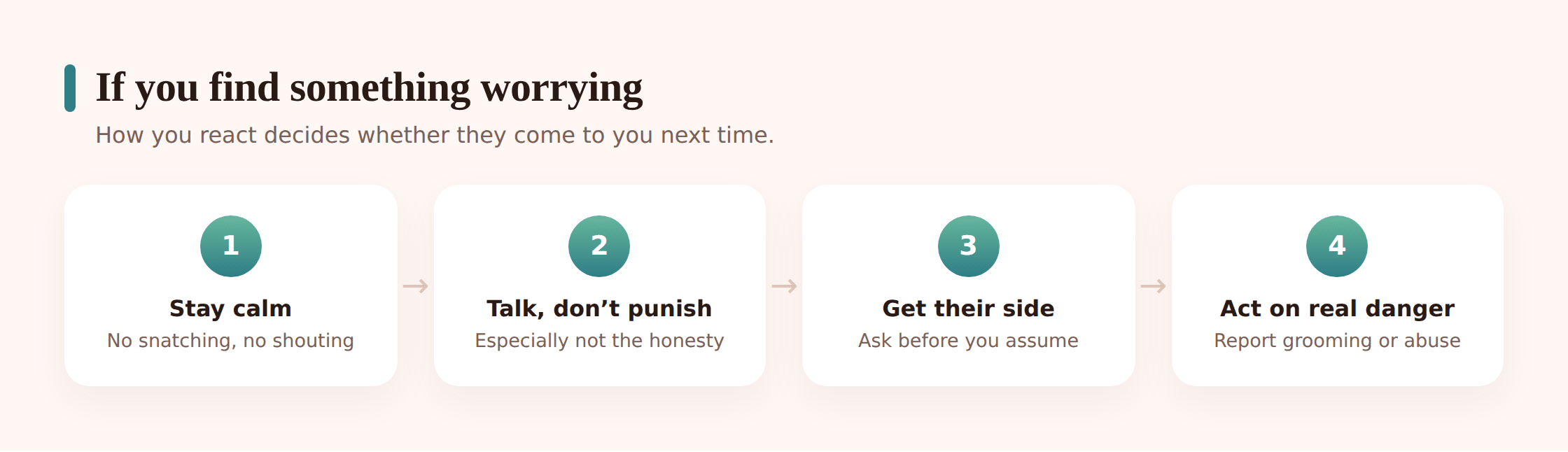
A brief, honest word on how our own tool fits this picture, because it’s built around exactly the approach above rather than against it. FreePhoneSpy is set up with your child, not behind their back — every monitored phone carries a Transparency screen that shows what’s shared, and the app is visible, not hidden. It’s designed for alerts on genuine concerns — a flagged phrase, an unknown contact, an odd pattern — rather than blanket reading; message content sits behind a deliberate consent switch that your child can see, so you can lean on headers and keyword flags and leave the private stuff private. It runs on the child’s Android phone, you watch from any browser with nothing to install on your side, and it’s free to start. It’s a way to notice sooner and start the right conversation — not a substitute for the trust and the check-ins that actually keep kids safe.
Questions parents ask
Should I read all my child’s text messages?
For most families, no. Reading everything is intrusive, usually more than the situation needs, and it teaches kids to move the real conversations somewhere you can’t see. A safety-oriented overview — who they talk to, plus alerts for genuinely worrying language — protects them just as well and keeps their trust intact. The younger the child the more visibility is reasonable; a teenager deserves real message privacy.
Is it wrong to monitor my child’s texts without telling them?
Yes — secret monitoring is the approach to avoid. Covert reading almost always comes out, and when it does the damage to trust outlasts whatever you were worried about. Do it openly: agree it together, be clear about what you can and can’t see, and keep the child in the loop as the rules ease off over time. Openness is what makes it protective rather than a betrayal.
At what age should I stop monitoring my child’s messages?
There’s no fixed age, but the direction is clear: taper off as your child shows they can handle things. By the mid-teens, the default should be that you don’t read their conversations at all, keeping only a light safety net for genuine danger. Tell them the plan out loud — kids respond well to “as I see you handling this, we’ll ease off,” because it makes good judgement worth something.
What if the messaging I’m worried about is on WhatsApp or Snapchat, not SMS?
That’s increasingly where it lives, and some of those apps are built so messages vanish, which means no tool can reliably show you what was said. Be honest about that limit. It’s exactly why the open habits — regular check-ins, a child who’ll bring you the phone — matter more than any technical view. Those reach into apps a flag never will.
My child got a message from a stranger. What do I do?
Stay calm, and don’t punish them for it — it isn’t their fault. Look at it together, block and report the contact, and keep the wider conversation open so they’ll tell you next time. If the messages are persistent, sexual, or feel like grooming, preserve them and involve the school or police. The lasting protection is a child confident enough to bring the next one straight to you.
Keeping a child safe around texting was never really about the texts. It’s about staying close enough that they’ll turn to you when something goes wrong, and trusting them enough that they still want to. The lightest honest touch — agreed together, alert to real danger, easing off as they grow — protects your child far better than reading every word ever could, and it leaves the relationship standing. That’s the version worth aiming for.