Buy Now, Pay Later & Teen Debt: A Parent’s Guide
Your teenager wants a £60 pair of trainers. They have £14. A few years ago that was the end of the conversation. Now a button at the checkout offers to split the cost into four payments of £15, the first one due today, the rest spread over six weeks, no interest if it all goes through on time. The trainers arrive tomorrow. Nobody said the word “debt,” and yet debt is exactly what just happened — quietly, cheerfully, in one tap. Buy Now, Pay Later has become the default way a lot of young people pay for things, and it isn’t a scam or a trap in itself. Plenty of adults use it sensibly. But for a teenager still learning what money even is, an instant, friendly way to spend cash they don’t have yet carries risks that are easy to miss until several plans are overlapping and a late fee has landed. This is a plain guide to how it works, why it appeals, where it bites, and how to coach your way through it together.
What Buy Now, Pay Later actually is
Buy Now, Pay Later — BNPL — is a way of splitting the cost of something into instalments instead of paying the full price up front. You’ve almost certainly seen the names even if you’ve never used them: Klarna, Afterpay (Clearpay in the UK), Affirm, Zip, PayPal’s Pay in 4. They all do a version of the same thing.
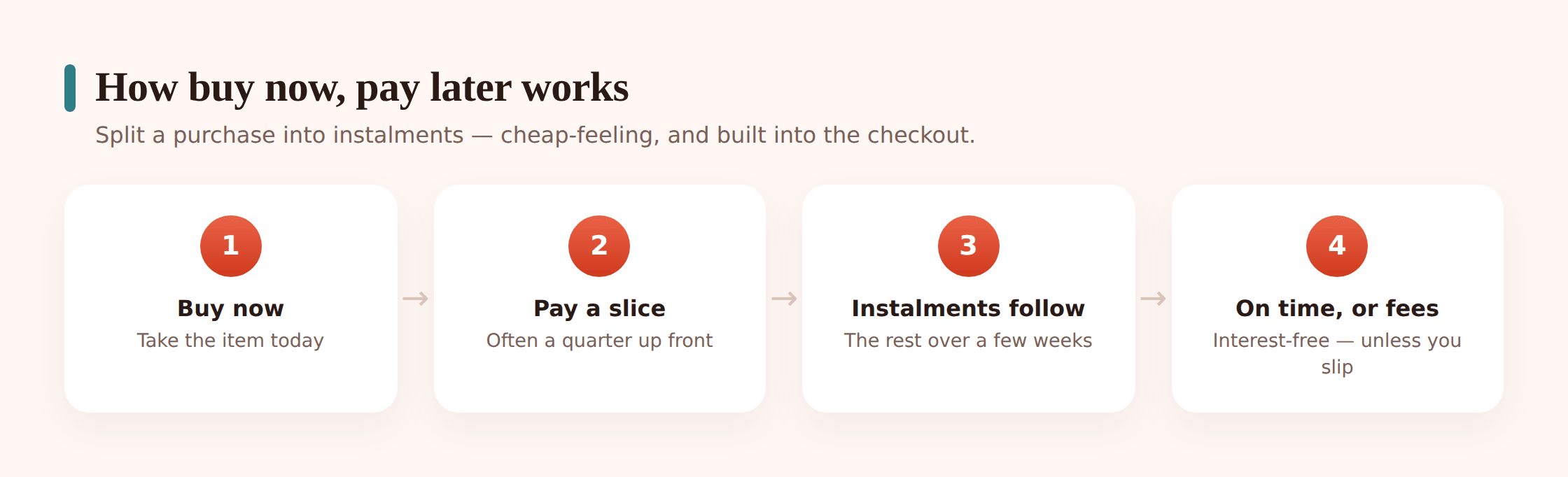
The most common shape is “pay in four.” A £60 purchase becomes four payments of £15 — one now, then three more, usually a fortnight apart. If every payment goes through on time, it’s often genuinely interest-free. That’s the pitch, and for a disciplined shopper who pays on schedule, it can be exactly as harmless as it sounds. Some providers also offer longer plans that stretch a bigger purchase over months, and those can carry interest, sometimes a lot of it.
The mechanics matter because they’re where the risk hides. The provider pays the shop the full amount straight away, so the retailer is happy — they’ve made a sale that might not have happened otherwise. You now owe the provider. Each instalment is usually pulled automatically from a linked debit card. Miss one, and depending on the provider you may face a late fee, a blocked account, or the debt being passed to a collector. Some providers report to credit reference agencies, which means missed payments can leave a mark on a credit file — the record lenders check years later when your teen wants a phone contract, a car loan, or a first flat.
None of that is hidden, exactly. It’s all in the terms. But the terms are a scroll of small print behind a bright button, and a fifteen-year-old excited about trainers is not reading them. This overlaps with the ground we cover in money and shopping safety for teens, and it’s worth reading alongside it.
Why it appeals to teens
Understanding the pull helps you talk about it without sounding like you’re just against everything fun. BNPL is designed to feel good, and it works.
The first hook is that it’s instant and it feels free. The item ships now; the pain of paying is pushed into a future that doesn’t feel real yet. Fifteen pounds today and “some more, later” reads to a teenage brain as almost nothing, even though the total hasn’t changed by a penny. Splitting a number makes it look smaller than it is — that’s the psychology the whole thing runs on.
The second is that it’s baked right into the checkout. Your teen isn’t seeking out a loan; the loan is offered to them, pre-selected sometimes, at the exact moment they most want the thing. There’s no trip to a bank, no application that feels like borrowing. It’s just another payment option sitting next to “card,” dressed up in the same cheerful colours as the shopping.
Then there’s the culture around it. BNPL is normalised — influencers haul entire wardrobes bought in instalments, “treat yourself” is a running theme across the feeds your teen scrolls, and paying in four is simply how a lot of their friends buy things. When everyone around you does it and nobody calls it debt, it doesn’t feel like debt. It feels like shopping.
Add impulse to all that. The whole point of “buy now” is to remove the friction that would otherwise give someone a moment to think. Take away the sting of paying full price today, and a purchase your teen would have talked themselves out of gets made in a second.
Why it’s risky for young people specifically
Adults use BNPL too, and most of the risks apply to everyone. But a few things make it sharper for teenagers, and it’s worth being specific rather than just anxious.
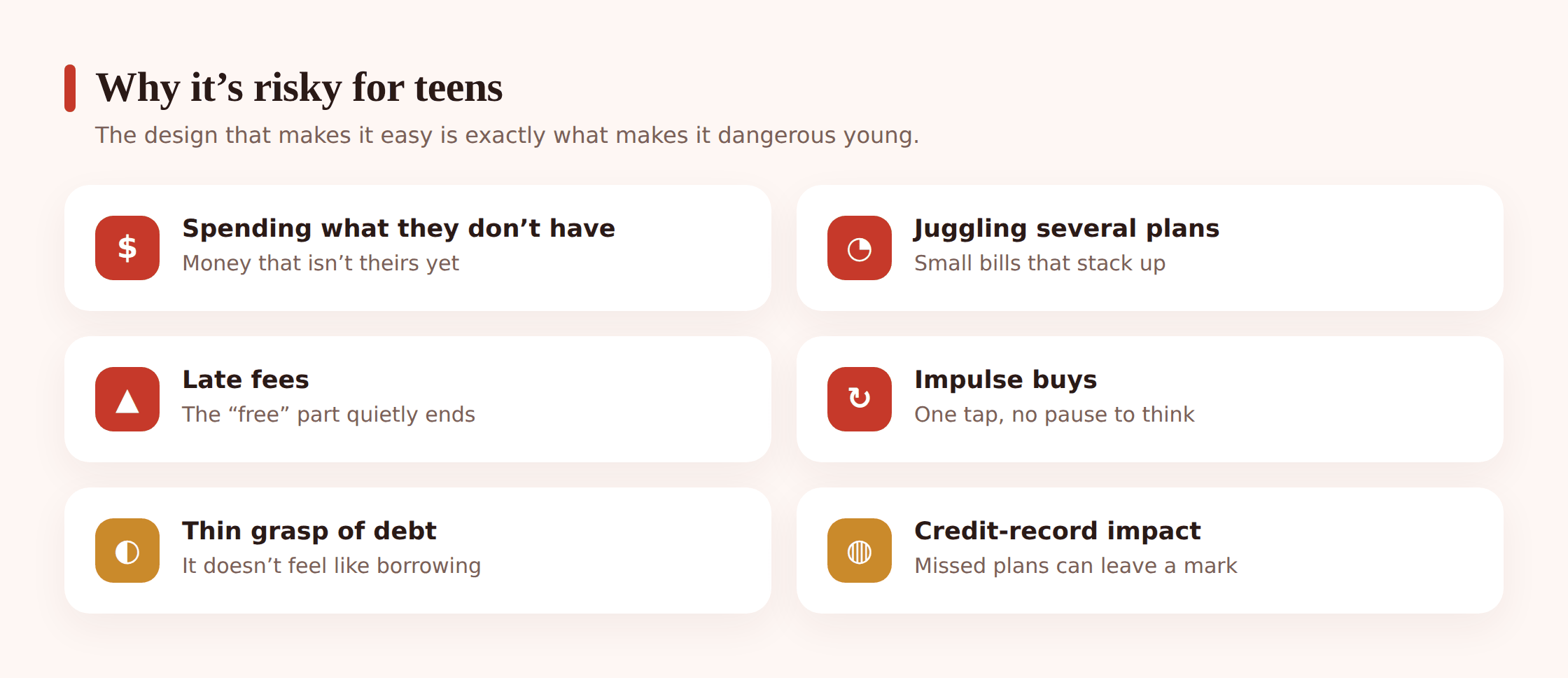
The core problem is spending money they don’t have yet. A teen’s income is thin and irregular — some pocket money, a Saturday job, birthday cash. BNPL lets them commit future money they’re not certain will arrive. The £15 due in a fortnight assumes there’ll be £15 in the account in a fortnight, and for a young person with no financial cushion, that’s a real gamble on a fixed date.
Then there’s juggling several plans at once. One instalment plan is manageable. The trouble starts when there are four or five running together — trainers from one provider, a hoodie from another, a game, concert merch — each with its own payment dates. The individual amounts stay small and forgettable, but they stack. A teen can end up owing a meaningful chunk of a month’s money across half a dozen little debts they’ve half lost track of, with payments landing on days they don’t remember agreeing to.
Late fees turn a manageable slip into a spiral. Miss a payment because the money wasn’t there, and some providers add a charge — which makes the next payment harder, which risks another fee. A young person without a buffer can tip from “paying in four” into “owing more than the thing cost” faster than they realise.
Under all of it sits a thin understanding of debt. Many teens simply haven’t learned yet that BNPL is borrowing, that missing payments has consequences, or that a “credit file” is a thing that follows you. Some providers report to credit reference agencies, so a run of missed payments at seventeen can quietly damage the score that decides whether they get a phone contract or a flat at twenty. The harm is delayed and invisible, which is the worst combination for a brain that discounts the future.
And most BNPL is meant for adults. Age checks exist, but they can be thin — a date of birth typed into a box, easy for an under-18 to fudge, especially where a plan is linked to a debit card a younger teen already holds. That a service isn’t designed for them doesn’t stop them reaching it.
Consumer groups have warned for a while that BNPL sits in a lighter-regulated corner than traditional credit, and regulators have flagged concerns about how easily younger and lower-income users take on multiple plans. You don’t need a scary statistic to make the point. The mechanics themselves — easy in, delayed pain, stackable debt — are enough to explain why caution is sensible for someone still learning to manage money at all.
Warning signs a teen is over-using it
You’re not looking to catch anyone out. You’re looking for the moment a normal tool has quietly become a problem, so you can help before a late fee does the teaching for you. A few things tend to show up.
- Parcels arriving more often than their actual money would explain — a steady drip of deliveries with no visible way they were paid for.
- Being cash-poor right after payday or allowance, because instalments are eating the money before it’s spent on anything new.
- Emails or app notifications about “payment due,” “payment failed,” or “your Klarna” that they seem tense about or quick to dismiss.
- Vagueness about what they’ve actually spent — “it was only fifteen quid” repeated about several different things.
- Borrowing small amounts from you or from friends to cover a payment date, which is debt paying debt.
- A new BNPL or shopping app appearing on the phone, or several, especially if it arrived alongside a spending spree.
- Stress or secrecy around money that wasn’t there before — flinching at their own notifications is a tell.
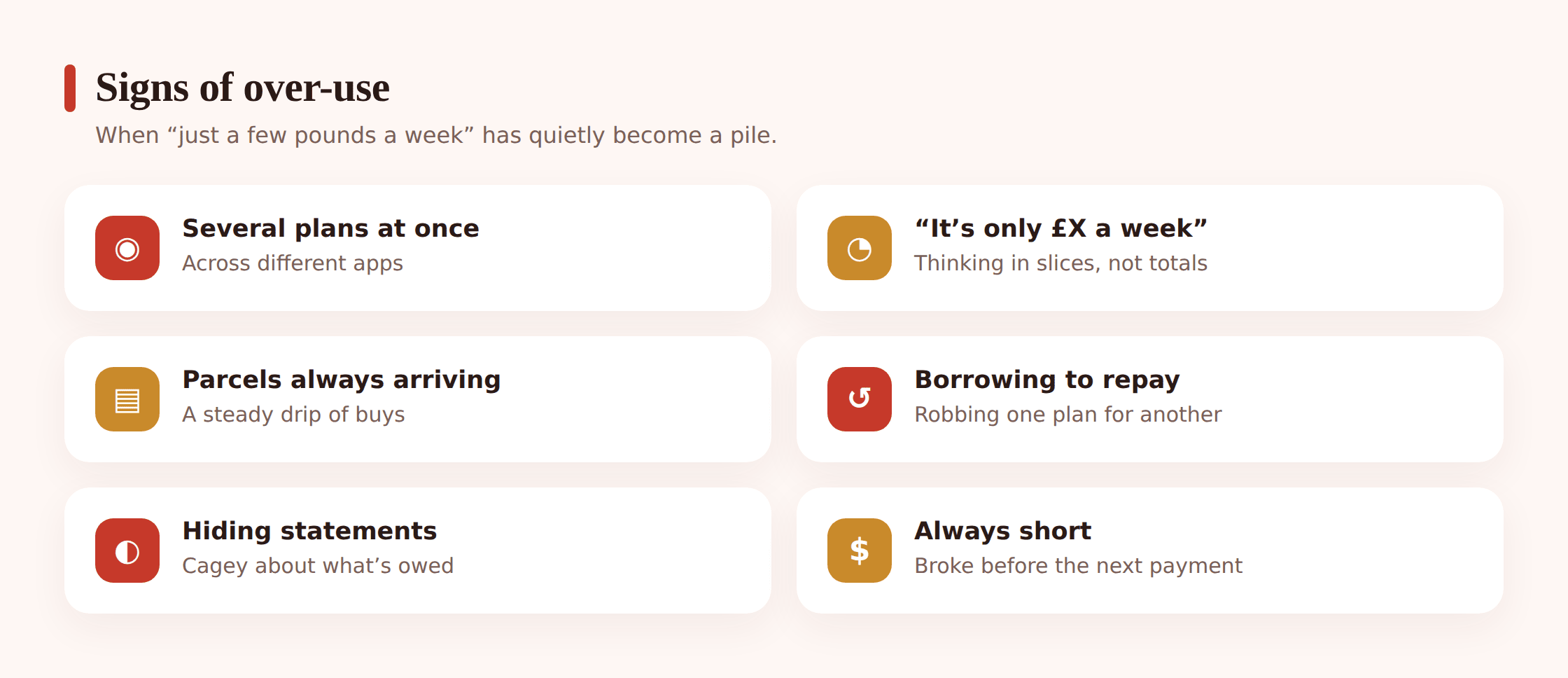
One of these on its own means little. Teenagers get parcels and lose track of money without any crisis behind it. It’s the cluster that’s worth a conversation — and a calm one, because panic teaches a teen to hide the next plan rather than tell you about it.
How to talk about it
The goal isn’t a ban. A flat “you’re never using that” mostly teaches a resourceful teenager to use it where you can’t see. The goal is understanding — that they grasp what they’re actually agreeing to, and that they’d come to you early if it went wrong.
Start from curiosity rather than a verdict. “I noticed a few parcels lately — are you using one of those pay-in-four things? Show me how it works, I want to understand it.” That opens a door where an accusation slams one. Let them explain it to you; the gaps in their explanation are exactly the things worth filling in.
Make the hidden bits visible. The most useful thing you can teach isn’t “BNPL is bad,” it’s “here’s what’s really happening.” Splitting £60 into four doesn’t make it cost less than £60. The money is still leaving, just later and in pieces. Every plan is a promise that the money will be there on a specific future date. And missing a payment can cost extra and, with some providers, leave a mark that follows you for years. Said plainly, without drama, that lands better than a lecture.
Building healthy habits
Rules fade; habits stick. A handful of small, repeatable ones do more than any single ban, and most of them are things an adult could stand to use too.
1. Track what’s actually owed
The single most powerful move against a fog of small debts is to write them down. Sit together and list every open plan — provider, item, amount left, next payment date — on a note or a simple sheet. Seeing “£72 owed across five things, next payment Tuesday” in one place turns a vague unease into a manageable number. You can’t manage what you can’t see, and BNPL is designed to keep each piece out of sight.
2. Use the “could I pay for this today?” test
Before splitting anything into four, ask one question: if the shop wanted the whole amount right now, in full, could I pay it — and would I still buy it? If the honest answer is no, the instalments aren’t making it affordable, they’re hiding that it isn’t. This one test, made a habit, quietly kills most of the impulse buys BNPL exists to encourage.
3. Understand the total, not the instalment
Teach them to read the whole cost, not the friendly first number. “Four payments of £15” is £60. A longer plan with interest might be more than the sticker price. The instalment is the bait; the total is the truth. Getting into the habit of adding it up before agreeing is a skill that outlasts any single purchase.
4. Budget around fixed dates
If a plan is already running, the payment dates are now fixed costs, like a subscription. The money for Tuesday’s £15 has to be set aside, not spent on Monday. Learning to ring-fence money that’s already promised is basic budgeting, and BNPL is a surprisingly good, if painful, place to learn it.
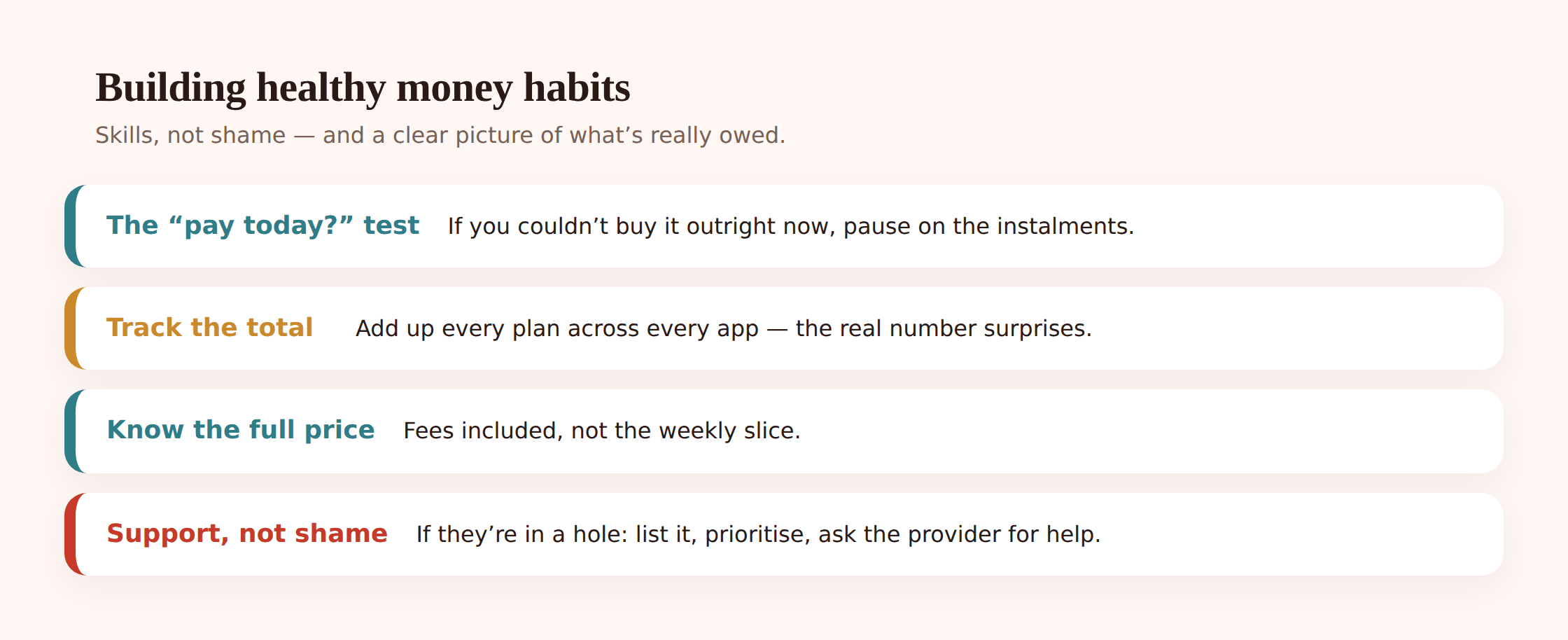
These habits pair naturally with the tools we cover in teen banking and money apps — a spending notification, a savings pot, a visible balance all make the abstract feel real. And they sit alongside the wider point that easy spending shows up everywhere a phone touches money, from checkouts to games; our guide to in-app purchases and kids covers the version of this that lives inside apps.
If they’re already in a hole
Sometimes the conversation happens after the fact — the plans have stacked, a payment’s been missed, and there’s real worry in the room. This is fixable, and how you handle it decides whether your teen learns to face money trouble or hide from it.
1. List every debt, calmly
Same exercise as before, now urgent. Get it all down — every provider, every amount, every date, plus any fees already added. It usually looks less frightening written out than it felt in their head, and you can’t make a plan against a number you haven’t named. Do this side by side, not as an interrogation.
2. Prioritise
Not all debts are equal. The ones charging fees or interest, or closest to being passed to a collector, get paid first; the interest-free ones that are simply on schedule can wait their turn. Tackling the most expensive or most urgent debt first is the standard, sensible order, and it stops the pile growing.
3. Talk to the provider
Providers would generally rather be paid late than not at all, and many can pause a payment, rearrange a date, or set up a plan if someone gets in touch before things go badly wrong. Encourage your teen to contact them — or do it together — rather than ghosting the emails. Silence is what turns a late payment into a collections letter.
4. Support, don’t shame
The instinct to say “I told you so” is strong and completely counterproductive. Shame teaches concealment. A teen who’s helped through their first money mess, without humiliation, learns that problems get smaller when you tell someone — which is the single most valuable financial lesson there is. Fix the debt together; save the lecture, or skip it entirely.
If it’s beyond a quick fix, free, non-judgemental help exists — you don’t have to solve it alone, and neither does an eighteen-year-old. See the resources below.
Where FreePhoneSpy fits
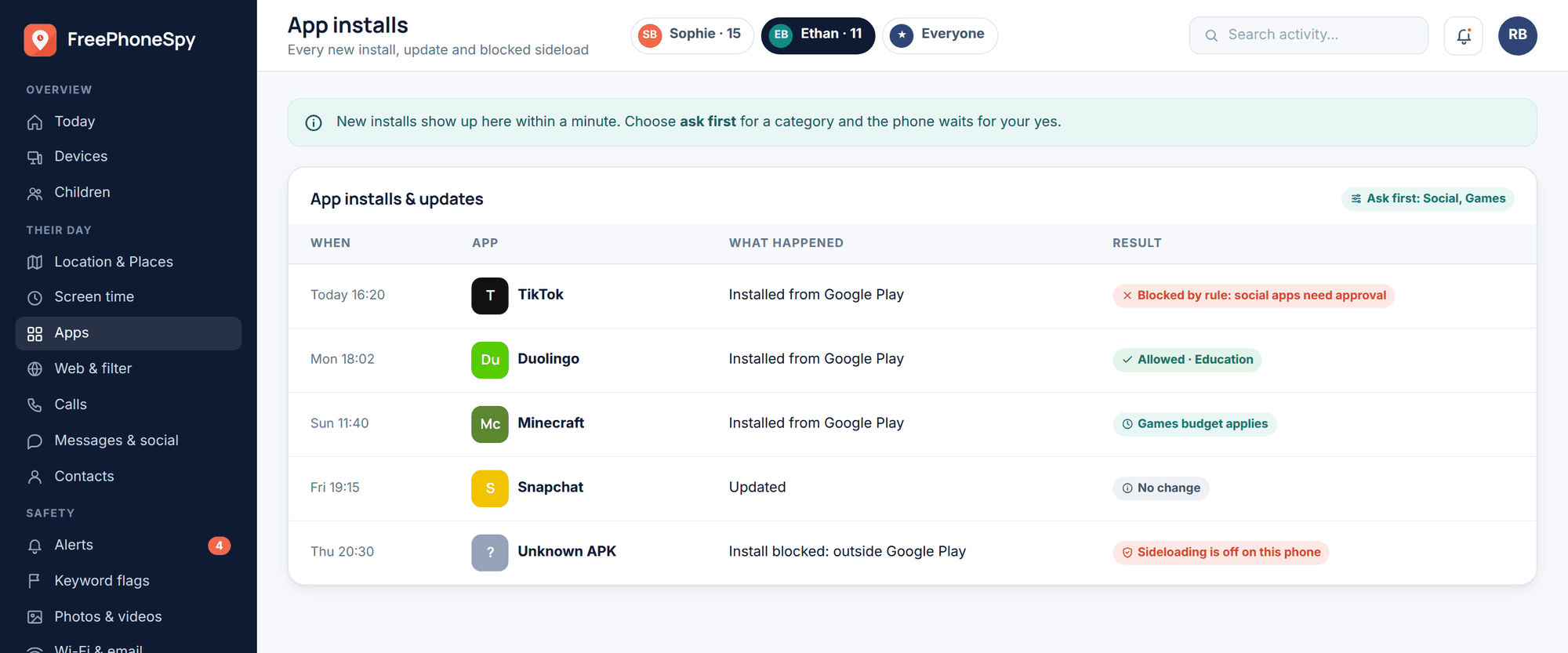
Most of this lives in conversation and in the shopping and banking apps themselves. But a spending problem often shows up on the phone before it shows up in a bank balance — a new BNPL or shopping app installed overnight, a run of “payment due” notifications, a checkout app that wasn’t there last week. On an Android phone you own and set up together, FreePhoneSpy can show you newly installed apps and unusual activity, which is less about catching anyone and more about noticing early enough to ask a kind question. It’s free to start, works on Android through any browser, and is meant to be a conversation starter — “I saw a new shopping app went on, how’s that going?” — not a hidden watcher.
Where to get real help
If BNPL debt has grown past a tidy fix, free and confidential help is available, and using it is a sign of good sense rather than failure.
In the UK, StepChange (stepchange.org) and Citizens Advice both offer free debt advice, and MoneyHelper (moneyhelper.org.uk) gives free, impartial money guidance including on BNPL specifically. In the US, the CFPB (consumerfinance.gov) publishes guidance on how Buy Now, Pay Later works and your rights around it, and the NFCC connects people with nonprofit credit counselling. None of these charge for their core help, and none of them will judge a young person for getting into a mess — sorting it out is the entire point.
FAQ
Is Buy Now, Pay Later a scam?
No. It’s a legitimate way to spread the cost of a purchase, and used carefully — paying every instalment on time, on things you could have afforded anyway — it can be genuinely harmless and even interest-free. The problem isn’t fraud. It’s that the design encourages spending money you don’t have yet, in small pieces that are easy to lose track of, which is a sharper risk for a teenager with no financial cushion than for a salaried adult. Treat it as real borrowing that happens to be dressed up as a payment option, and you’ve got the right frame.
Can under-18s even use BNPL?
Most providers say their services are for adults and run age checks, but those checks can be thin — often just a date of birth typed into a box, which a determined teenager can get around, especially where a plan links to a debit card a younger teen already has. So “it’s not meant for under-18s” doesn’t mean your teen can’t reach it. That’s a reason to talk about it openly rather than assume the age gate is doing the work for you.
Will missing a BNPL payment hurt my teen’s credit?
It can. Some providers report to credit reference agencies, so a run of missed payments can leave a mark on a credit file — the record lenders look at years later for a phone contract, a loan, or a first flat. Not every provider reports, and a single hiccup that’s quickly sorted usually isn’t a catastrophe, but the possibility is real and the harm is delayed, which is exactly why teens tend not to take it seriously. Contacting the provider early, before a payment is badly overdue, is the best way to keep a slip from becoming a mark.
Should I just ban BNPL completely?
You can set that boundary while your teen is younger and dependent on money you provide, and for some families that’s the right call. But a flat, permanent ban tends to teach an older teenager to use it where you won’t see rather than to use it wisely — and they’ll be an adult soon, meeting it with no practice. For most, the stronger long-term play is coaching: make sure they understand it’s debt, teach the “could I pay for this today?” test, and stay the person they’d tell if it went wrong. Understanding travels with them; a ban stops at your front door.
My teen owes across several plans and is stressed — what’s the first move?
Sit down together and write every debt out in one place — provider, amount left, next date, any fees. It almost always looks more manageable on paper than it felt in their head, and it’s the only way to make a plan. Then pay down the ones with fees or interest first, contact any provider your teen is struggling to pay rather than ignoring them, and keep the whole thing shame-free so they learn that money problems shrink when you face them. If it’s beyond a household fix, StepChange, Citizens Advice or MoneyHelper in the UK, or the CFPB and NFCC in the US, offer free help.
Buy Now, Pay Later isn’t going away, and your teenager will meet it again and again — at every checkout, in every haul video, right up to the adult version with a proper credit card behind it. You can’t wall it off forever, and trying mostly teaches them to spend where you can’t see. What you can do is make sure they understand what splitting a price really means, give them one honest question to ask before they tap, and stay the calm person they’d come to when a payment date arrives and the money isn’t there. Handle the small debts of a teenager well, and you’re not just clearing £72 across five plans — you’re teaching someone how to face money trouble for the rest of their life, which is worth far more than the trainers.