Child Identity Theft: How to Protect Your Child’s Personal Data
A child’s identity is a clean slate — no credit history, no debts, no reason for anyone to check. That is exactly what makes it valuable to a thief and dangerous to your family, because the damage can sit hidden for a decade before it surfaces on a first bank application, a student loan, or a first job. The good news is that this is a solvable problem. A few practical habits close most of the doors, a handful of warning signs tell you if one is open, and a clear plan handles the rare case where something goes wrong.
What child identity theft is
Child identity theft happens when someone uses a minor’s personal details — most often a Social Security number in the US or a National Insurance number and date of birth in the UK — to do something in that child’s name. That might mean opening a credit card or a loan, taking out a phone contract or utilities, claiming a tax refund or a benefit, or renting a flat. It can even mean using the child’s identity to dodge a debt, a warrant, or a bad record of their own.
The thief does not need the child’s actual credit history, because there isn’t one. They need only the raw identifiers, and sometimes not even a matched set. A stolen number paired with a made-up name and address — what fraud teams call synthetic identity — can be enough to build a fake person that borrows real money. That synthetic file may share nothing with your child except the number at its core, which is one reason these cases are so hard to spot.
This is distinct from two things families often confuse it with. It is not doxxing and protecting personal information, which is about someone publishing your details to harass you. And it is not sharenting and sharing kids’ photos, which is about the digital footprint parents create by posting. This guide is specifically about the financial and legal theft of a minor’s identity — money and records taken in their name.
Why children are prime targets
An adult notices identity theft fairly quickly. A declined card, a strange charge, a call from a lender — the alarms go off within weeks because an adult is using their own credit constantly, and so is everyone lending to them. A child sets off none of those alarms.
Three things make a minor unusually attractive. The credit file is spotless, so a thief starts with a clean history and no red flags. The number is rarely used, so nobody is monitoring it — no lender pulls a five-year-old’s credit report, and no five-year-old logs in to check. And the delay is enormous. A number stolen when a child is six may not be used the day it is taken; it can be sold, sat on, and activated years later, discovered only when the young adult applies for their first card, phone plan, student loan, or job and is turned down for debts they never knew existed.
That long silence is the real hazard. By the time the theft surfaces, the trail is cold, the accounts are tangled, and the young person is trying to clear their name at the very moment they most need clean credit. Catching it early — or preventing it outright — is worth far more than any cleanup later.
How a child’s identity gets stolen
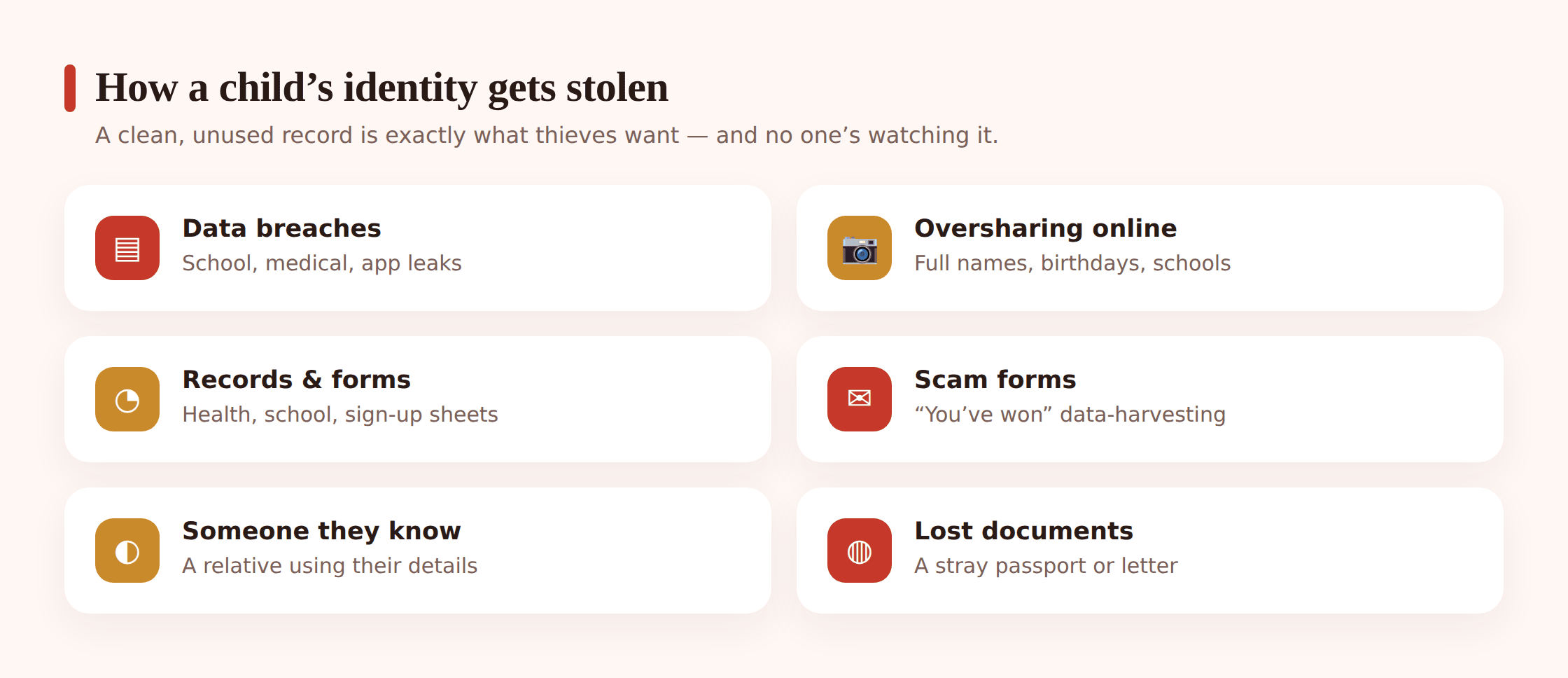
Knowing the common routes is not about fear; it is about knowing which doors are yours to close. Most of these are ordinary, everyday leaks rather than dramatic hacks.
- Data breaches. Schools, hospitals, pediatric clinics, camps, and children’s apps all hold a minor’s details, and any of them can be breached. A child’s number sitting in a leaked database is a common starting point.
- Oversharing and sharenting. A birthday post with the full name and date, a first-day photo tagged at the school, a proud announcement of a new baby with every detail. None of it is a number, but it assembles the profile a thief pairs with one.
- School and medical records. Enrollment forms, health forms, and activity sign-ups often ask for a Social Security or National Insurance number. Ask whether it is truly required, how it is stored, and who can see it — frequently it is optional.
- Scam forms and fake offers. A “free” gaming reward, a talent-search sign-up, a scholarship or prize that asks for a child’s birth date and number. These forms exist to harvest exactly those fields.
- Family members. Uncomfortable but real: a large share of child identity theft is committed by someone who knows the child and has easy access to their documents — a relative in financial trouble who uses a clean number to open accounts.
- Lost or stolen documents. A Social Security card in a wallet, a birth certificate in an unlocked drawer, a benefits letter left in the recycling. Physical paper is still one of the easiest ways in.
Notice the pattern. Almost none of this requires anyone to break through security. It requires a number to be shared too freely, stored too loosely, or left where the wrong person can reach it. That makes the defense straightforward to describe: give the number out rarely, store the paper securely, and watch for the few signs that something slipped.
The warning signs
Because a child cannot check their own credit and nobody sends a bill to a seven-year-old, the theft usually announces itself through mail and official letters. Any of the following, addressed to or about your child, is worth taking seriously.
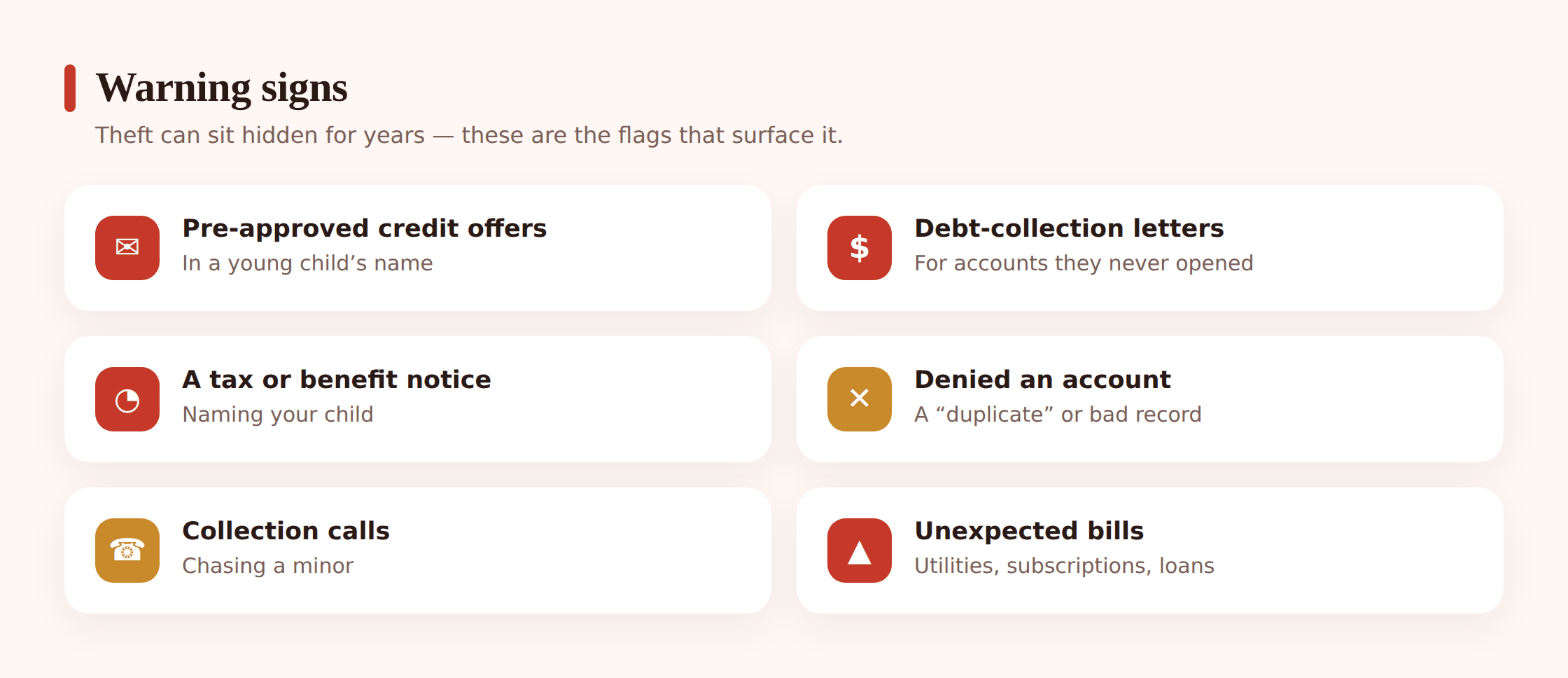
- Pre-approved credit offers in your child’s name. Banks send these to people who already appear in credit records. A young child has no reason to be in those records, so an offer suggests a file already exists.
- Debt-collection letters or calls. Notices about unpaid accounts, a phone contract, or a loan your child obviously never took out.
- A tax or benefit notice. A letter from the tax authority saying wages were reported under your child’s number, that they owe tax, or that a benefit was claimed in their name.
- Being denied an account. Your child is refused a bank account, a student card, or a phone plan because of existing debt or a poor credit history they could not possibly have.
- A credit report that shouldn’t exist. If you check and find that your minor child has any credit file at all, that itself is a red flag worth investigating.
- Turned-down government benefits. A claim for a benefit is rejected because the number is already in use under another claim.
One letter is enough to act on. You do not need to wait for a pattern. A single pre-approved credit offer or collection notice in a young child’s name warrants a credit check straight away — it is far easier to close a new problem than an old one.
How to protect your child
This is where an afternoon of work pays off for years. None of it is technical, and most of it is one-time.
Give the number out rarely
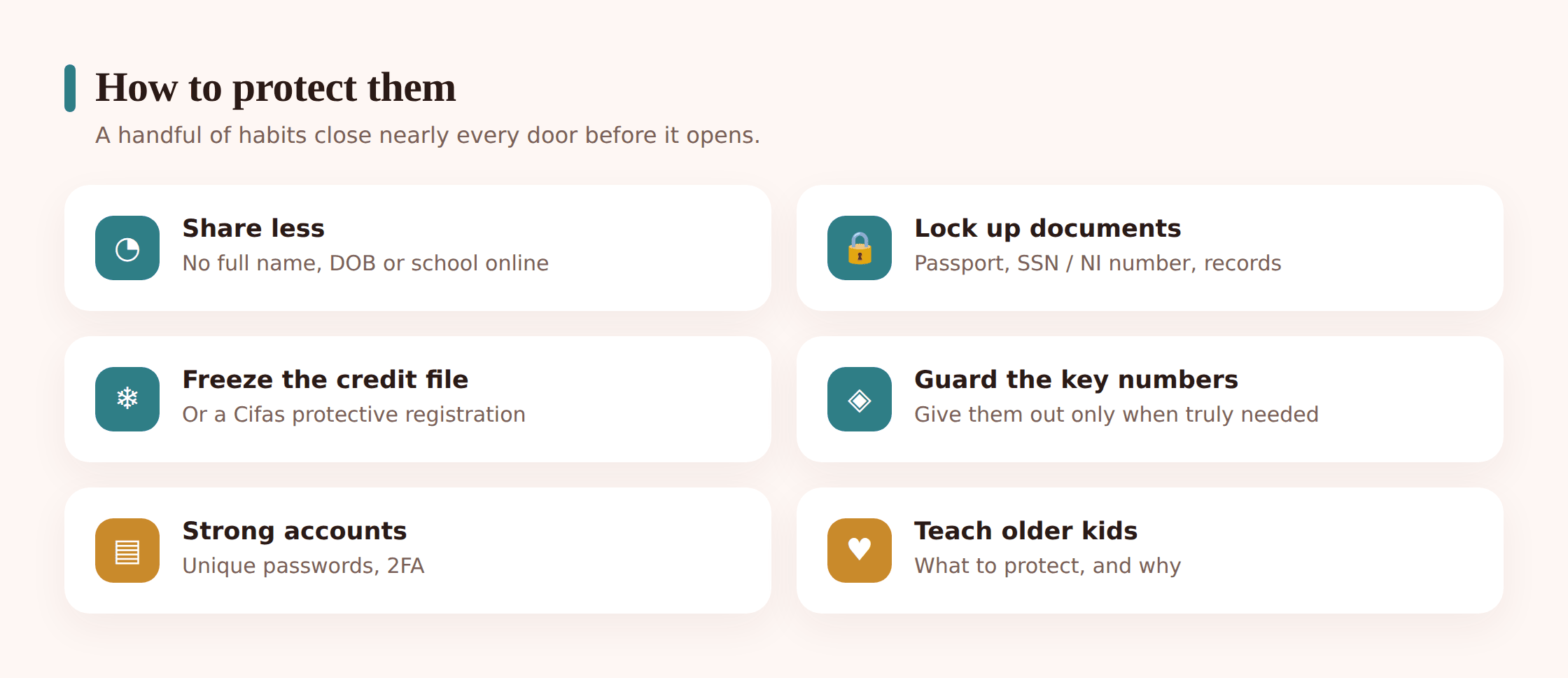
Treat your child’s Social Security or National Insurance number as need-to-know. When a form asks for it, ask whether it is genuinely required, whether a partial number will do, and how it will be stored. Schools, clubs, and clinics often request it out of habit; you can frequently leave it blank or supply it another way. Every place that holds it is one more place that can leak it.
Secure the documents
Keep birth certificates, Social Security cards, passports, and benefit letters in a locked box or a safe, not a kitchen drawer. Don’t carry your child’s card in a wallet. Shred anything with their details before it goes in the bin — pre-approved offers, medical statements, old forms. Physical documents are still one of the most common routes in, and a locked drawer closes it.
Set up a credit freeze or protective registration
This is the single strongest step. In the US, you can place a free credit freeze on your minor child’s file with each of the three bureaus — Equifax, Experian, and TransUnion. If no file exists yet, the bureau creates one and freezes it, so no new credit can be opened in your child’s name until you lift it. The Federal Trade Commission explains the process at IdentityTheft.gov. In the UK, Cifas offers Protective Registration (cifas.org.uk), which flags your child’s details so lenders apply extra checks before granting credit. Either way, you are putting a lock on a file the child will not need for years.
Be careful with the number itself
Never send a Social Security or National Insurance number by ordinary email or text, and never enter it into a form that arrived unsolicited. Memorize it rather than carrying it. If a school or app stores it, ask how, and push back on anyone who wants it without a clear reason. The fewer copies exist, the fewer can go missing.
Strengthen the accounts around your child
The email addresses, app logins, and family accounts tied to your child are part of the same defense — a compromised inbox can leak forms, letters, and documents. Strong, unique passwords and two-factor authentication on those accounts stop one leak from becoming several. Our guide to family passwords and two-factor authentication makes this quick to set up for the whole household at once.
Teach teens as they take the wheel
Older children start filling in their own forms, signing up for their own apps, and applying for their own first accounts. Teach them what their number is for, why it is precious, and the simple rule that no legitimate game, quiz, or prize needs it. A teen who understands why they guard the number will guard it long after they leave home.
What to do if it happens
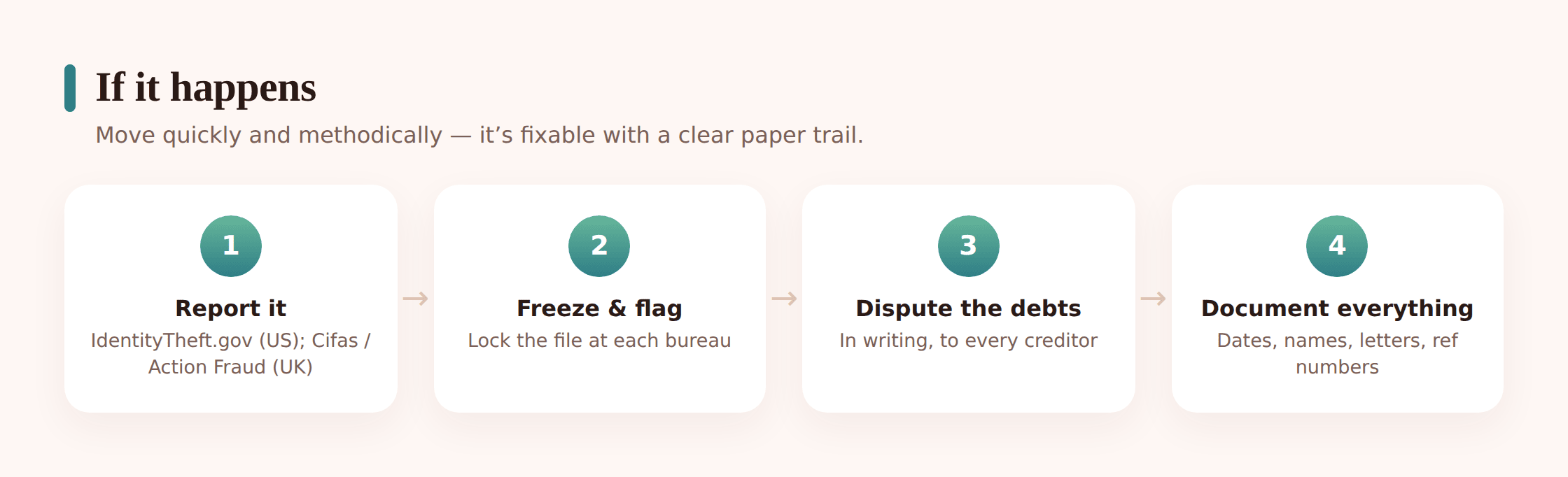
If you find evidence of theft, a calm, methodical response fixes it. The order below is what works. Do it in sequence and keep a record as you go.
Step 1 — Confirm and document
Request your child’s credit report from each bureau and confirm what accounts exist. Start a file — dates, letters, account numbers, names of anyone you speak to, and copies of everything. This record is what every later step relies on, so build it first and keep it complete.
Step 2 — Report it officially
In the US, report the theft at IdentityTheft.gov (the FTC), which generates a formal identity-theft report and a personalized recovery plan. In the UK, report it to Action Fraud (actionfraud.police.uk). This official report is the document that banks, bureaus, and creditors will ask for.
Step 3 — Freeze the credit
If you have not already, place a freeze on your child’s file with Equifax, Experian, and TransUnion in the US, or a Cifas Protective Registration in the UK. This stops any further accounts from being opened while you clean up the existing ones.
Step 4 — Contact each bank or creditor
For every fraudulent account, call the bank or company that opened it. Tell them the account is the result of identity theft of a minor, ask for their fraud department, and send them your identity-theft report. They can close the account and stop collection. Ask each one to confirm in writing that the account was removed and the debt cleared.
Step 5 — Dispute the entries with the bureaus
Ask each credit bureau to remove the fraudulent accounts from your child’s file and to confirm the removal in writing. Because the victim is a minor, bureaus have a specific process for this — mention that a child is involved. Keep every confirmation you receive.
Step 6 — Keep watching
After the cleanup, keep the freeze in place and check your child’s credit once a year until they need it themselves. Theft that happened once can resurface, and the same number may be sold again. A yearly check is a small habit that catches a repeat early.
A note on tools and trust
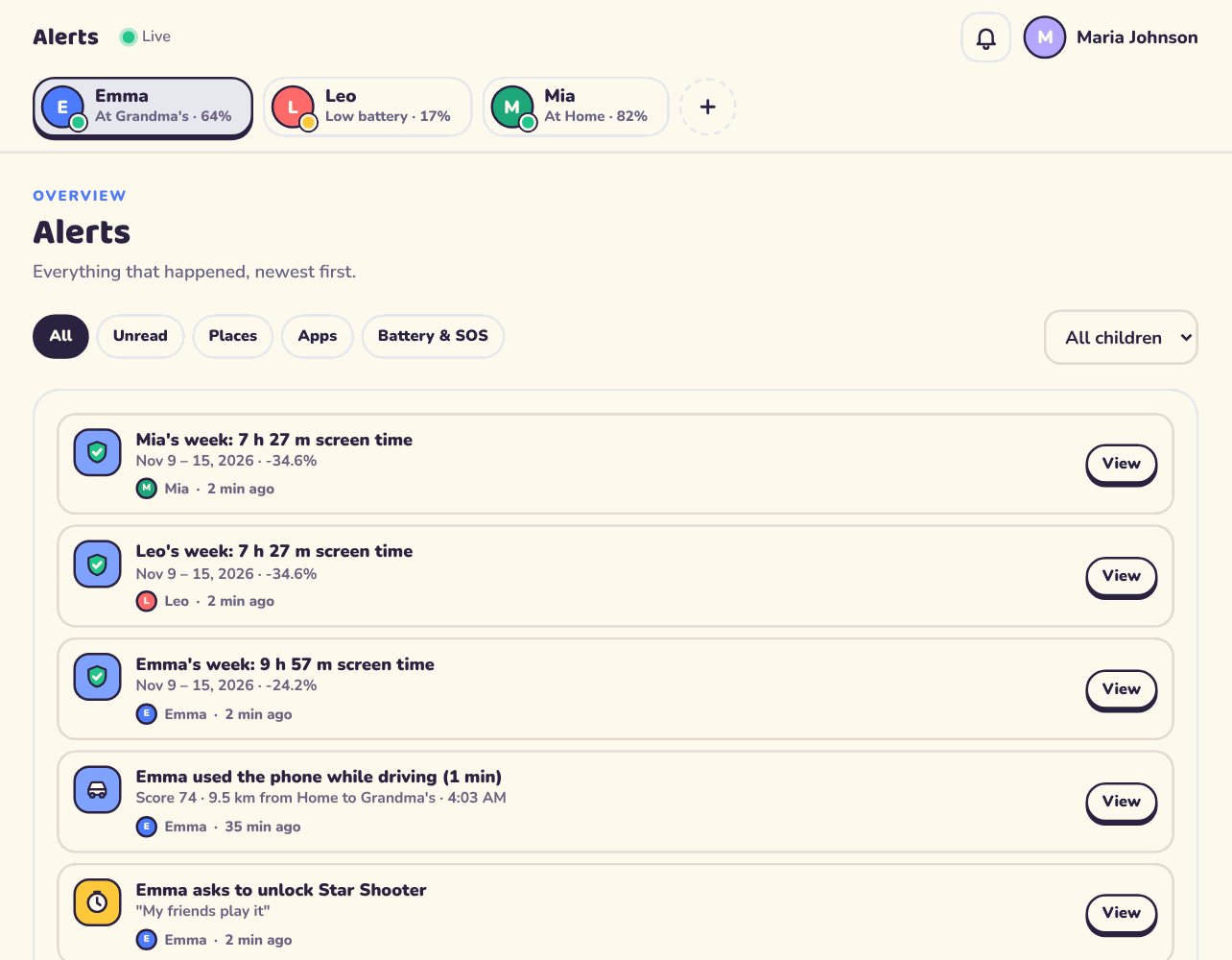
Much of what protects a child’s identity happens off the phone — in a locked drawer, on a credit bureau’s website, in the choice to leave a form field blank. But a phone is where a good deal of the risk arrives: scam forms, fake prize offers, sketchy apps asking for personal details, and messages fishing for a birthday or a number. That is where a transparent family tool can help.
Your protection checklist
Work through this once as a family, tick what is done, and diarise a repeat check each year. Most of it is one-time work that keeps paying off.
- Birth certificates, Social Security or National Insurance cards, and passports stored in a locked box, not a drawer or wallet.
- Anything with your child’s details shredded before it is thrown away.
- A credit freeze placed with all three bureaus (US) or a Cifas Protective Registration (UK).
- Every form that asks for your child’s number questioned — is it required, and how is it stored?
- The number never sent by email or text, and never entered into an unsolicited form.
- Strong, unique passwords and two-factor authentication on the family accounts and inboxes tied to your child.
- Teens taught what their number is for and the rule that no game, quiz, or prize needs it.
- A yearly check of your child’s credit file diarised until they need it themselves.
- A clear family plan if it happens: document, report, freeze, dispute, keep it in writing.
FAQ
At what age should I check my child’s credit?
There is no bill or statement that prompts you, so it falls to you to check deliberately. Many identity-protection services suggest a first check by around the mid-teens, and sooner if you have any reason to worry — a data breach that named your child, a lost document, or a suspicious letter. If your young child already has a credit file at all, that is itself a red flag worth investigating now rather than later.
Can I freeze my child’s credit if they have no credit history?
Yes. In the US the three bureaus will create a file for your minor child and freeze it, so no new credit can be opened in their name until you lift it. It is free. In the UK, Cifas Protective Registration serves a similar purpose by flagging the child’s details so lenders apply extra checks. A freeze on an empty file is one of the strongest preventive steps available.
Why would someone steal a child’s identity rather than an adult’s?
A child’s identity is clean and unwatched. There is no credit history to raise flags, nobody is monitoring the number, and the theft can stay hidden for years — often until the young person applies for their first account or job. Regulators warn that these long delays are exactly what make children attractive targets and the damage hard to spot early.
My child was denied a bank account for existing debt. What now?
That is a strong sign of identity theft. Request their credit report to see the accounts, then report the theft — IdentityTheft.gov in the US, Action Fraud in the UK. Freeze the credit, contact each bank or creditor to close the fraudulent accounts, and dispute the entries with the bureaus in writing. Keep every confirmation you receive; the paperwork is what clears their name.
Can monitoring my child’s phone prevent identity theft?
Not on its own — the strongest protection is offline: guarding the number, securing documents, and freezing the credit file. What a transparent tool your child knows about can do is help you spot the phone-based risks early: a scam form, a fake prize asking for personal details, or a suspicious app. Used openly, it is a prompt to talk and act together, a backstop to the real protection rather than a substitute for it.
Child identity theft feels alarming because it works in the dark and surfaces late. But the defense is squarely in your hands, and none of it is complicated: share the number rarely, lock the documents away, freeze the file the thief wants to use, and glance at the credit report once a year that nobody else will check. Do that, teach your teens to do it themselves, and you have closed the doors that matter — quietly protecting your child today for the applications, loans, and jobs that are still years away.