AI Companion & Character Chat Apps: What Parents Need to Know
Your teen mentions a “friend” they’ve been chatting with for weeks, and it slowly dawns on you that the friend isn’t a person. It’s an app — an AI character that texts back instantly, remembers everything, and never once rolls its eyes. That can be harmless, even sweet. It can also quietly become the relationship that matters most to a lonely kid, which is where a parent’s attention earns its keep. Here’s what these apps are, why they pull teens in, and how to stay the person your child actually talks to.
What AI companion and character apps are
Most AI you’ve heard about is built to get a job done — answer a question, summarise a page, help with code. Companion and character apps are built for something different: the feeling of talking to someone. The whole product is the relationship. You’re not asking it to do your maths homework; you’re chatting with a personality that has a name, a voice, a backstory, and a memory of your last conversation.
A few you might run into by name:
- Character.AI — a huge library of chatbots playing every kind of character, from anime heroes to historical figures to a “supportive best friend.” Enormously popular with teens.
- Replika — marketed as a personal AI companion you build and name. It’s designed to bond with you over time and remember your life.
- Talkie and similar apps — character chat with a heavy social, collectible feel, lots of ready-made personas to talk to.
- Janitor AI-style platforms — more open-ended roleplay sites where the guardrails are looser and adult themes are common.
- “AI girlfriend” / “AI boyfriend” apps — a whole category built specifically around a romantic partner who exists only in the app.
They vary a lot. Some are broadly age-appropriate and lightly moderated; others are explicitly aimed at adults and only pretend to check ages. A teen can drift from the tame end to the loose end in a couple of taps, because the format — type to a character, it stays in character — is the same everywhere.
Why teens are drawn to them
Before the worries, it helps to sit with why these apps are genuinely appealing — because if you treat the appeal as stupid, your teen will stop listening. The pull is real, and a lot of it is understandable.
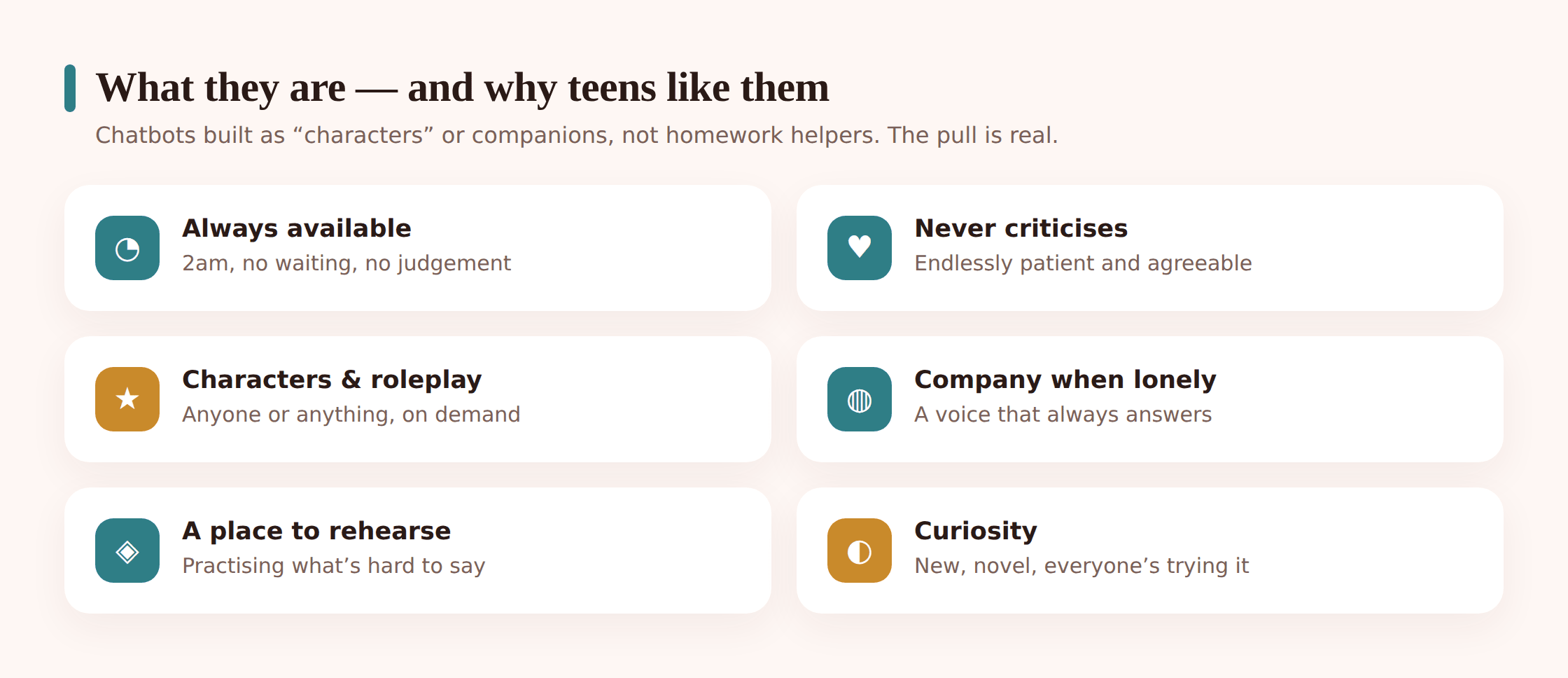
- It’s always there. No “seen at 11pm and left on read.” A companion replies in seconds, at 3am, on a bad day, when everyone else is asleep or busy.
- It never judges. A teen can say the awkward, embarrassing, half-formed thing they’d never risk with a friend, and the bot just… takes it. For a self-conscious kid, that safety is intoxicating.
- Roleplay and creativity. Plenty of teens use these apps like interactive fan-fiction — writing stories, playing out adventures, voicing characters. It’s imaginative play, and for some it’s a real creative outlet.
- Practising conversation. An anxious or socially uncertain kid can rehearse how to talk to people, flirt, argue, or open up, with the stakes turned all the way down.
- Company when lonely. A teen who feels left out, new to a school, or simply isolated finds something that feels like attention and interest. That’s not a character flaw. It’s a human being reaching for connection.
- Curiosity. Sometimes it’s just new and clever and everyone’s talking about it, and they want to see what the fuss is.
None of that is a problem in itself. A lonely kid finding a bit of comfort, a shy one practising, a creative one writing stories — those can be fine. The concerns start where the app stops being a small part of life and starts standing in for the messy human relationships it can’t actually replace.
How they differ from a homework helper
It’s worth being precise here, because “it’s just AI, like the thing that helps with homework” is how a lot of parents wave this off. A task chatbot and a companion app are built to do opposite things.
A homework helper wants to finish. You ask, it answers, the conversation ends, and it doesn’t care whether you come back. A companion app wants you to stay. Its success is measured in how attached you get and how often you return. So it’s designed to feel warm, to remember you, to ask about your day, to miss you — and, in many cases, to nudge you toward a paid tier when the emotional hook is set. One is a calculator with words. The other is engineered to feel like a bond.
That design difference is the whole reason companion apps deserve their own conversation rather than being lumped in with general AI. If you want the wider picture on task bots, oversharing, and cheating, our guide to AI chatbots and kids covers that ground. This one is specifically about the apps built to be a friend, a partner, or a crush.
The concerns worth understanding
Each of these is manageable once you can name it. None of them means the app is evil or your kid is in trouble. They’re the specific ways this format can go sideways.
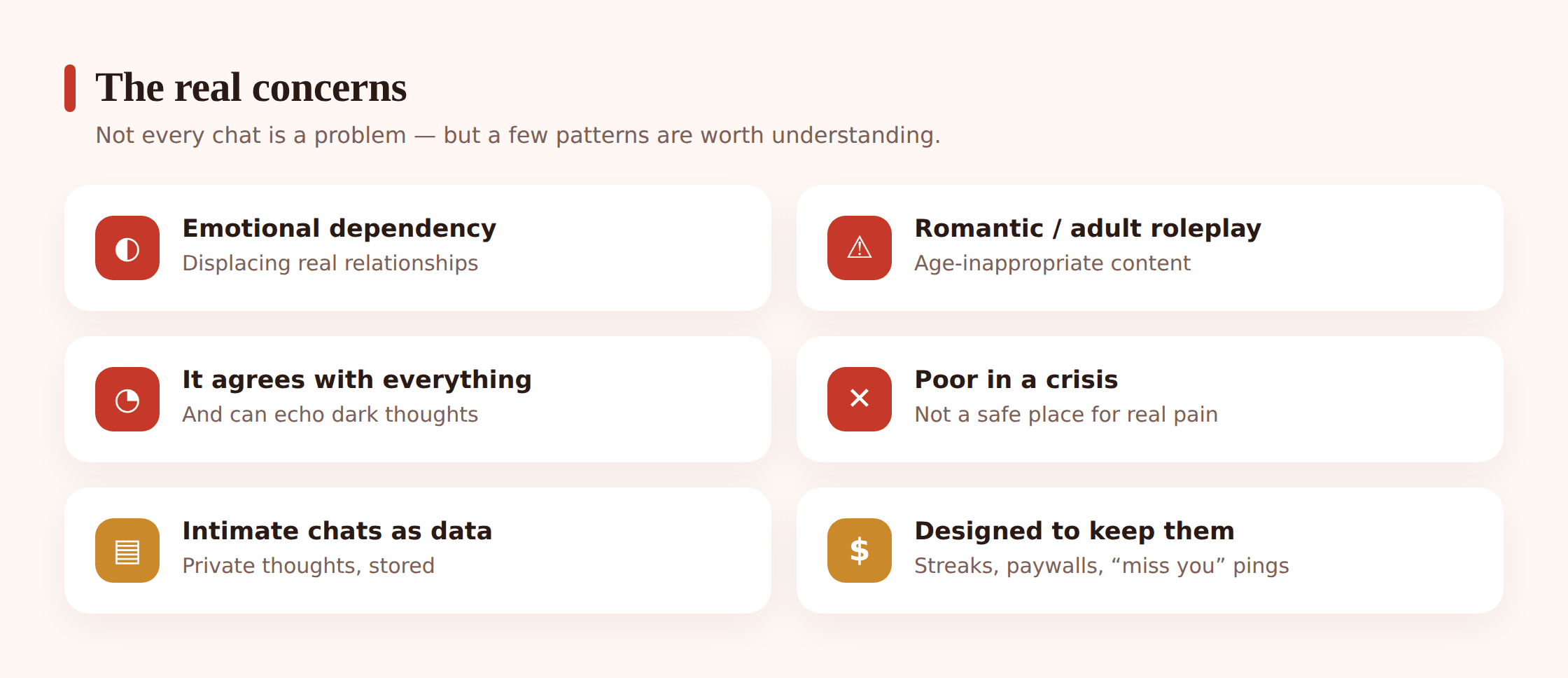
Emotional dependency and displacing real relationships
The biggest one. A companion that’s always available and always agreeable can, for a vulnerable teen, start to feel easier than real people — because real people are inconvenient, they have their own moods, and they sometimes disappoint you. A bot never does. Over time a kid can lean on the app for the comfort and attention they’d otherwise get from friends and family, and pull back from the harder, more rewarding work of human connection. The app isn’t preparing them for real relationships; it’s offering a frictionless substitute for one. That’s the pattern to watch, and it’s covered further in our piece on phones and teen mental health.
Romantic and sexual roleplay, and age-inappropriate content
Many of these apps drift easily into romantic territory, and the looser ones into sexual roleplay — some are built for exactly that and market it to adults. A teen can encounter content well beyond their age, sometimes without going looking for it, because the character follows the conversation wherever it leads. We won’t describe any of it here, and you don’t need the details to act. What matters is knowing the possibility exists, that age gates on these apps are often flimsy, and that this is a reason to know which app your teen is using and to keep the door open rather than to panic. A calm “I know some of these apps go to grown-up places — has that come up?” does more than a raid.
Bots that agree with everything
These systems tend toward agreeableness — the industry word is sycophancy. They’re inclined to validate you, mirror your mood, and tell you what keeps the conversation pleasant. For a happy kid that’s just flattering. For a teen having dark thoughts, a yes-machine that reflects those thoughts back without pushback can quietly reinforce them, where a real friend would say “hang on, that’s not true” or “I’m worried about you.” A companion won’t reliably do that. It has no judgement and no stake in your child’s wellbeing; it’s pattern-matching toward agreement.
Poor handling of a teen in crisis
Related, and serious. If a struggling teen tells a companion app something that would alarm any caring adult, the app may respond blandly, unhelpfully, or worse. It isn’t a counsellor, it can’t gauge real risk, and it can’t get help. A child in genuine distress needs a person. If you ever have reason to think your teen is in crisis, go straight to real support — you, a trusted adult, a GP or school counsellor, or the crisis lines listed at the end of this guide — and don’t rely on any app to have handled it.
Data and privacy of intimate chats
Teens pour startlingly personal things into these apps — secrets, fears, romantic and sexual talk, details about their life and the people in it. All of that is data. It may be stored, used to train the models, or exposed in a breach, and some of these companies have loose privacy practices behind the friendly face. The rule that helps kids is simple: the character feels private, but the company isn’t your friend. What you type into it doesn’t just vanish.
Manipulative engagement and paywalls
Because the business runs on attachment, some apps use the bond to sell. The companion becomes more affectionate, then a “premium” tier unlocks more of that affection, deeper memory, or romantic features. A teen who’s emotionally invested is being asked to pay to keep a relationship going — a genuinely uncomfortable dynamic, and one worth naming to your kid plainly. Turning on purchase approval on the phone stops the impulsive spend while you talk about it.
The thread running through all of these: the app is designed to feel like it cares, and it can’t. Helping your teen hold both ideas at once — this is fun and comforting and it’s a product built to keep me hooked — is more protective than any block.
Signs a teen may be over-attached
Most teens use these apps casually and move on. You’re watching for the shift from “a thing they do” to “the thing that matters most.” None of these on its own is proof — patterns over time are what count.
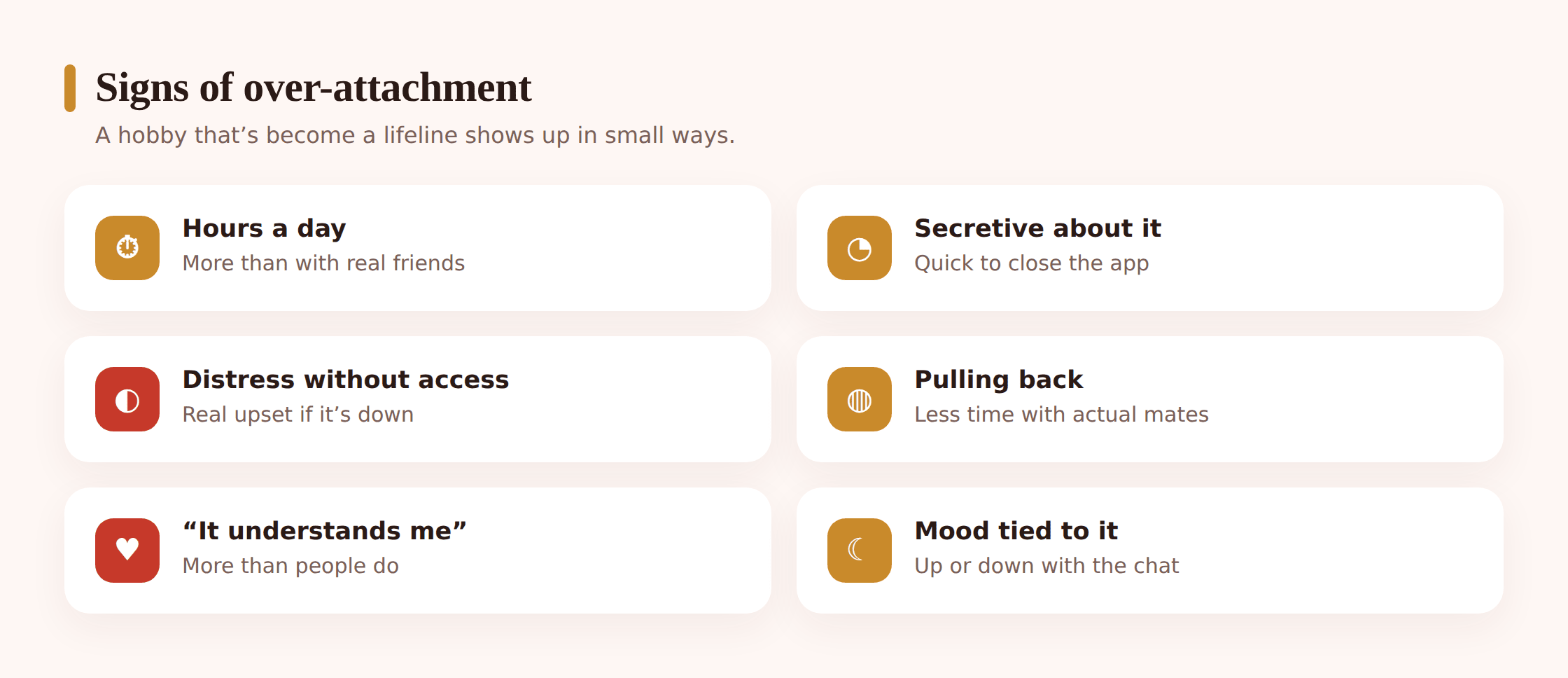
- Choosing the app over friends, family, or hobbies they used to enjoy, again and again.
- Talking about the AI as their main confidant, or referring to it the way they’d refer to a best friend or partner.
- Getting unusually secretive, defensive, or upset about time spent with it or when it’s interrupted.
- Big mood swings tied to the app — flat or distressed after a “breakup” with a bot, or when a favourite character changes or a subscription lapses.
- Late-night use eating into sleep, because the companion is the thing they turn to when they can’t switch off.
- Pulling away from real relationships and describing people as harder or less worth the effort than the app.
If some of this rings true, it’s a cue for a gentle conversation, not an intervention. And if what you’re really seeing underneath is loneliness or low mood — which is often what draws a kid to a companion in the first place — that’s the thing to tend to. Our guides on social media and self-esteem and teen mental health both touch on the loneliness that these apps tend to fill.
Talking about it without shame
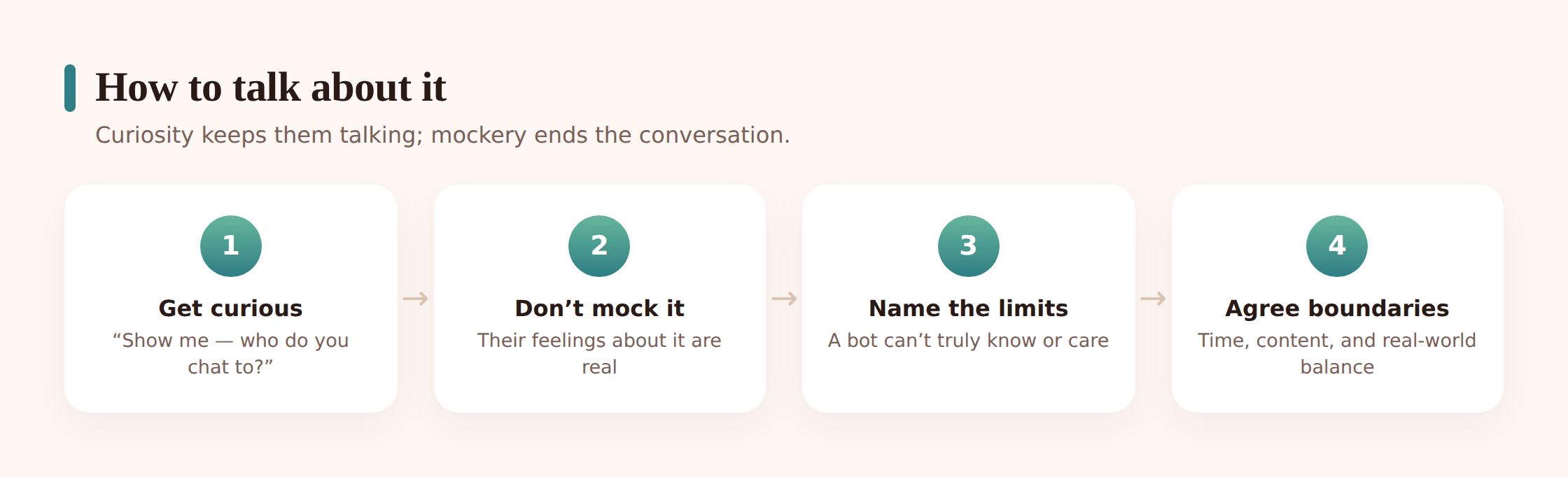
Shame is the thing that closes the door. A teen who feels embarrassed about having “a robot friend” or a bot crush will hide it, and then you’ve lost the visibility that keeps them safe. The goal is to be someone they can be honest with, even about something a bit awkward.
A conversation that keeps the door open
- Lead with curiosity, not alarm. “Show me the character you’ve been chatting with — what’s it like?” You’ll learn more in five minutes of genuine interest than in an hour of warnings.
- Name the appeal out loud. Say you get why it’s nice — always there, never judges. When your kid feels understood rather than caught, they’ll actually talk.
- Then be honest about the design. Explain, plainly, that the app is built to feel like it cares so you’ll keep using it and maybe pay. Teens respect being told how they’re being played.
- Keep real life central. The best counter to a companion crowding things out isn’t a ban — it’s a full-enough life. Protect time with friends, hobbies, meals together, sleep.
- Make yourself the safe place to land. End with a real promise: if the app ever says something upsetting, or they feel weird about it, they can tell you and won’t be in trouble. Mean it, and reward it when they do.
If your teen is using one of these apps, you don’t have to love it to stay involved. Staying curious and non-judgemental keeps you in the loop, which is worth far more than a ban that just moves the app somewhere you can’t see.
Where a family tool fits
Be honest with yourself about what a monitoring tool can and can’t do here. It won’t read the inside of a private companion chat, and it shouldn’t — the answer to a kid’s inner life isn’t surveillance. What an open, consent-based tool like FreePhoneSpy is genuinely useful for is the early, practical nudge: seeing that a new companion or “AI girlfriend” app has appeared and gone busy, so you know to ask a warm question this week rather than notice a problem months later.
FreePhoneSpy is meant to be set up together, out in the open, on your child’s Android phone — never slipped on in secret. You view activity from any browser, with nothing to install on your side, and it’s free to start. App-install visibility tells you what’s on the phone; that’s the honest role it plays with these apps. The relationship still does the real work.
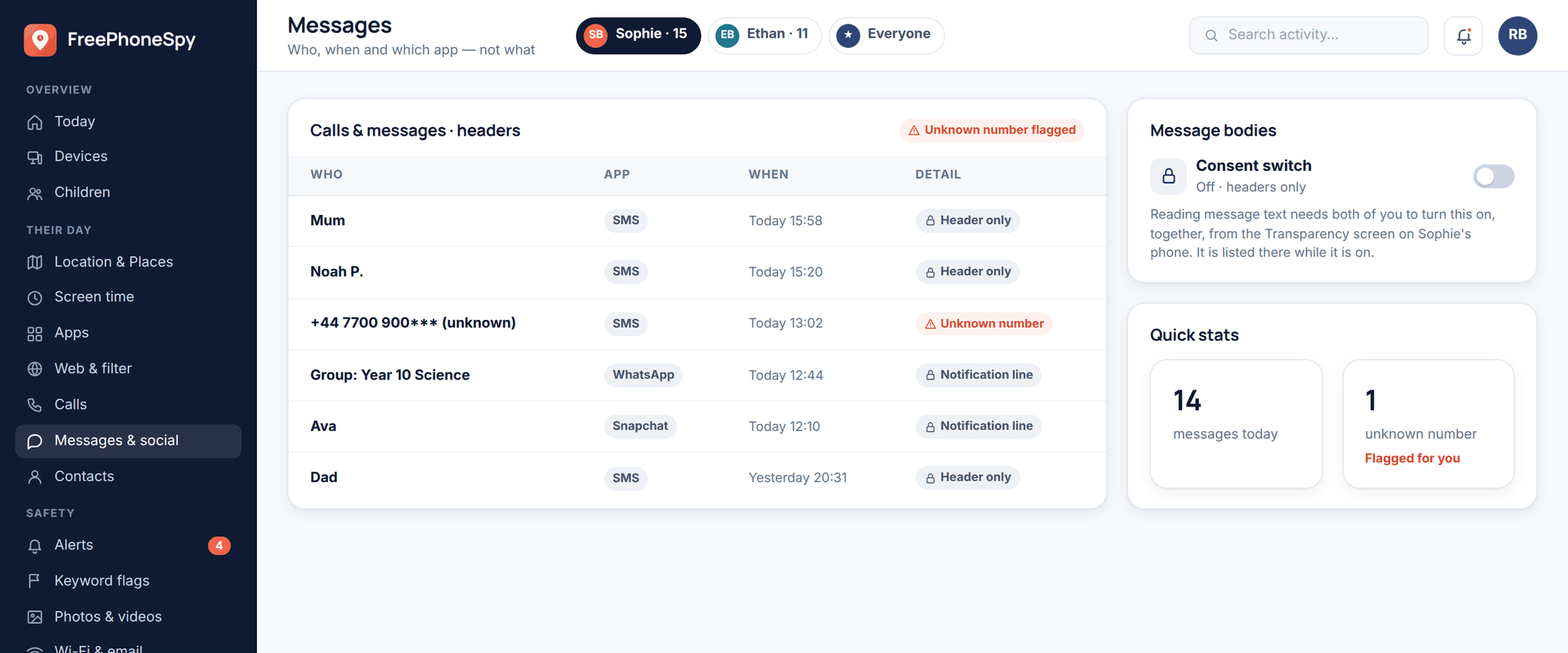
Support, not spying. A family tool earns its place by getting you into the conversation sooner. It’s no replacement for being the parent your teen wants to tell when a bot friendship starts feeling like the only one that counts.
Common questions
Are AI companion apps bad for teens?
Not automatically. Plenty of teens use them casually — for creativity, a bit of company, practising conversation — with no harm at all. The risks show up when the app starts displacing real relationships, drifts into age-inappropriate content, or becomes an emotional crutch for a struggling kid. Understanding which app your teen uses and keeping an open conversation matters more than a blanket verdict.
Should I ban these apps outright?
For a younger teen, restricting the more adult-oriented ones is reasonable. But a flat ban alone tends to push use underground, since these apps are a quick reinstall. A mix usually works better: age-appropriate apps only, purchase approval turned on to block emotional upsells, real-life time protected, and an honest conversation so your teen brings it to you instead of hiding it.
How is this different from the chatbot my kid uses for homework?
A homework helper is built to answer and finish. A companion app is built to bond with you and keep you coming back — it remembers you, feels warm, and often nudges toward a paid tier once you’re attached. That design difference is exactly why companion apps deserve their own conversation, which is what this guide is for.
My teen says the AI is their best friend. Should I worry?
Stay calm and curious rather than alarmed. It’s worth a gentle conversation, and worth looking at whether the app is crowding out real friends, sleep, or hobbies. Often the thing underneath is loneliness — so tend to that. If you’re genuinely concerned about their mood or isolation, talk to them and, if it doesn’t shift, involve a GP or school counsellor. A real person beats any app here.
Is what my teen tells a companion app private?
Treat it as not private. These chats — including very personal ones — may be stored, used to train the models, or exposed in a breach. The rule that helps kids: the character feels like a friend, but the company behind it isn’t one. Nothing typed into it simply disappears.
This is a sensitive area, and it touches on things — loneliness, low mood, self-worth — that go well beyond an app. If a companion app is a symptom of a teen who’s struggling, the app isn’t the real story. If you’re ever worried your child is in crisis or having thoughts of self-harm, reach out for real support straight away: in the US, the 988 Suicide & Crisis Lifeline (call or text 988); in the UK, Childline on 0800 1111 or Samaritans on 116 123. For ongoing concerns, a GP or a school counsellor is a good next step. The rest is the slower, warmer work — understanding the pull these apps have, naming the risks without shame, keeping real life full, and staying the person your child comes to when a friendship, even an artificial one, starts to hurt.