Talking To Kids About Monitoring
The conversation is the hard part, not the software. Any app can track a phone. What decides whether monitoring helps your family or damages it is whether your child hears about it from you first, in words that sound like care rather than suspicion. This guide is about that conversation: what to say at different ages, how to agree the rules instead of announcing them, which promises to make about what you will not look at, and how to have the talk when trust is already frayed.
Why the conversation comes first
It is tempting to install something and say nothing. No awkward talk, no pushback. The trouble is that a child who finds out later does not take away “my parent cares.” They take away “my parent lied to me,” and that lasts longer than whatever you were monitoring for. The full argument for why open monitoring is also the more effective kind, and where the legal line sits, is in monitoring vs spying. This guide takes that as settled and deals with the practical question: how do you tell them?
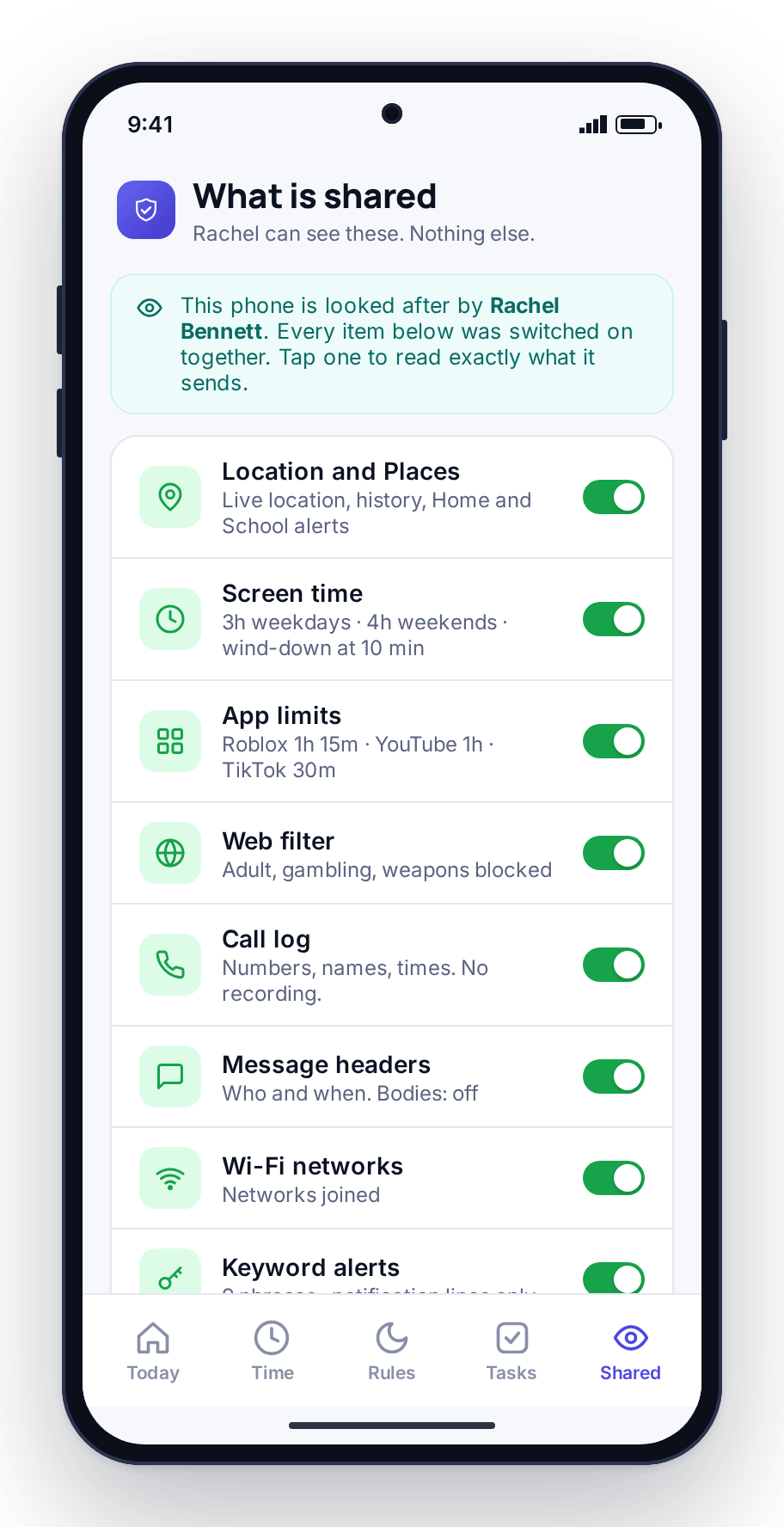
The good news is that the conversation does real work beyond disclosure. A child who knows you will see a late-night message thinks twice before sending it, which is worth more than reading it the next morning. And a child who was told, and who had a say, treats the setup as a family arrangement rather than something done to them. The app can support that: FreePhoneSpy puts a Transparency screen on the child’s phone that lists what is shared, so “you can check for yourself” is something you can say and mean.
How to raise it, by age
There is no single script, because a nine-year-old and a sixteen-year-old are having different conversations. Match it to where they are.
Younger children (roughly 8–11). Keep it short and matter-of-fact. At this age monitoring is part of how the phone works, like a bike helmet. “This phone has some parent settings on it, same as your tablet. I can see roughly where you are so I know you got to school, and there’s a limit so it goes off at bedtime.” Show them the settings on their own screen so they can point to them. They usually accept it easily, because it fits how they already understand your role. What to avoid: apologizing for it, or making it sound like a big deal. It is not one at this age.
Pre-teens and early teens (roughly 12–14). Now it needs a reason, and they need a voice. Explain the specific worry rather than a general one: “I want to know you got home, and I want the phone off at night so you sleep,” not “the internet is dangerous.” Then hand over some control. Let them push back on the parts that feel excessive, and be prepared to drop one. A twelve-year-old who negotiated their own bedtime is far more likely to keep it than one who was handed it.
Older teens (roughly 15+). Lead with independence. Frame it as the thing that lets you give them more rope, not less: “I’d rather know you got home safe than call you every time you’re late. This means I can leave you alone more, not watch you more.” Then make that true. At this age the setup should be visibly shrinking, with less looked at each year, or they will rightly feel it is holding back their growing up. Tell them what came off since last year and what will come off next.
Agreeing the rules together
The single biggest predictor of whether this goes well is whether the rules are agreed or announced. A rule your child helped write is one they will defend to their friends. A rule you handed down is one they will test.
So make it a conversation with two voices. Say what you need, ask what they think is fair, and be willing to move. Maybe you wanted the phone off at nine and you settle on nine-thirty on weekends. That compromise is them buying in, not you losing. Some things to put on the table: the bedtime, the daily budget, which apps get a limit, whether location stays on at weekends, and how they can earn more time.
Write the deal down somewhere you both can see it, even as a note on the fridge. Put your side in it too: what you will do, what you will not look at, when you will review it, and how the rules loosen as they get older. A monitoring arrangement that only lists the child’s obligations reads as a leash. One that lists yours too reads as a deal between people who trust each other. Then set it up in the app together, so they watch each rule go on and can see the same rules on their own phone afterward.
What you will and won’t look at
This is the part parents skip and should not. Telling your child what you will not look at does more for trust than almost anything else, because it shows this is about safety rather than control.
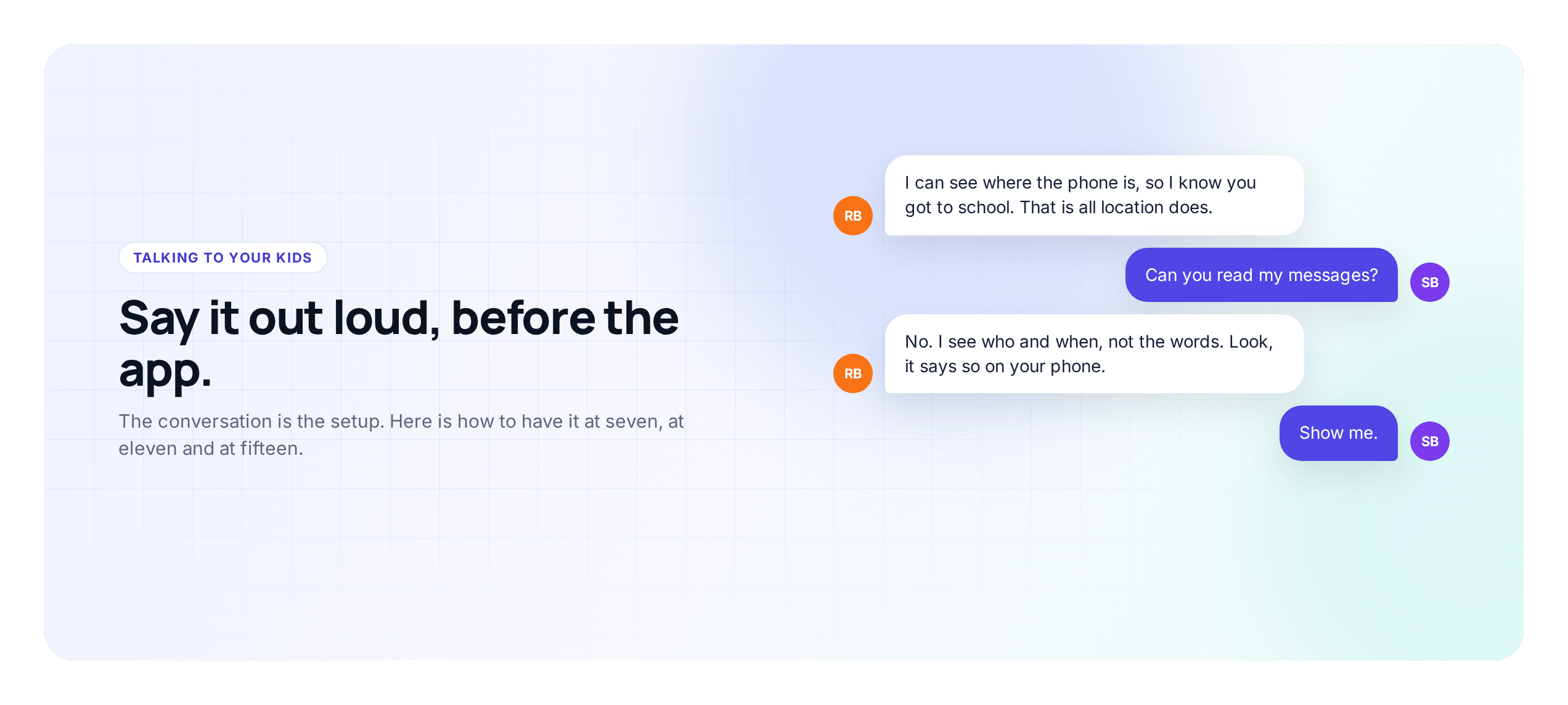
Be specific. You might say you will check location and screen time, you will get an alert if a real safety keyword comes up, and you will not be reading their group chats or scrolling their message history. Make sure the app matches the promise. Message bodies stay off in FreePhoneSpy unless a consent switch is turned on, and that switch is designed to be turned on by parent and child together, so “I’m not reading your messages” is the default the app ships with rather than a promise you have to keep by willpower.
The principle is minimum necessary. Look at the least that addresses your worry, and tell your child that is the deal. A parent who reads everything “just in case” teaches their child that privacy is something you lose by being young. A parent who looks only at what safety requires teaches that privacy is real and worth respecting, which is what you want them carrying into adulthood.
Rebuilding trust when it’s frayed
Sometimes you are not starting fresh. Maybe something already happened, or maybe you set something up without telling them and it came out. That is a harder conversation, but not a lost one.
Start by owning your part. If you watched in secret, say so and say it was the wrong way to do it. That admission costs you nothing you have not already lost, and it models the openness you are asking of them. Do not pair the apology with a justification (“but I was worried”); let it stand on its own, and give the reason separately if they ask.
Then reframe forward: this is the new way, in the open. Make the monitoring visibly conditional and shrinking. Agree what your child can do to earn a control coming off, put a date on the first review, and then take the control off when they have done their part. Trust is rebuilt by prediction: you say what you will do, then you do it, over and over, until they believe you again. A setup that never loosens tells a child there is no path back, and then they stop trying.
A sample conversation
Here is roughly how it might go with a thirteen-year-old. Not a script to read out, just a shape.
You: “I want to talk about your phone, and I want you to know up front I’m not in trouble mode. There’s an app I’d like to set up on it, and I’m telling you exactly what it does before I do anything.”
Them: “So you’re spying on me.”
You: “Fair question. No. Here’s the full version. I can see roughly where you are, so I’m not texting ‘where are you’ every hour. There’s a screen-time limit so the phone’s not keeping you up. And I get an alert only if something worrying comes up, like a stranger. What I’m not doing is reading your chats with your friends. That stays off, and you can check on your phone that it’s off.”
Them: “What if I don’t want it?”
You: “Then we talk about it. Tell me which bit bothers you and let’s see. Some of this I need. Some of it I’ll drop if you’d rather. And all of it loosens as you get older, that’s the deal. I’d rather you trust me enough to tell me things than have me find them on a screen.”
Them: “Can I turn the location off when I’m at Maya’s?”
You: “Not turn it off, but let’s talk about what it’s for. If you text me when you get there and when you leave, I’ve got no reason to look at the map. Give it a month like that and we’ll see if I need it on at weekends at all.”
Notice what is doing the work there: naming what you will not look at, offering a real negotiation, answering the specific objection with a specific deal, and putting an expiry on the whole thing. That is the conversation, whatever the exact words. If they go silent instead of arguing, leave the app for now and come back in a day or two; a conversation that ends in silence is not one that ended in agreement.
FAQ
Isn’t it more effective to monitor secretly?
No, and it usually backfires. Secret monitoring nearly always comes out, and the discovery costs more trust than it bought in safety. Open monitoring also changes behavior in the moment, since a child who knows you might see a message thinks twice before sending it. The fuller argument is in our monitoring vs spying piece.
What if my child flatly refuses?
Treat the refusal as the start of a negotiation, not the end of one. Ask which specific part bothers them and be willing to drop the parts you do not strictly need. Lead with what you will not look at, offer a review date, and put a visible expiry on the controls. Most resistance is to feeling controlled rather than to the app itself.
How much should I look at?
The minimum that addresses your real worry, and tell your child exactly what you will not check. For most families that means location, screen time and safety alerts, with message bodies left off. If you ever need more because of a specific concern, say so and turn it on together rather than in secret.
We had a trust problem already. Can this help?
It can, if it is open and visibly shrinking. Own your part without attaching a justification, set it up in plain sight, and agree what your child can do to earn a control coming off, then take it off when they do. Trust rebuilds through kept promises, so the setup needs a real path back rather than a permanent leash.
What if my child is too young for a conversation like this?
Then keep it to one or two sentences and show rather than explain. “The phone goes to sleep at eight, and I can see where it is” is enough for an eight-year-old, especially if they can see the bedtime and the location setting on their own screen. Save the negotiation for when they are old enough to want one, usually around twelve.